
Swiss-Type vs. Gang Tool Lathe: The Decision Beyond Just Part Diameter in CNC Machine and Programming
Preamble
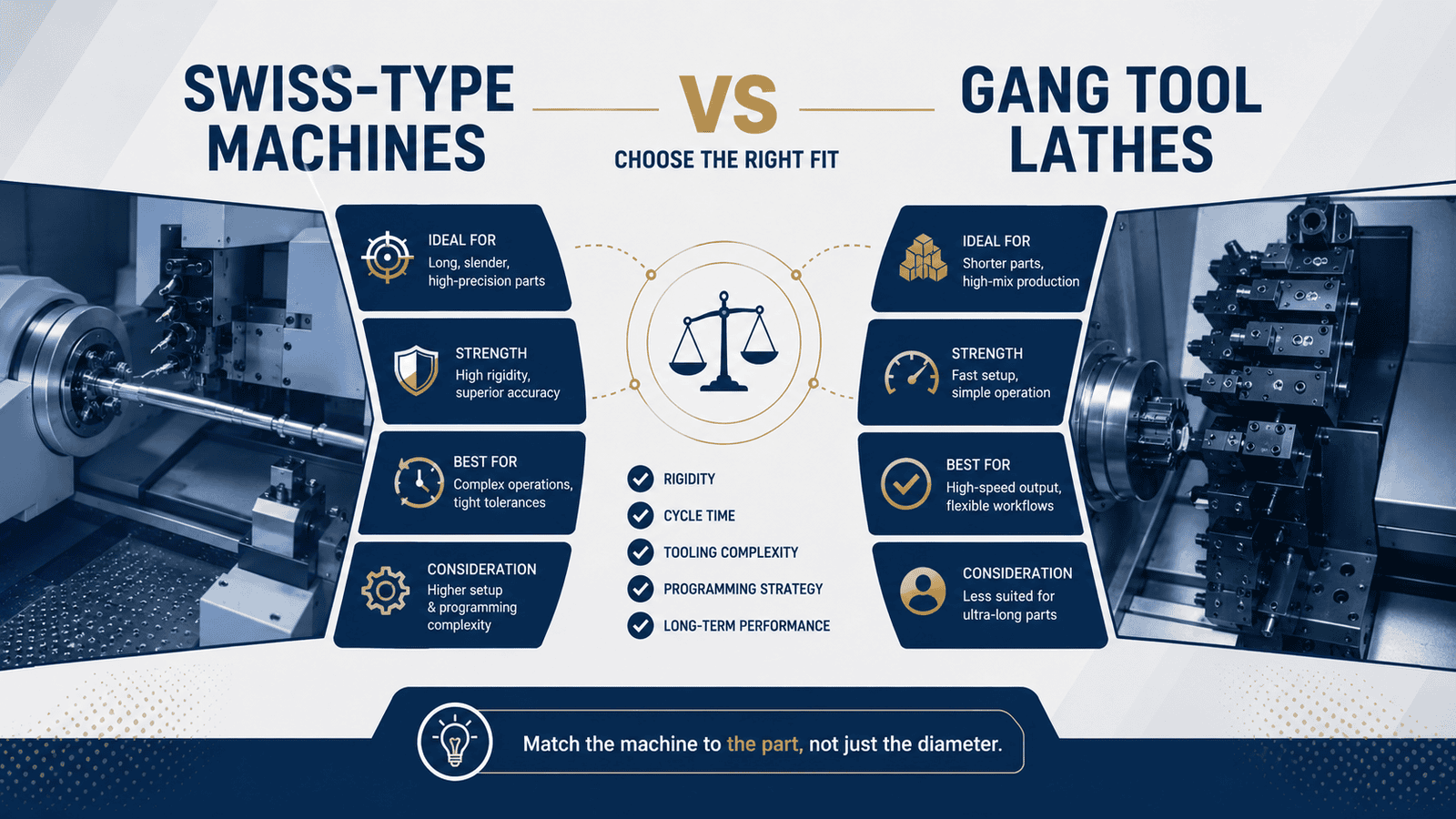
Choosing between Swiss-type machines and gang tool lathes involves more than simply comparing part diameter capacity. Rigidity, cycle time efficiency, tooling complexity, and programming strategy all influence long-term production performance. In modern cnc machine and programming environments, the wrong machine choice can increase setup time, reduce flexibility, and limit machining efficiency.
While Swiss machines are often associated with ultra-precise small-diameter components, gang tool lathes continue to dominate many high-mix production environments due to their simplicity and speed. Understanding how Swiss and gang tool platforms behave under real production conditions helps suppliers improve throughput, reduce operational complexity, and select the right machine architecture for specific manufacturing goals.
Introduction
Swiss-type machines and gang tool lathes are both widely used in precision turning environments, particularly for small and complex components. While many purchasing decisions focus primarily on part diameter capability, real production performance depends on much more than size alone.
Rigidity, tooling access, synchronization complexity, and programming requirements all affect machining efficiency significantly.
Swiss machines excel in certain high-precision and long-slender-part applications, while gang tool lathes often provide simpler programming and faster setup flexibility for shorter parts.
For every advanced machining supplier, understanding the operational trade-offs between these platforms is essential for improving production efficiency and long-term scalability.
Machine selection also influences labor requirements, training investment, maintenance complexity, and future production capacity. A machine that performs exceptionally well for one product family may become a bottleneck when production requirements change. Looking beyond spindle specifications and marketing claims allows suppliers to make equipment decisions based on actual manufacturing realities.
Choosing between Swiss-type machines and gang tool lathes involves more than simply comparing part diameter capacity. Rigidity, cycle time efficiency, tooling complexity, and programming strategy all influence long-term production performance. In modern cnc machine and programming environments, the wrong machine choice can increase setup time, reduce flexibility, and limit machining efficiency.
While Swiss machines are often associated with ultra-precise small-diameter components, gang tool lathes continue to dominate many high-mix production environments due to their simplicity and speed. Understanding how Swiss and gang tool platforms behave under real production conditions helps suppliers improve throughput, reduce operational complexity, and select the right machine architecture for specific manufacturing goals.
Understanding Swiss-Type Machine Architecture
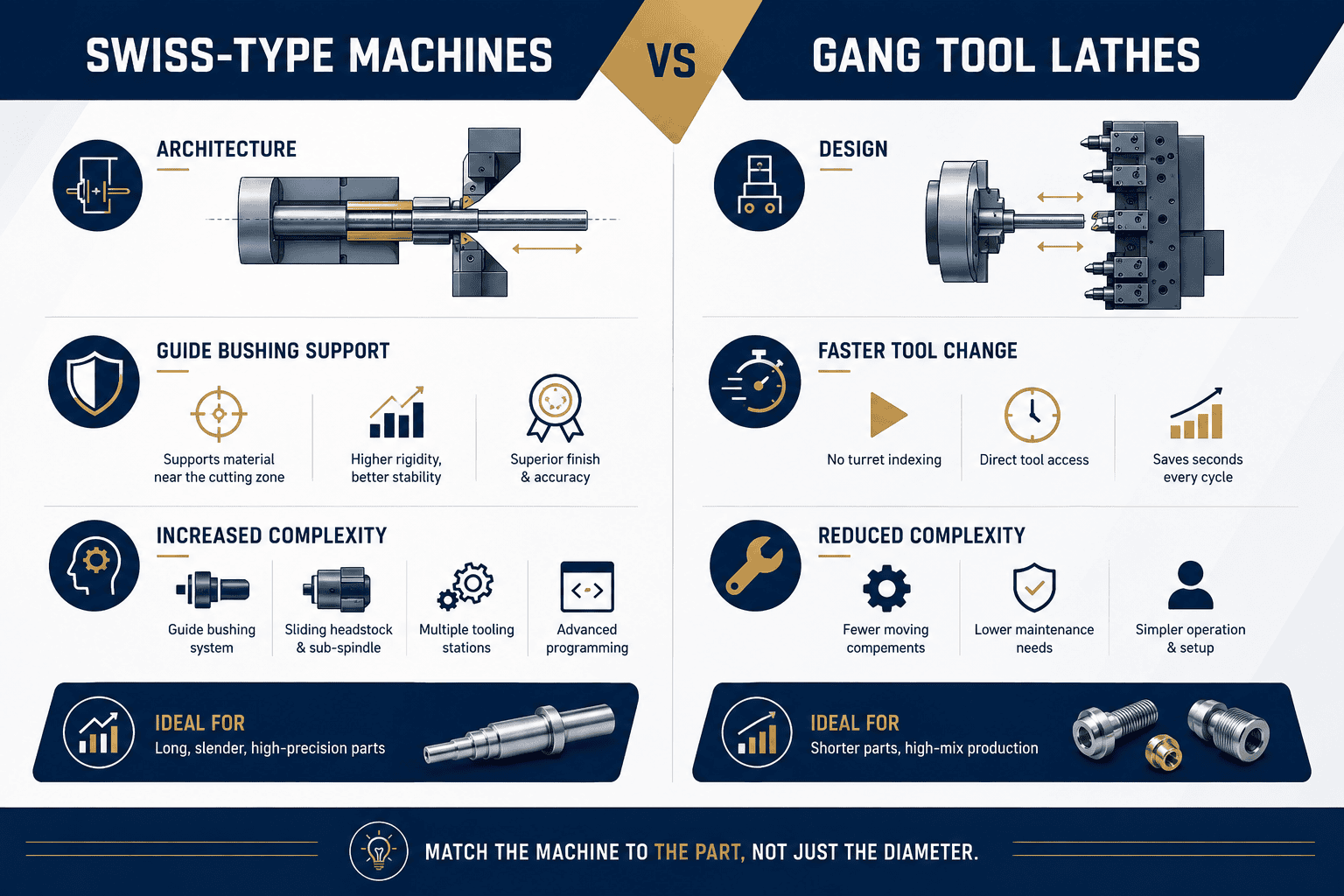
Swiss machines support material close to the cutting zone using a guide bushing system.
This dramatically improves rigidity during slender-part machining.
Unlike conventional lathes where the workpiece extends away from the chuck during machining, Swiss machines continuously support the material near the cutting location. This design fundamentally changes how cutting forces act on the workpiece and is one of the primary reasons Swiss machines dominate industries such as medical, aerospace, electronics, and precision instrumentation.
- Advantages of Guide Bushing Support
Supporting material near the cutting area minimizes deflection during machining.
The guide bushing acts as a support point located only millimeters away from the cutting tool. In a conventional lathe, cutting forces are transmitted through a longer unsupported section of material, allowing the part to bend or vibrate under load.
By reducing this unsupported length, Swiss machines dramatically increase effective rigidity. This allows aggressive cutting conditions on long, thin components that would otherwise suffer from chatter, taper, poor surface finish, or dimensional variation.
For example, machining a long medical pin or aerospace shaft with a high length-to-diameter ratio becomes significantly more stable because the material remains supported throughout the operation.
- Increased Machine Complexity
Swiss machines introduce additional synchronization and programming requirements compared to conventional turning platforms.
The sliding headstock, guide bushing system, sub-spindle coordination, and multiple simultaneous tooling stations create significantly more variables than a standard turning center.
As a result, setup personnel, programmers, and operators typically require more specialized training. Shops transitioning into Swiss machining often face a learning curve before realizing the machine's full productivity potential.
Understanding Gang Tool Lathe Design
Gang tool lathes use a simpler tooling arrangement designed for fast operation and reduced mechanical complexity.
These systems prioritize speed and flexibility.
Rather than relying on rotating turrets or guide bushings, gang tool machines position multiple tools on a fixed tool plate. The machine moves directly between tools, reducing unnecessary motion and simplifying operation.
For many production environments, this simplicity creates significant advantages in setup efficiency and machine utilization.
- Faster Tool Change Simplicity
Gang tooling eliminates turret indexing delays during machining.
Because all tools remain fixed on the gang plate, the machine simply moves to the required tool position without waiting for turret rotation.
Although each individual movement may save only seconds, these savings accumulate significantly across thousands of production cycles, particularly in shorter-part applications with frequent tool changes.
- Reduced Mechanical Complexity
Fewer moving systems reduce maintenance requirements and simplify machine operation.
Without complex guide bushing assemblies, synchronized headstock movement, or advanced spindle coordination systems, gang tool lathes typically require less maintenance and fewer specialized adjustments.
This benefits rapid machining suppliers seeking predictable uptime and operational simplicity.
CNC Machine and Programming Trade-Offs
Programming complexity differs substantially between Swiss and gang tool platforms.
Machine architecture directly affects workflow structure.
Many equipment decisions focus heavily on hardware specifications while underestimating programming and process development requirements. However, programming complexity directly affects setup time, troubleshooting efficiency, and production scalability.
- Swiss Programming Complexity
Programming of cnc machines on Swiss platforms requires synchronization between guide bushing movement, spindle control, and tooling position.
Programmers must carefully coordinate sliding headstock motion, main spindle operations, sub-spindle transfers, cutoff sequences, and multiple simultaneous tooling stations.
This increases programming difficulty and often extends process development time for complex components.
- Simpler Gang Tool Workflows
Gang tool lathes often use more straightforward programming structures with reduced synchronization overhead.
Because the machine architecture is simpler, setup verification and troubleshooting are generally faster.
This improves setup speed for many jobs and reduces the learning curve for programming teams.
Rigidity and Machining Stability Differences
Rigidity directly affects achievable tolerances, surface finish, and machining aggressiveness.
Different machine architectures behave differently under cutting load.
Understanding how machine rigidity influences machining outcomes is critical when evaluating long-term production capability rather than simply machine specifications.
- Long Slender Part Performance
Swiss machines maintain better support during machining of long, thin geometries.
Because the workpiece remains supported close to the cutting zone, vibration and bending are minimized even as the part length increases.
This improves dimensional consistency significantly and allows tighter tolerances across challenging geometries.
- Short Part Efficiency
Gang tool lathes often outperform Swiss machines on shorter components that do not require guide bushing support.
When rigidity advantages become less important, the simplicity of gang tooling can provide faster cycle times and reduced setup requirements.
This improves efficiency for many production environments manufacturing compact precision components.
High-Mix Low-Volume Production Considerations
Machine flexibility becomes critical in high-mix production environments.
Setup efficiency affects profitability directly.
Many suppliers operate in environments where product changes occur daily or even multiple times per shift. In these situations, machine adaptability often becomes more valuable than maximum machining capability.
- Setup Complexity and Changeover Time
Swiss machines frequently require more complex setup procedures and guide bushing adjustment.
This increases changeover duration.
Examples of these setup activities include:
- Guide bushing sizing and alignment for each material diameter
- Sliding headstock synchronization verification
- Sub-spindle transfer setup and validation
- Material feed length adjustments
- Guide bushing lubrication checks
- Tool station synchronization verification
- Bar feeder integration and alignment
While these adjustments improve machining capability, they also require additional setup expertise and machine downtime during product transitions.
- Flexibility for Rapid Job Changes
Gang tool systems often adapt faster to varied production requirements.
Tooling changes are typically simpler, setup procedures are shorter, and fewer machine subsystems require adjustment.
This benefits high-mix low-volume suppliers managing diverse part families with frequent changeovers.
Production Scalability and Throughput
Machine selection should align with long-term production goals rather than immediate capability alone.
Operational scalability matters significantly.
A machine that performs well today may not support future growth if product complexity, volume requirements, or labor availability change.
- Balancing Cycle Time and Operational Simplicity
Faster cutting performance does not always create higher overall throughput if setup complexity increases excessively.
A machine producing parts slightly faster may still generate lower total output if changeovers, troubleshooting, or programming requirements consume excessive time.
Operational efficiency depends on the entire workflow rather than cutting speed alone.
- Matching Machine Capability to Product Mix
Different industries and part geometries benefit from different machine architectures.
Medical devices, electronic connectors, and long precision shafts often favor Swiss platforms, while shorter precision components and high-mix production environments frequently benefit from gang tool systems.
Selecting the right platform improves long-term manufacturing stability and production efficiency.
Conclusion
Choosing between Swiss-type machines and gang tool lathes involves balancing rigidity, programming complexity, setup efficiency, and production flexibility carefully.
Swiss machines provide exceptional support and stability for long, slender, high-precision components, making them ideal for industries where dimensional accuracy and part geometry create significant machining challenges. Gang tool lathes, meanwhile, offer simplicity, faster changeovers, and lower operational complexity, making them highly effective for shorter-part production and high-mix environments.
By understanding how machine architecture affects cnc machine and programming workflows, suppliers can improve machining efficiency, reduce operational complexity, and make more informed equipment decisions.
For every advanced machining supplier, rapid machining supplier, and high-mix low-volume supplier, selecting the right turning platform is essential for maintaining scalable and profitable production performance.
If your shop is evaluating turning platforms for precision production, focusing only on part diameter may overlook critical operational trade-offs affecting long-term efficiency.
Reviewing machine rigidity, setup requirements, programming complexity, production flexibility, and workforce capabilities together can help identify the best-fit machining platform for your workflow.
Companies like Vulcury support suppliers with production-focused machining insights, helping teams improve cnc machine and programming workflows, optimize machine utilization, and strengthen long-term manufacturing scalability.
By aligning machine selection with real production demands, suppliers can improve throughput, reduce complexity, and achieve more predictable machining performance.
Frequently Asked Questions
1. What is the main difference between a Swiss-type machine and a gang tool lathe?
The primary difference lies in how the workpiece is supported and machined. Swiss-type machines use a guide bushing to support material close to the cutting zone, making them ideal for long, slender, high-precision parts. Gang tool lathes use a fixed tool plate design that prioritizes simplicity, faster changeovers, and efficient production of shorter components.
2. When should a supplier choose a Swiss-type machine over a gang tool lathe?
Swiss machines are typically the better choice for small-diameter parts with high length-to-diameter ratios, tight tolerances, and complex geometries. The guide bushing system minimizes deflection and vibration, allowing greater machining stability when producing medical components, aerospace shafts, electronic connectors, and other precision parts.
3. How does CNC machine and programming complexity differ between Swiss and gang tool platforms?
Programming of cnc machines on Swiss platforms is generally more complex because programmers must coordinate sliding headstock movement, guide bushing support, sub-spindle transfers, and multiple tooling stations simultaneously. Gang tool lathes typically use simpler programming structures, making setup verification, troubleshooting, and process development faster and easier.
4. Which machine is better for high-mix, low-volume manufacturing environments?
Gang tool lathes are often preferred for high-mix, low-volume production because they offer faster changeovers, simpler setups, and lower operational complexity. While Swiss machines provide superior rigidity for specific applications, gang tool systems typically deliver greater flexibility when suppliers frequently switch between different part families and production runs.