
The Job Was Good. It Just Belonged in Someone Else’s Shop.
The Biggest Request of the Year
When the drawing package landed, Dan's first reaction was a low whistle.
His shop is built around complexity. Four 5-axis machining centers, a CMM, and a team that loves the parts other shops send back: titanium brackets with compound angles, prototype manifolds, aerospace fixtures in quantities of five or fifty. Most of his customers are engineers who need something hard made right, quickly.
This request was different. A medical device company needed a small stainless steel pin, 6 mm in diameter and 22 mm long, with a cross-drilled hole and a fine thread on one end. They wanted 40,000 a year, with a long-term agreement attached.
The part was simple. The customer was established and paid well. The volume was more than his shop's next three largest jobs combined.
It was, by every measure on the spreadsheet, a good job.
The Math Said Yes
Dan and his programmer spent an afternoon figuring out how they could make it work.
They could dedicate one machining center to the job. They could build a multi-part fixture that held sixteen blanks at a time, cut from bar on the saw. They could run it lights-out overnight. On paper, the cycle times penciled out to something close to competitive, and the margin looked healthy enough to justify the fixture.
A steady 40,000-piece job would smooth out the shop's lumpy schedule. It would cover a good share of overhead every month. It would make the bank happy.
Dan drafted the quote that evening. Then he did what he always does with a big number: he left it on his desk overnight.
The Second Look
In the morning, the job looked different.
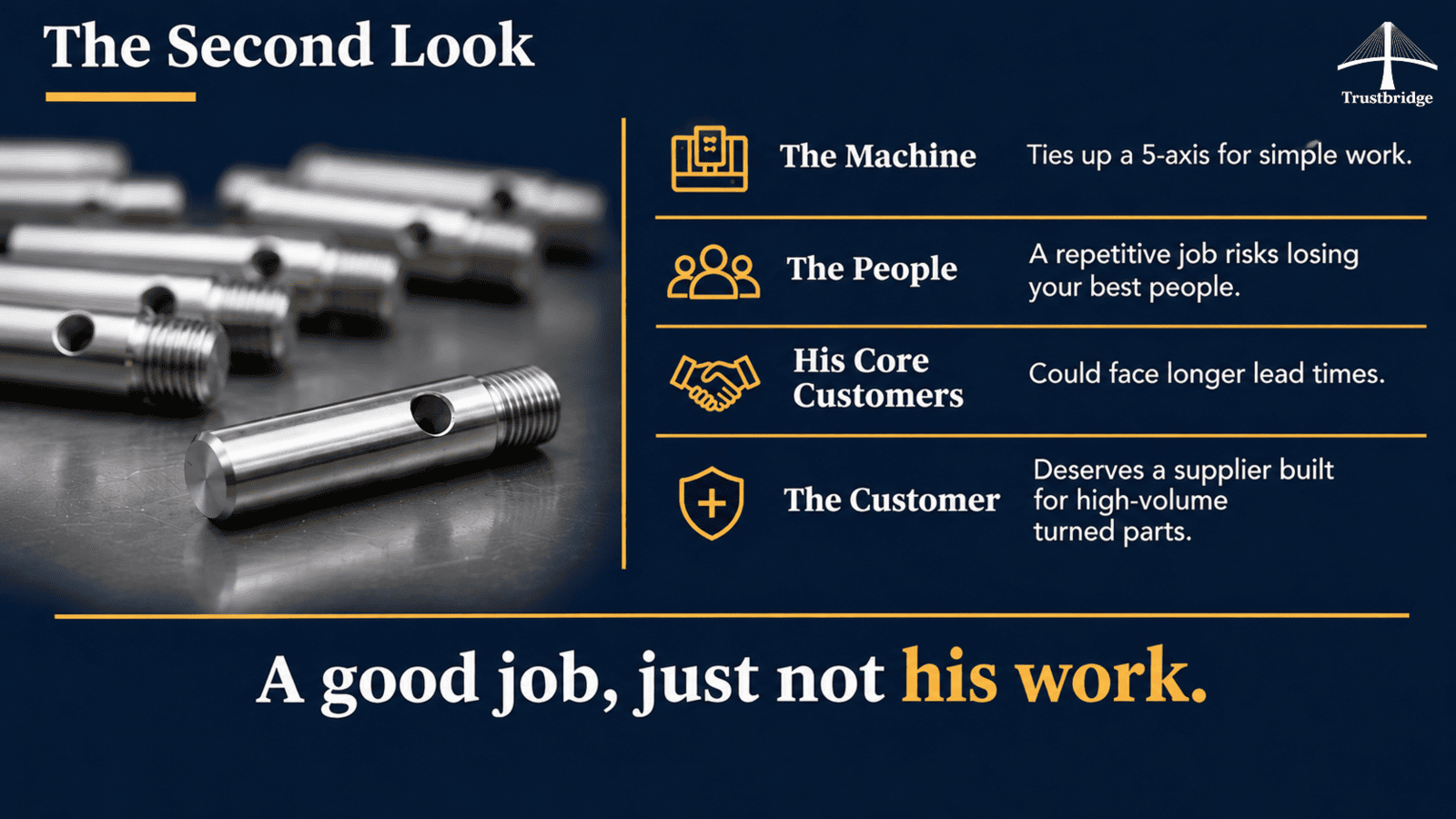
The pin was a turned part, the kind a Swiss-type lathe makes from bar stock in about forty seconds, complete, with no secondary operation. His machining center would take nearly three times that, with extra handling for every blank. The competitive price only worked if nothing went wrong, and on a 40,000-piece job something always goes wrong.
Then there was everything the spreadsheet didn't show:
The machine. One of his four 5-axis centers would be locked up making pins, the simplest work in the building, on the machine most suited to his hardest work.
The people. His machinists were problem-solvers. Babysitting a repetitive job for a year was a fast way to bore his best people into looking elsewhere.
His core customers. The engineers who relied on him for quick-turn complex parts would wait longer every time the pin job ran behind.
The customer. A medical device company deserved a supplier whose whole process was built around high-volume turned parts, with the inspection and lot control to match. Dan could do it. He couldn't do it as well as a shop that did nothing else.
The job wasn't bad. It was good work. It just wasn't hiswork.
The Call
Dan threw out the quote and picked up the phone instead.
He told the customer's engineer the truth. His shop could make the pin, but it wasn't the right shop to make 40,000 of them. A Swiss turning shop would make them faster, more consistently and probably cheaper. He gave her the name of one he trusted, an hour away, run by someone he had known for fifteen years.
The engineer was quiet for a moment. "I've never had a supplier talk me out of an order before," she said.
Then he called his friend at the Swiss shop and gave him a heads-up. The friend was surprised, and grateful. He mentioned that he turned away complex milled parts every month, because his shop wasn't set up for them, and he never knew who to send them to.
Dan said he had an idea.
Bad Work and Bad-Fit Work
Six weeks later, the medical device engineer called Dan back. Her team was developing a new instrument, and they needed a complex titanium housing machined from solid, in quantities of twenty. She wanted the shop that had been honest with her.
That same quarter, three milled-part jobs arrived from the Swiss shop down the road. None of them were huge. All of them were exactly the kind of work Dan's shop does best.
Turning down the pin job cost Dan nothing he needed. It earned him two things he couldn't have bought: a customer's trust, and a peer who now sends him work.
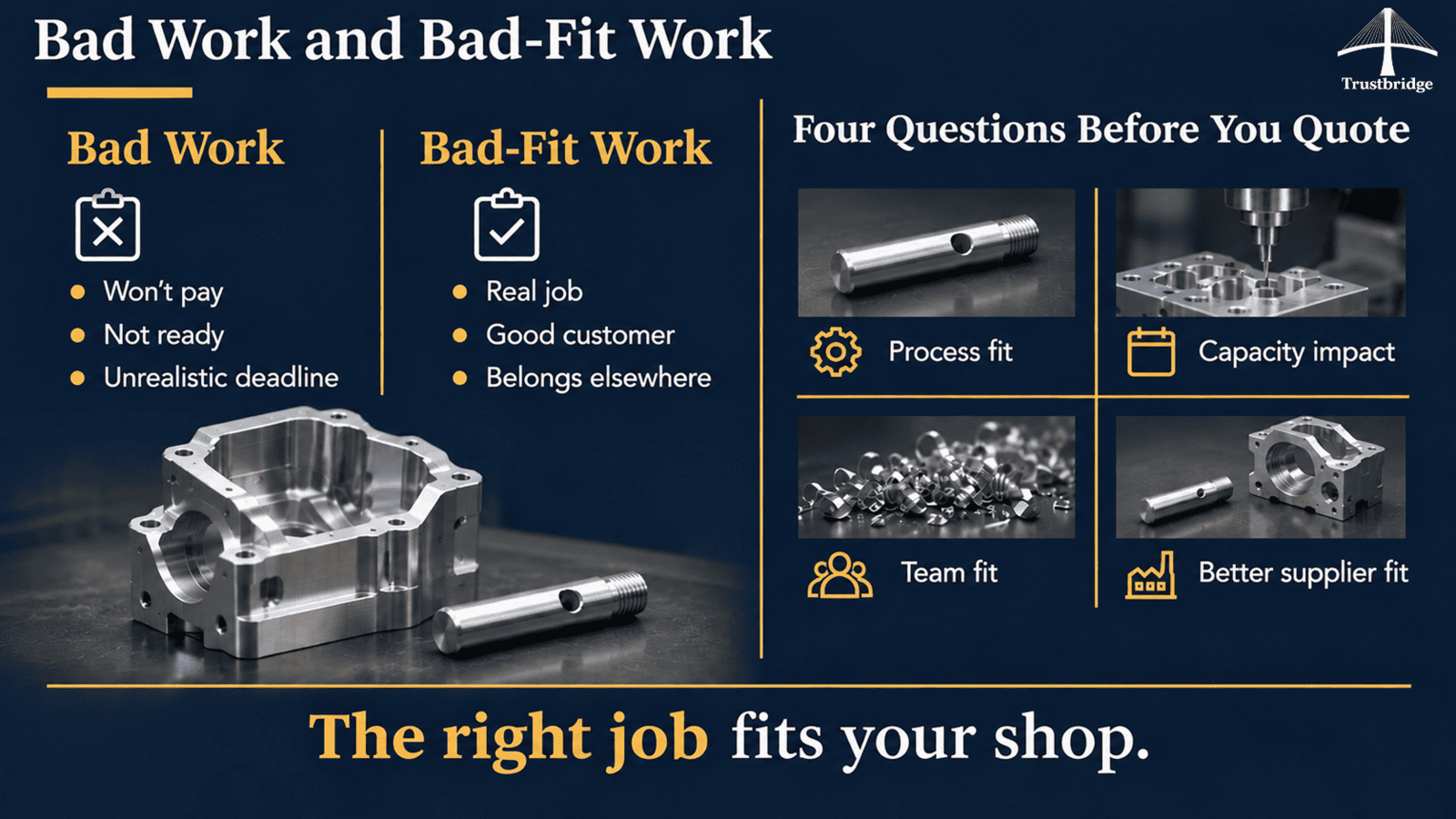
It also sharpened how he thinks about what comes through the door. Bad work is work you shouldn't take from anyone: a customer who won't pay, a design that isn't ready, a deadline built on fantasy. Bad-fit work is something else. The job is real, the customer is good, and the part is fine. It simply belongs on someone else's machines. Today, Dan asks a few questions before he quotes anything new:
Is this the process the part wants? Ask what process would make it best, rather than whether your machines can make it at all.
What does this job push out? Every hour on the wrong job is an hour your best customers don't get.
Would my best people want to run it? If the answer is no, the job carries a cost the quote doesn't show.
Is there a shop that would do this better? If so, telling the customer builds more than the order would have.
Forcing a bad-fit job usually doesn't fail on the first order. It fails slowly, through thin margins, frustrated people and customers who start to wonder why their work is late.
Why We Tell This Story
Dan is a composite, but his instinct is one we've come to value deeply.
Trustbridge is a product design studio, and design for manufacturability shapes everything we do. Part of designing for manufacturing is knowing that no single shop is right for every part. A housing that belongs on a 5-axis machine and a pin that belongs on a Swiss lathe need different conversations, with different people.
When our clients' designs are far enough along to benefit from real manufacturing feedback, we bring in partner shops whose process actually fits the part. Feedback is most useful when it comes from the people best suited to make it, and fit is how a good first conversation becomes a lasting relationship.
We work with a group of manufacturers who think the way Dan does: proud of what they do well, and honest about what they don't. We're also building practical tools for the shops we work with, aimed at the everyday decisions that never make it onto a drawing.
If you run a shop and you know exactly what kind of work you're built for, tell us about your shop.
And if you're designing a product headed for production, talk to us. The right part in the right shop is where good manufacturing starts.