
Why the "Perfect Spec" Is a Myth and What to Optimize for Instead
A perfect manufacturing spec is not the goal; manufacturable intent is. A strong drawing defines the tolerances, materials, finishes, and requirements needed for a part to perform correctly while leaving non-critical decisions open to supplier expertise. This approach helps avoid both over-specification, which adds unnecessary cost, and under-specification, which creates ambiguity, rework, and quality problems later.
Introduction
There's no such thing as a perfect spec. Every drawing either asks for more precision than the part functionally needs, or it leaves out something the part genuinely requires to work and both mistakes are expensive, just in different currencies. Over-specification shows up early, as inflated quotes, longer lead times, and a shrinking list of shops willing to bid competitively. Under-specification shows up later, as rework, disputes, and parts that technically meet the print but still don't do their job on the bench. Neither one is really a sign of bad engineering. Both are usually a sign that "precision" got treated as a stand-in for "quality," when the two aren't the same thing at all a part can be extremely precise and still wrong for its job, and a part can be built to a fairly loose spec and be exactly right for it. The goal worth optimizing for instead of a mythical perfect spec is what's often called manufacturable intent: a drawing precise enough to guarantee the part works, and no more precise than that.
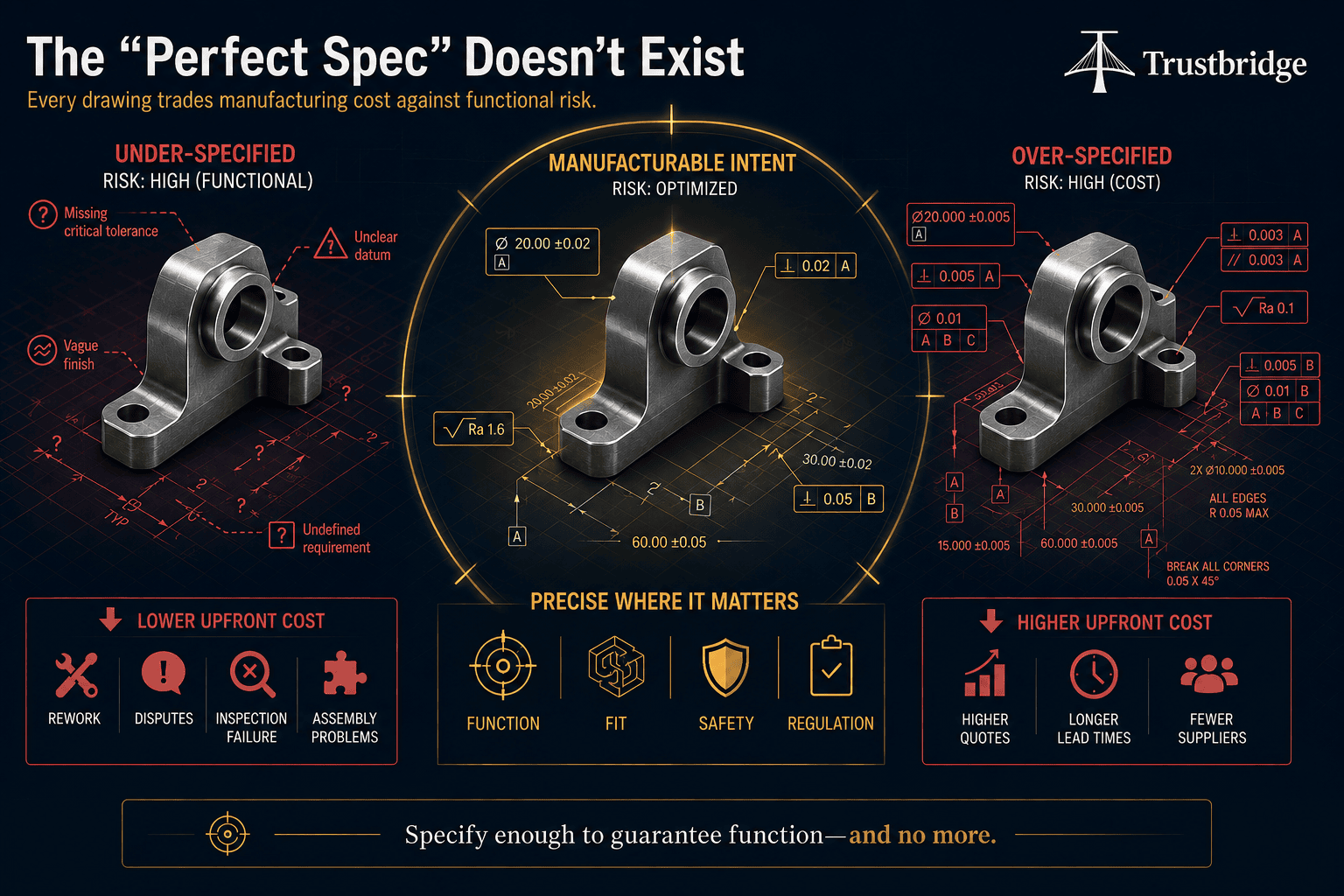
Over-specification costs as much as under-specification, just differently
Over-specification is the easier of the two to spot once you're looking for it. One of the more sobering findings on where manufacturing cost actually comes from is that roughly 70% of a product's total cost gets locked in during specification and design, long before a single part is cut because tolerance, material, finish, process, and geometry are almost entirely decided on paper. Over-engineering, in this context, isn't about building something too well; it's specifically about specifying more precision, more features, or tighter control than a part's actual function requires. A tolerance tightened "to be safe," a custom geometry chosen where standard stock would perform identically, a surface finish specified to aesthetic preference rather than functional need each of these choices feels reasonable in isolation, and each one adds cost without adding a single unit of real performance. One widely cited illustration puts a number on it: a single tolerance tightened past what a design genuinely needs can add 40 minutes of setup time to a job, and stacked across a handful of similar decisions on one part, that kind of over-specification can double the total cost of a machined component without making it perform any better.
Under-specification is less visible but no less expensive, because its cost shows up downstream instead of on the quote. A requirement that's ambiguous, incomplete, or unverifiable doesn't fail at the moment it's written it fails later, when a supplier interprets it one way, a buyer meant something else, and the disagreement only surfaces during inspection or assembly. Requirements research has found that defects traced back to poor requirements can account for as much as 85% of a project's total rework cost, and the pattern holds just as true on a shop floor: a drawing that leaves a critical dimension or datum open to interpretation doesn't save the cost of specifying it properly. It just moves that cost downstream into a corrective action later, usually a more expensive one than getting it right the first time would have been.
What manufacturable intent actually looks like on a drawing
Manufacturable intent means specifying the outcome a part needs to achieve, and only as much of the "how" as that outcome actually requires. It's the difference between a drawing that calls out a mounting hole's tolerance based on what the assembly actually needs to align correctly, and one that tightens that same tolerance three times further because that's what a template happened to default to. The same logic applies to something like surface finish: a mirror-polished callout on a mounting face that never contacts another moving part is over-specification with no functional payoff, while that identical value on a hydraulic seal journal is exactly the spec that keeps the seal from failing early. Manufacturable intent doesn't mean vague it means every number on the drawing should be traceable back to a real functional or regulatory reason, not a habit, a template, or an abundance of caution carried over from an unrelated project. When a designer can answer "what does this specific number protect against" for every tight tolerance, tight finish, or unusual material call-out on a drawing, the spec is doing its job well. When the honest answer is closer to "I'm not sure, but it felt safer," that's usually the exact spot where cost is being added without buying anything back in return.
Where to hold firm, and where to leave room for supplier expertise
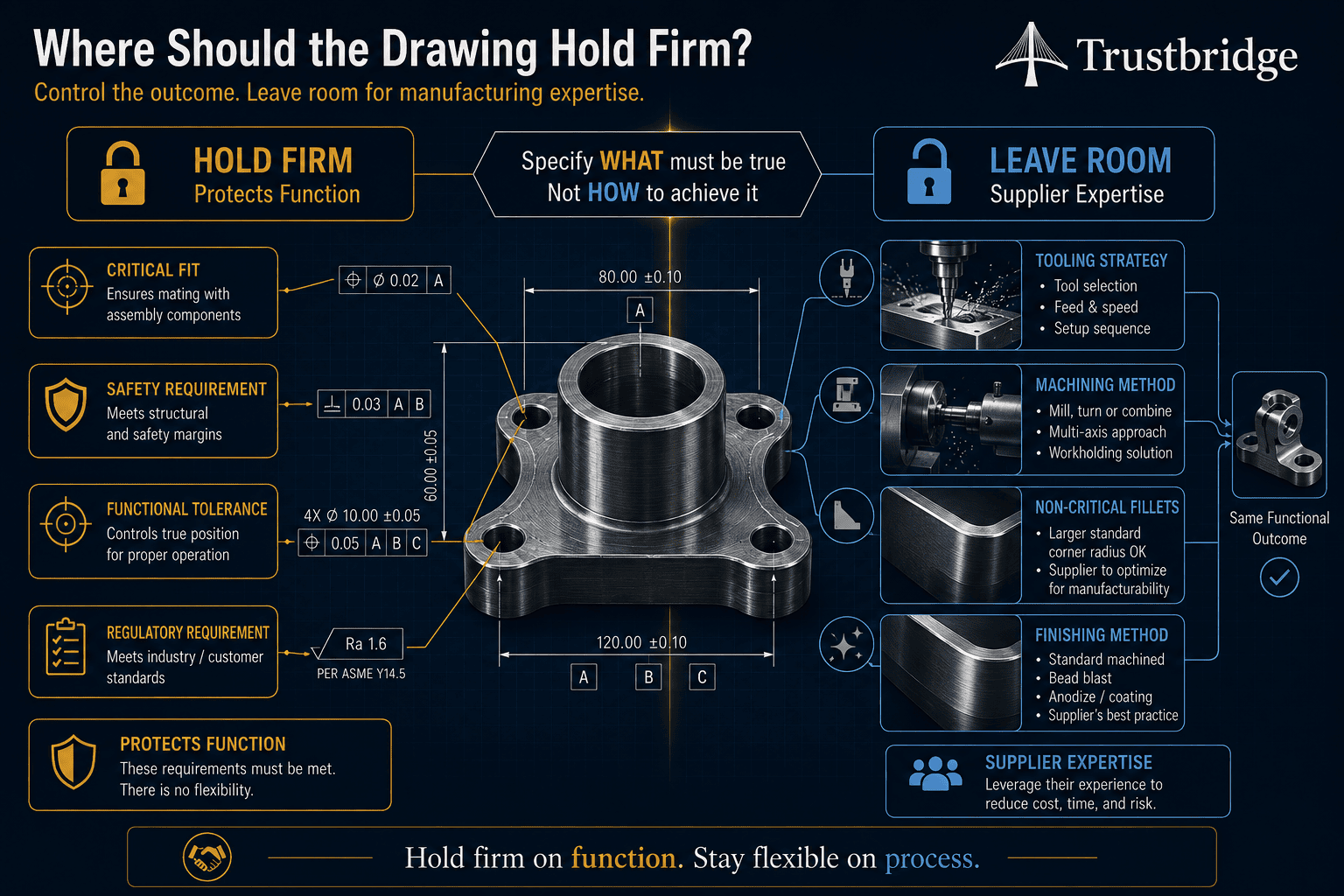
Not every line on a drawing deserves the same level of designer control. Some specifications protect something real a critical fit, a safety margin, a regulatory requirement, a functional tolerance the part genuinely cannot work without and those are worth holding firm on regardless of what a supplier proposes changing. But a large share of what ends up locked into a drawing is really a process decision dressed up as a design requirement: which specific coolant strategy gets used, how a non-critical fillet gets machined, which of several equally valid finishing methods produces an acceptable surface.
These are exactly the decisions a good manufacturing partner is better positioned to make than the designer who specified them, simply because the shop knows its own equipment, tooling, and process capability in more detail than any drawing note could capture. Research on early supplier involvement backs this up directly: bringing a manufacturing partner into the conversation before a spec is finalized, rather than after, consistently surfaces alternative materials, processes, or geometries that meet the same functional requirement at a lower cost, because the supplier can see options the designer simply doesn't have visibility into from a CAD screen. Holding firm on whatever protects function and safety, while deliberately leaving room on everything else, is what turns a drawing from a rigid set of instructions into a genuine collaboration between two parties who each know something the other doesn't.
Strategic design whitespace
There's a useful distinction between leaving a spec deliberately open and leaving it accidentally ambiguous, and it's worth being precise about the difference, because the two can look identical on paper while behaving very differently in practice. Ambiguity is an unintentional gap in something that actually matters a missing tolerance on a critical feature, a datum that doesn't reflect how the part functions and it creates risk nobody chose on purpose; it just happened because a drawing was rushed or a template was incomplete. Strategic whitespace is the opposite: a deliberate, clearly bounded decision to leave a non-critical parameter unspecified, precisely so a manufacturing partner can apply their own process knowledge to it instead of guessing at a designer's unstated preference. Procurement research frames this well: a buying organization can directly control how much of a supplier's expertise it actually gets access to simply by adjusting how tightly it specifies its own requirements going in, since the more that gets locked down upfront, the less room is left for a supplier's judgment to add any value at all. A drawing with well-placed whitespace tells a manufacturing partner exactly what has to be true about the part, and stays deliberately silent on everything that doesn't need to be dictated. That silence isn't a gap in the design it's a decision, and often the more sophisticated one of the two.
A simple test before a spec is finalized
A few questions tend to separate a well-optimized spec from one that's either over-built or under-defined, and they're worth running through before a drawing is released rather than after a quote comes back higher than expected:
Can I name the specific functional or regulatory reason behind every tight tolerance, tight finish, or unusual material on this drawing? If not, it's probably inherited rather than intentional.
Is there a critical dimension, datum, or requirement currently left open to interpretation? If so, that's ambiguity rather than whitespace, and it needs to be nailed down before release, not after.
Am I specifying a process the "how" where I could instead specify an outcome and let a manufacturing partner choose the method that gets there most efficiently?
Would a supplier with deep process knowledge likely flag any of these choices as unnecessary the moment they saw the print?
None of these questions require giving up control over what actually matters on the part. They're aimed squarely at the much larger category of decisions that only feel like they matter.
Conclusion
A perfect spec was never really the goal, because no single drawing can simultaneously guarantee zero functional risk and zero unnecessary cost those two things trade off against each other, and the trade only goes well when it's made on purpose rather than by default. Over-specification and under-specification are the same underlying mistake wearing different costumes: both substitute a designer's discomfort with ambiguity for a genuine analysis of what the part actually needs to do. Manufacturable intent, strategic whitespace, and knowing precisely where to hold firm are really the same discipline applied consistently across a drawing specify whatever protects function, leave real room for the people who build the part to do what they do best, and treat every remaining tight number as a question worth answering before it becomes a cost worth paying.
Not sure which lines on your next drawing are worth holding firm on?
Every spec has a handful of dimensions and callouts that genuinely protect function, and a much longer list that's really just inherited habit sitting on the page, copied forward from a template or a previous program without anyone asking whether it still applies. Send over the drawing, and get a straight read on which of your tolerances, finishes, and material choices are earning their cost and which ones are strategic whitespace waiting to be opened up for a manufacturing partner's expertise instead. Get a second read on your spec before it goes out for quotes, not after the number comes back higher than expected.
Frequently Asked Questions
1. What is manufacturable intent in engineering design?
Manufacturable intent means defining the requirements a part genuinely needs to meet while avoiding unnecessary restrictions on how it must be manufactured. It focuses on specifying functional tolerances, materials, finishes, and requirements that protect performance while leaving non-critical manufacturing decisions open to supplier expertise.
2. Why do overly tight tolerances increase manufacturing costs?
Overly tight tolerances can require slower machining, additional setup verification, more inspection, tighter process control, and specialized equipment. When a tolerance is tighter than the part's functional requirements demand, these added costs increase manufacturing complexity without necessarily improving product performance.
3. What is the difference between over-specification and under-specification?
Over-specification places tighter tolerances, finishes, materials, or process requirements on a part than its function requires, increasing cost and manufacturing complexity. Under-specification leaves important requirements unclear or incomplete, creating ambiguity that can lead to rework, quality problems, and disputes during manufacturing or inspection.
4. How can engineers give manufacturing suppliers more flexibility without compromising quality?
Engineers can clearly define critical functional, safety, and regulatory requirements while leaving non-critical manufacturing decisions open to supplier expertise. This strategic whitespace allows suppliers to choose efficient processes, materials, tooling, or finishing methods while still meeting the required part performance and quality standards.