
How to Write a Capability Statement That Actually Wins RFQs
Introduction
A procurement buyer with a stack of RFQs to place and a dozen candidate suppliers doesn't read a website top to bottom or schedule a call to find out what each shop actually makes. They open a one-page capability statement, scan it in under a minute, and decide whether that shop stays in consideration. Whether you're a job shop, a contract manufacturer, or chasing a spot on an OEM manufacturer's approved-vendor list, that one page is doing more qualifying work than almost anything else you send a new buyer.
Most capability statements fail that scan for a simple reason: they're written like marketing copy instead of the operational facts a buyer is actually checking for. The shop doing the work is often perfectly qualified — the document just doesn't prove it fast enough, and by the time it might have, the buyer has already moved to the next one in the stack. What follows is what buyers are actually looking for, where shops consistently undersell themselves, a structure built specifically to survive the one-minute scan, and what it takes to keep that document doing its job well after the first read.
What Buyers Actually Look For
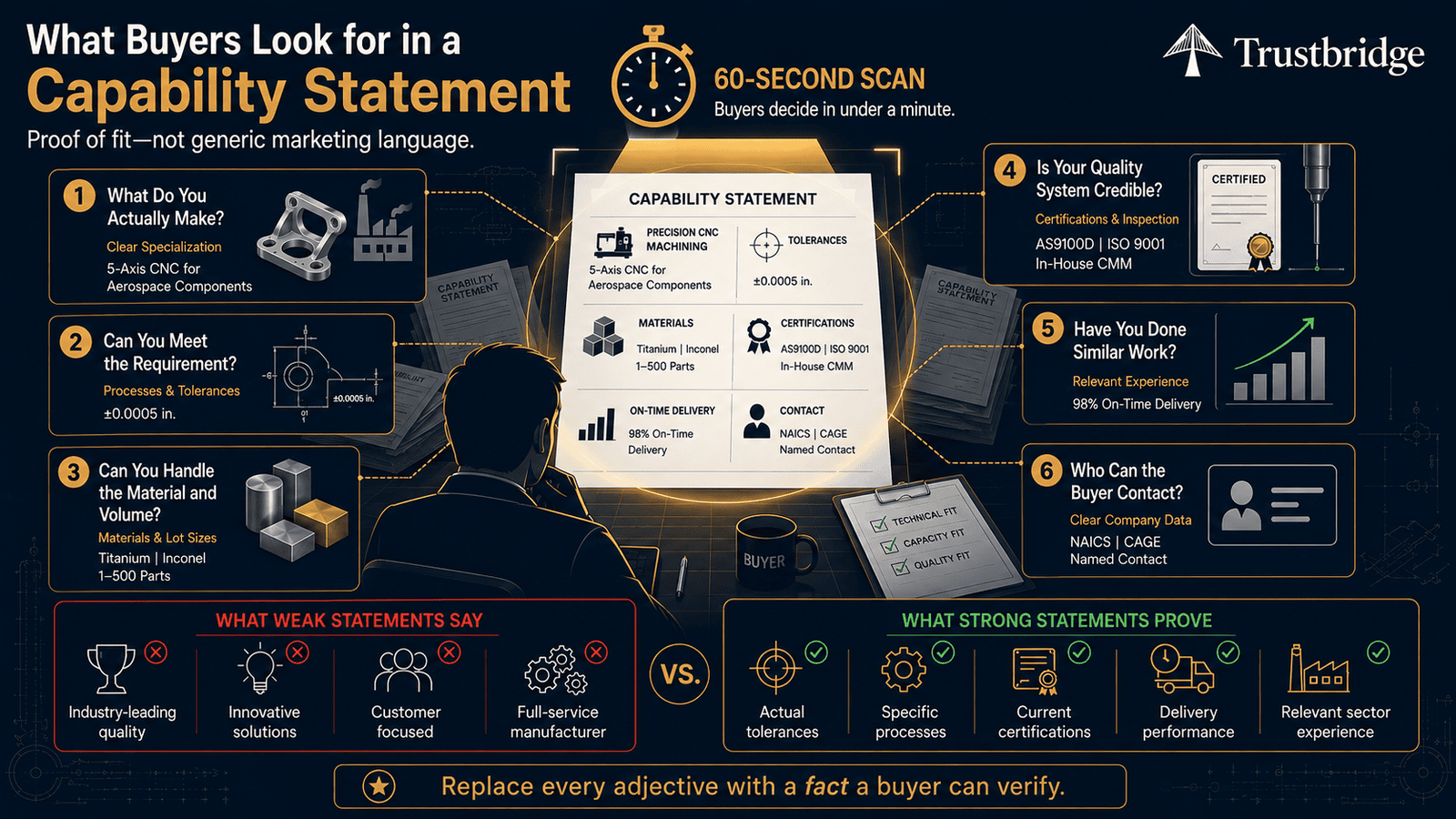
A manufacturing capability statement isn't a brochure — buyers already have your website for that. It's closer to a technical resume: a document built around operational facts rather than brand messaging, meant to answer one question fast — does this shop have the processes, capacity, and experience this project needs? Procurement teams use it as an early filter, confirming fit before committing time to pricing conversations, plant visits, or engineering reviews. For OEMs and larger contract manufacturers screening dozens of vendors at once, this document alone often decides who gets that further conversation at all, which is exactly why it's worth more attention than most shops give it.
Buyers scan for proof, not adjectives
Generic phrases like "industry-leading quality" or "customer-focused solutions" tell a buyer nothing, because every competitor's statement says the same thing in the same words. The fix is mechanical rather than creative: replace the adjective with the number behind it. "Reliable delivery" becomes "98% on-time completion across 50+ projects in the last two years." "Precision machining" becomes the actual tolerance the shop reliably holds. A buyer skimming for a minute can verify a number in a way they can't verify a claim, and a document full of specifics reads as credible before they've even finished it.
Buyers want a specialist, not a generalist
Stating that a shop specializes in precision CNC machining for aerospace, medical devices, and industrial equipment tells a buyer more in one sentence than a page of "innovative manufacturing solutions" ever will. Shops trying to look capable often list every capability they have instead — a dozen processes, unrelated disciplines, pages of certifications — on the theory that more options means more chances to match a buyer's need. Buyers read it the opposite way: a shop claiming to do everything usually reads as not being especially good at any one thing. Four to six competencies that map directly to what the target buyer procures outperforms a long list every time.
How Shops Undersell Themselves
Most underselling isn't a confidence problem — it's a formatting problem. Shops doing genuinely strong work still lose the one-minute scan because the document doesn't hand over what it's carrying clearly enough for a skeptical reader to verify it fast. Two habits show up across almost every weak capability statement, and unlike a lot of sales problems, both are fixable in an afternoon without touching the actual work the shop does or requiring a professional rewrite. Neither habit is about a shop's actual capability — both are about the gap between what a shop can do and what the document manages to prove.
One generic statement for every buyer
The single most common mistake is sending the identical statement to a government buyer, a corporate procurement team, and a walk-in prospect at a trade show. A version tailored to what a specific buyer procures — using their language, foregrounding the competencies relevant to their sector — reads as informed. A generic, one-size-fits-all version reads as exactly that, and busy buyers notice the difference within the first line. Tailoring doesn't require rewriting the whole document each time; in practice it usually means keeping two or three versions of the core competencies section, ordered around different buyer types, and sending whichever one actually matches who's reading it.
Equipment listed without explaining what it enables
A long list of machine models — mills, lathes, EDM units, CMMs — provides little value on its own, because a buyer scanning quickly doesn't know what any of it means for their specific part. The fix is connecting the equipment to the outcome: not "5-axis CNC, Swiss turning, robotic welding," but what those specifically enable — complex geometries in a single setup, tight-tolerance small-diameter parts, high-volume consistent welds. The same logic applies to industries served: naming aerospace, medical device, or automotive experience only helps if it's tied to what those sectors actually require, since each carries different documentation and compliance expectations a generic list doesn't address. A shop that names the standard by name — traceability requirements, DFARS compliance, IATF 16949 — signals it already understands the buyer's world, which a bare list of past clients never quite manages to do.
The Structure That Actually Works
Strip away the design choices and nearly every capability statement that performs well is organized the same way, because that's the order buyers actually look for the information in. Fixing the language problems above matters, but they only pay off if the document is also structured so a skimming reader finds each fact where they expect it. The table below is deliberately literal — copy the structure, replace every example with a specific fact from your own shop, and don't leave a placeholder in the version you send out.
Section | What Goes In It | Example |
Company Overview | 1-2 sentences: what you make, for whom, how long | "Ridgeline Precision has machined aerospace-grade aluminum and titanium components for Tier 1 suppliers since 2011." |
Core Competencies | 4-6 capabilities grouped into categories (machining, fabrication, finishing, inspection) — not a flat equipment list | "5-axis CNC machining, ±0.0005 in. tolerance, titanium and Inconel, lot sizes of 1 to 500" |
Certifications & Production Experience | Current certifications, dated, plus concrete production history | "AS9100D (recert. 2025), ISO 9001:2015; 98% on-time delivery across 50+ subcontract line items, 2022–2025" |
Differentiators | What's true of you and verifiably not true of most competitors | "In-house CMM inspection and an ITAR-registered facility — no outsourced QA step" |
Treat It as a Living Document, Not a One-Time Deliverable
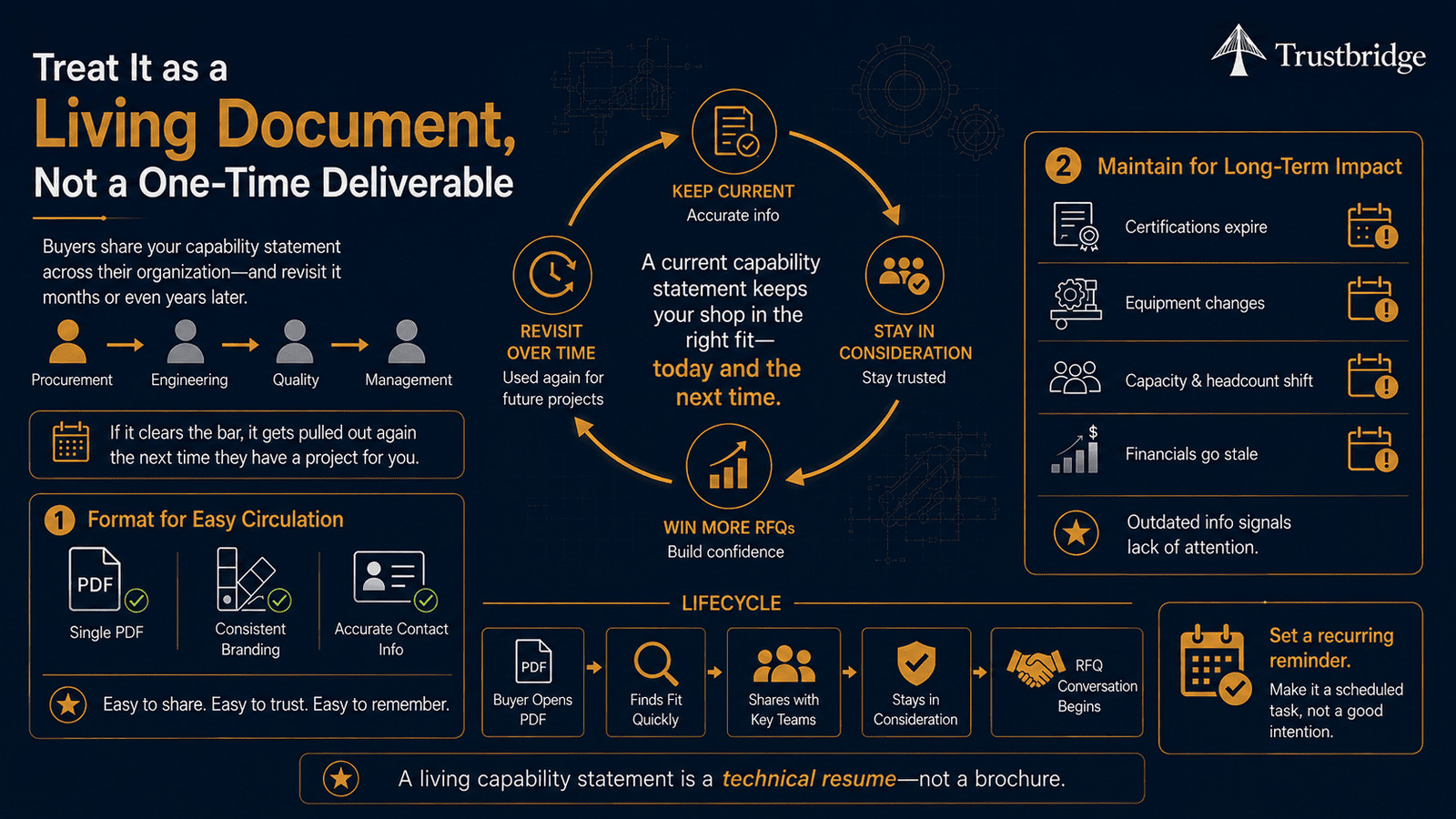
A capability statement rarely gets read once and filed away. Procurement typically forwards it to engineering, quality, and management before a vendor clears an approved-supplier list, and if it clears that bar, it often gets pulled back out again the next time that buyer has a project this shop is a plausible fit for — sometimes a year or more later, long after whoever wrote it has stopped thinking about it. A document built to satisfy a single reader on a single afternoon misses most of the value it's actually capable of generating over its real lifespan.
That reality points to two practical habits, and neither has anything to do with rewriting the content itself. First, format: a clean, single PDF with consistent branding and accurate contact information circulates far more easily inside a buyer's organization than a set of brochures or a link to a website that might change or go down. Second, maintenance: certifications expire, equipment changes, and revenue or headcount figures go stale, and a document that hasn't been touched in two years signals the same lack of attention a buyer would worry about in the actual production work. Reviewing it once or twice a year — closer to quarterly if certifications or capacity change often — keeps the document doing the job it was built for instead of quietly working against the shop that sends it out. Set a recurring reminder tied to a fixed date rather than "whenever we remember," since the shops that actually keep this current are almost always the ones who turned it into a scheduled task rather than a good intention.
Conclusion
None of this requires a redesign or a new writer. It requires replacing every adjective with a number, narrowing the competency list to what a buyer in front of you actually needs, connecting any equipment or certification you name to what it actually lets you deliver, and treating the result as something you'll revisit rather than something you write once. A capability statement built this way doesn't need to work harder to get attention — the structure above already puts the information where a buyer expects to find it, in a form they can verify in the time they're actually willing to spend. For a lot of buyers, this one page is the entire basis on which a first manufacturing partnership either starts or never gets the chance to.
A strong capability statement gets you noticed. It doesn't put you in front of the buyers who are actually looking. Trustbridge helps job shops, contract manufacturers, and custom manufacturing businesses showcase their capabilities to qualified OEMs actively sourcing new suppliers, so the document you just tightened up actually reaches someone who needs exactly what it describes, rather than sitting in a folder waiting for the right RFQ to happen to arrive. If you're ready to put a stronger capability statement in front of more of the right buyers, that's the gap Trustbridge closes. [See how Trustbridge connects suppliers with qualified buyers →]
Frequently Asked Questions
1. What is a manufacturing capability statement?
A manufacturing capability statement is a one-page document that summarizes a supplier's core capabilities, equipment, certifications, production capacity, and industry experience. It helps procurement teams quickly determine whether a job shop, contract manufacturer, or OEM manufacturer is a good fit for an RFQ before moving to detailed discussions.
2. What should a manufacturing capability statement include?
An effective manufacturing capability statement should include a brief company overview, core manufacturing capabilities, certifications, production experience, differentiators, and key business information such as contact details and relevant industry codes. The focus should be on measurable facts and operational strengths rather than marketing language.
3. Why is a manufacturing capability statement important for winning RFQs?
Procurement buyers often review capability statements before requesting quotes or scheduling supplier evaluations. A clear, well-structured document helps buyers quickly verify technical capabilities, manufacturing experience, and production capacity, increasing the likelihood of being shortlisted for RFQs and new manufacturing partnerships.
4. How often should a manufacturing capability statement be updated?
A manufacturing capability statement should be reviewed at least once or twice a year, or whenever there are significant changes such as new equipment, updated certifications, expanded capabilities, or increased production capacity. Keeping the document current ensures buyers receive accurate information and reinforces confidence in your manufacturing business.