
4 Ways the Best Manufacturers Win Smart Home & Consumer Hardware Manufacturing Contracts
The best manufacturers win smart home and consumer hardware manufacturing contracts by engaging early with product development teams, demonstrating relevant hardware manufacturing experience, building strong operational systems, and maintaining transparent communication throughout the production lifecycle. These capabilities help manufacturers reduce risk for OEMs, improve product outcomes, and secure long-term production partnerships
Introduction
The smart home and consumer electronics manufacturing ecosystem—where Design for Manufacturability (DFM) and Design for Assembly (DFA) principles are critical— is expanding rapidly, driven by increasing adoption of IoT-enabled devices, connected ecosystems, and automation technologies. From smart locks and security cameras to wearable devices and connected appliances, OEMs are continuously developing new products that require reliable and scalable manufacturing partners.
In this environment, winning manufacturing contracts requires more than competitive pricing. OEMs evaluate suppliers based on their ability to support product development, ensure production consistency, and collaborate effectively across engineering and procurement teams.
The most successful manufacturers differentiate themselves through early-stage collaboration, DFM (Design for Manufacturability) and DFX (Design for Excellence) capabilities, proven production experience, and strong operational and communication systems. These factors play a critical role in influencing supplier selection and long-term partnership decisions.
The best manufacturers win smart home and consumer hardware manufacturing contracts by engaging early with product development teams, demonstrating relevant hardware manufacturing experience, building strong operational systems, and maintaining transparent communication throughout the production lifecycle. These capabilities help manufacturers reduce risk for OEMs, improve product outcomes, and secure long-term production partnerships.
The Role of Early Engagement in Winning Manufacturing Contracts
Leading manufacturers engage with OEMs early in the product development lifecycle—well before production begins. At this stage, key decisions around design feasibility, materials, and manufacturing processes are made, often guided by DFM (Design for Manufacturability) and NPI (New Product Introduction) frameworks.
By contributing early, manufacturers can influence product architecture, reduce complexity, and ensure smoother transitions into production. This early involvement significantly improves their chances of securing long-term contracts.
Design Complexity and Manufacturability
Smart home and consumer electronics products—especially those involving PCBA (Printed Circuit Board Assembly) and electromechanical integration— integrate PCBA, embedded systems, sensors, and mechanical enclosures. Without proper Design for Manufacturability (DFM), these elements can create inefficiencies that increase cost and delay production.
Manufacturers who contribute to DFM reviews, tolerance analysis, and component optimization help simplify designs. This leads to improved yield rates, reduced redesign cycles, and more efficient scaling.
Early Alignment with OEM Manufacturing Stages
OEMs rely on structured validation stages such as EVT (Engineering Validation Test), DVT (Design Validation Test), and production ramp-up.
Manufacturers involved during these phases gain a deeper understanding of product requirements and can better support the transition to mass production, often aligning with NPI (New Product Introduction) milestones and validation protocols. This alignment reduces risk and builds stronger relationships with OEM teams.
Demonstrating Relevant Hardware Manufacturing Experience
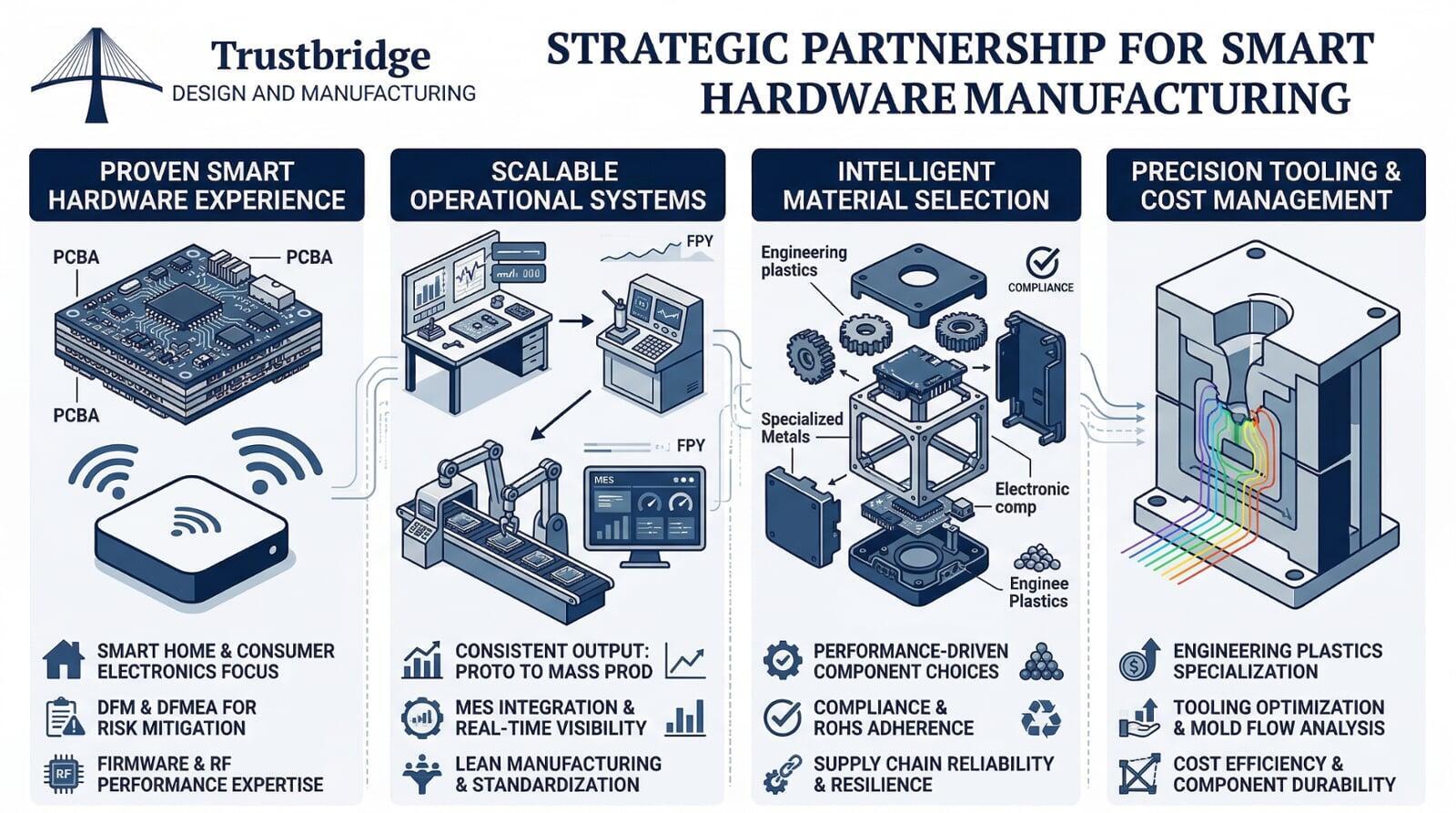
OEMs prioritize manufacturers with proven experience in similar smart home and consumer electronics segments, where DFM (Design for Manufacturability) and DFMEA (Design Failure Mode and Effects Analysis) play a key role in risk mitigation. These products require expertise across PCBA, firmware integration, RF performance, and precision assembly.
Manufacturers that present case studies, validation outcomes, and production metrics stand out during supplier evaluations. Their experience allows them to anticipate challenges such as thermal management, component compatibility, and testing requirements.
Providing measurable proof points—such as first-pass yield (FPY), production volumes, and successful product launches—helps build confidence with procurement and engineering teams.
Building Strong Operational Systems for Scalable Production
Operational consistency is essential for both winning and scaling manufacturing contracts. OEMs assess whether manufacturers can maintain stable output across prototyping, validation, and mass production, often evaluating MES (Manufacturing Execution Systems) integration and process standardization maturity.
Manufacturers that implement lean manufacturing practices, standardized workflows, and Manufacturing Execution Systems (MES) achieve better process control and real-time visibility. These capabilities ensure consistent quality and predictable delivery timelines.
Strong operational systems also allow manufacturers to scale efficiently as demand increases, without introducing variability or delays.
Material Selection and Supply Chain Reliability
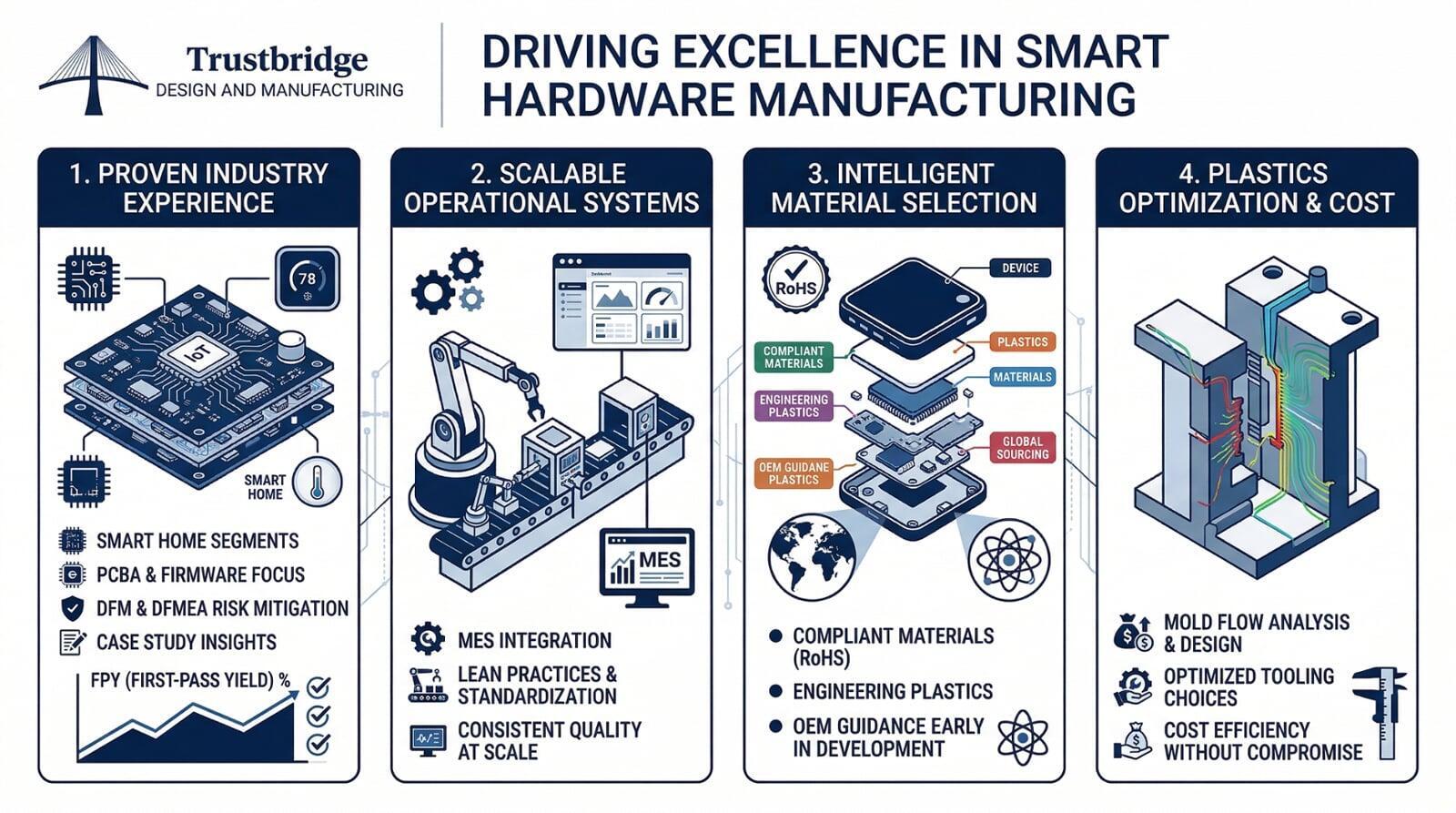
Material selection plays a critical role in determining product performance, cost, and manufacturability. Smart hardware and consumer electronics products—where DFM (Design for Manufacturability) and compliance standards like RoHS (Restriction of Hazardous Substances) are critical— depend on engineering plastics, electronic components, and specialized materials that must meet both functional and regulatory requirements.
Manufacturers who understand material behavior and sourcing dynamics can guide OEMs toward better decisions early in development.
Engineering Plastics and Cost Implications
Material choices—especially engineering plastics used in enclosures and structural components—directly affect tooling complexity, durability, and unit cost, often requiring DFM-driven tooling optimization and mold flow analysis.
Manufacturers with expertise in material selection help balance performance requirements with cost efficiency, ensuring products remain competitive without compromising quality.
Material Availability and Supply Chain Impact
Global supply chains for electronic components and materials are often volatile. Shortages or delays can disrupt production schedules and increase costs, making supply chain strategies like dual sourcing and BOM (Bill of Materials) optimization essential.
Manufacturers with strong supplier networks and sourcing strategies can mitigate these risks. Their ability to secure reliable supply or identify alternatives ensures continuity during production.
Maintaining Transparent Communication
Transparent and proactive communication is essential for successful OEM–manufacturer relationships. OEM teams rely on accurate updates regarding production status, component availability, and potential risks, often facilitated through PLM (Product Lifecycle Management) and MES-integrated reporting systems.
Manufacturers can strengthen communication through structured reporting systems, project dashboards, and regular cross-functional meetings. These tools ensure alignment across engineering, sourcing, and production teams.
Proactive communication helps identify and resolve issues early, preventing delays during critical stages such as EVT, DVT, and production ramp-up.
Conclusion
Winning smart home and consumer hardware manufacturing contracts requires more than production capability alone. The most successful manufacturers differentiate themselves by engaging early with product teams, applying DFM (Design for Manufacturability) and DFX methodologies, demonstrating relevant experience, and maintaining strong operational and communication systems.
As smart home devices become more complex and competition intensifies, OEMs increasingly prioritize manufacturers who can act as strategic partners throughout the product lifecycle.
Manufacturers that invest in these capabilities are better positioned to reduce risk, support innovation, and secure long-term production opportunities in a rapidly evolving market.
Winning high-value smart home and consumer hardware contracts requires early engagement, technical alignment, and proven execution.
Manufacturers that proactively connect with OEMs during product development—and demonstrate strong engineering and operational capabilities—gain a clear competitive advantage.
Vulcury helps manufacturers strengthen their positioning by improving alignment with OEM expectations, increasing visibility into manufacturing readiness, and enabling more effective collaboration across product development and production stages, particularly across DFM, NPI, and supplier coordination workflows.
If you're looking to win more contracts and build long-term OEM partnerships, adopting a more structured and proactive engagement approach can make a meaningful difference.
Frequently Asked Questions (FAQs)
1. How do manufacturers win smart home manufacturing contracts?
Manufacturers win contracts by engaging early with OEM teams, demonstrating relevant production experience, maintaining strong operational systems, and providing transparent communication throughout the product lifecycle.
2. Why is early collaboration important in hardware manufacturing?
Early collaboration allows manufacturers to influence product design, improve manufacturability, reduce production costs, and minimize redesign risks—making them more valuable to OEMs.
3. What do OEMs look for when selecting manufacturing partners?
OEMs evaluate suppliers based on technical expertise, past experience, production capabilities, operational reliability, communication, and supply chain strength—not just pricing.
4. How does manufacturing experience impact contract decisions?
Experience with similar products helps manufacturers anticipate production challenges, improve efficiency, and deliver consistent quality, which increases trust with OEMs.