
Los Angeles: 100+ New Machine Shops in Five Years — What the Data Says About America's Fastest-Growing Manufacturing Markets
Preamble
Los Angeles has long been recognized as one of the United States' largest manufacturing centers, but recent conversations around the industry have introduced a bold claim: more than 100 new machine shops have emerged in the region over the past five years. While this figure appears frequently in industry discussions, verifying it is more complicated than simply checking one government database.
Different organizations measure machine shops in different ways. Some track businesses registered under NAICS 332710 (Machine Shops), while others include contract manufacturers, prototype shops, CNC service providers, and diversified manufacturers that perform machining as part of broader production operations. Add in reporting delays, acquisitions, business closures, and new company registrations, and the picture becomes far less straightforward.
Rather than asking whether the number is exactly 100, a better question is: What do the available datasets collectively tell us about the direction of Los Angeles manufacturing?
This article combines data from the U.S. Census Bureau, IBISWorld, County Business Patterns, the Aerospace Industries Association (AIA), California Employment Development Department (EDD), Reshoring Initiative, and several industry reports to separate fact from assumption. The goal is not simply to validate a headline but to understand why Los Angeles continues to attract machining investment despite statewide manufacturing challenges.
Introduction
Ask five different manufacturing databases how many machine shops currently operate in Los Angeles and you will likely receive five different answers. That is not because the data is inaccurate—it is because the manufacturing landscape is evolving faster than many reporting systems can capture.
Federal datasets such as the U.S. Census Bureau's County Business Patterns (CBP) and Statistics of U.S. Businesses (SUSB) are invaluable, but they are released with a delay. Meanwhile, commercial databases like IBISWorld, supplier directories, and industry associations continuously update their records based on new registrations, acquisitions, relocations, and business closures. Each source therefore measures a slightly different version of the same market.
This is why relying on a single statistic often creates misleading conclusions. A declining statewide machine shop count does not necessarily mean machining capacity is shrinking. Likewise, an increase in supplier listings does not automatically indicate hundreds of entirely new businesses. Understanding Los Angeles requires looking beyond one metric and examining multiple economic signals together.
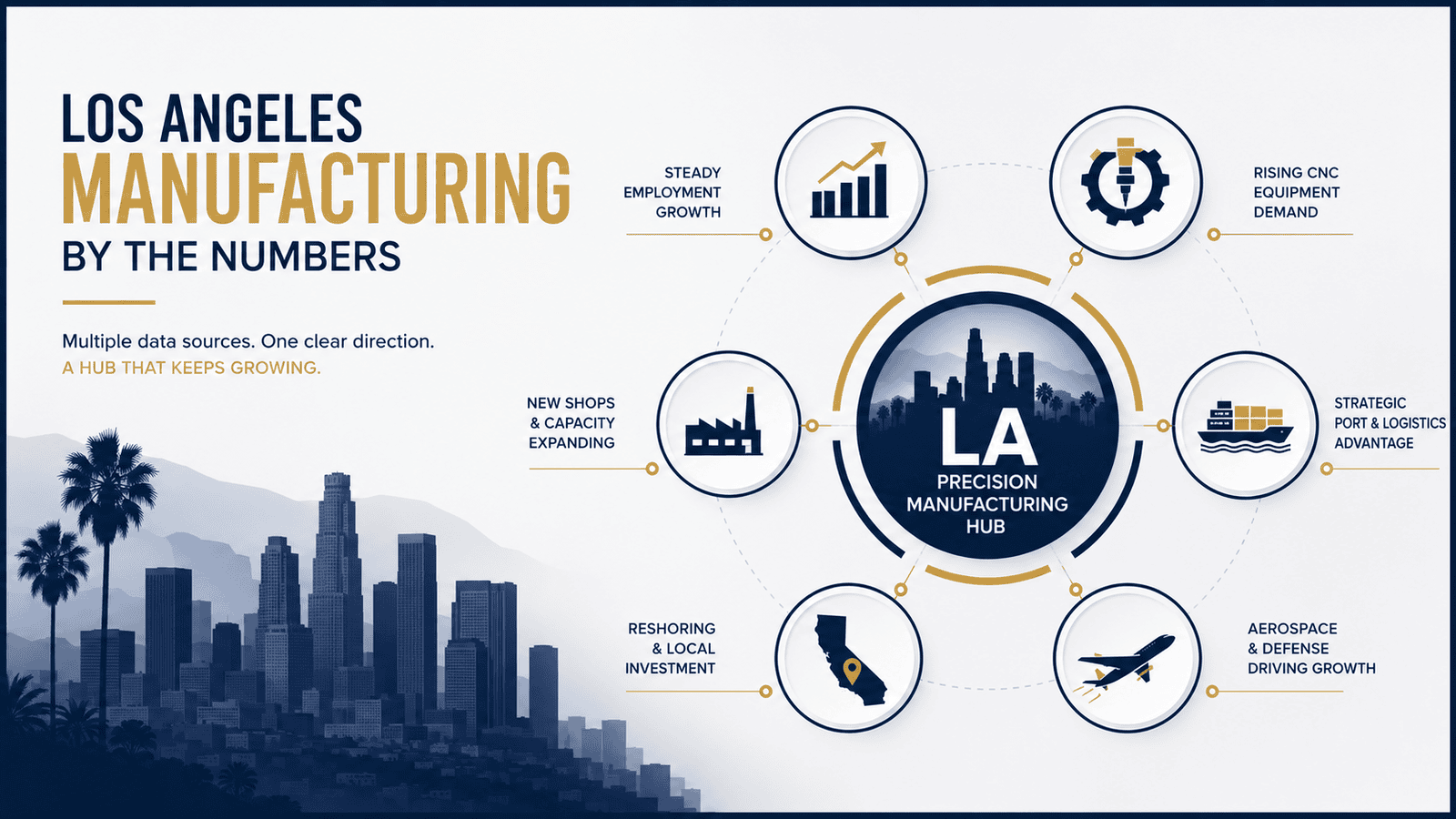
Instead of focusing on a single number, this article analyzes manufacturing employment, aerospace investment, port logistics, reshoring activity, CNC equipment demand, and industry revenue to understand where precision manufacturing is actually heading.
By connecting these datasets, a much clearer picture emerges: Los Angeles remains one of North America's most strategically important precision manufacturing hubs—not because one report says so, but because numerous independent indicators point in the same direction.
The Real Number Behind the Headline
The phrase "100+ new machine shops" has become a popular talking point in discussions about Southern California manufacturing. However, no single government publication confirms that exact figure. Instead, it is an estimate pieced together from supplier directories, state business registrations, industry investment announcements, and broader manufacturing growth indicators.
Understanding where this estimate comes from is more valuable than debating the number itself. Different organizations classify machining businesses differently. Some only include establishments registered under NAICS 332710 (Machine Shops), while others count contract manufacturers, prototype shops, aerospace suppliers, and mixed-service manufacturing companies that generate a significant portion of their revenue from CNC machining.
Rather than treating the headline as a verified statistic, manufacturers should view it as an indicator of increasing regional activity. The more important takeaway is that multiple independent datasets point toward continued investment in precision machining throughout Los Angeles County.
- What Official Business Counts Actually Show
The most widely referenced federal datasets are the U.S. Census Bureau's Statistics of U.S. Businesses (SUSB) and County Business Patterns (CBP) reports. These publications track establishments, employment, payroll, and industry classifications across the United States.
According to IBISWorld's 2026 Machine Shop Services Industry Report, the United States had approximately 16,403 machine shop businesses (NAICS 332710), while California accounted for roughly 2,170 establishments in 2025. These reports also suggest a modest decline in business counts over recent years.
Meanwhile, the U.S. Census Bureau's 2020 Statistics of U.S. Businesses (SUSB) report recorded approximately 17,275 machine shop establishments employing more than 209,000 workers nationwide. Because these datasets use different reporting periods and methodologies, variations between them are expected rather than contradictory.
The important lesson is that official counts provide an excellent historical baseline, but they do not always reflect the most recent market activity. New businesses, acquisitions, and facility expansions often occur long before they appear in federal statistics.
- Why the Ground-Level Picture Looks Different in Los Angeles
While statewide establishment counts appear relatively stable—or even slightly lower—the day-to-day reality in Los Angeles often tells a different story.
The first reason is reporting lag. The U.S. Census Bureau's County Business Patterns (CBP) data is intentionally published after significant verification, meaning rapidly changing local markets are not immediately reflected in national datasets.
The second reason is industry consolidation. Today's machining businesses often operate larger facilities equipped with multiple multi-axis machining centers, automation systems, and digital manufacturing technologies. As a result, fewer businesses may collectively produce significantly more machining output than a larger number of smaller shops did a decade ago.
Finally, Los Angeles benefits from several regional growth drivers that are unique to Southern California. Aerospace expansion, reshoring initiatives, defense spending, medical manufacturing, and strong logistics infrastructure continue attracting investment even while broader statewide manufacturing statistics remain mixed.
Taken together, these factors explain why manufacturers on the ground often perceive stronger growth than national establishment counts alone might suggest.
Los Angeles Manufacturing, By the Numbers
Understanding the broader manufacturing ecosystem helps explain why machining demand remains resilient in Los Angeles. Machine shops do not operate in isolation—they depend on the industries that surround them. When aerospace companies expand, medical device manufacturers launch new products, or logistics networks strengthen, demand for precision machining typically increases alongside them.
Unlike manufacturing regions that depend heavily on one dominant industry, Los Angeles supports an unusually diverse industrial base. Aerospace, defense, transportation, electronics, industrial equipment, renewable energy, and medical technology all require precision-machined components, creating multiple independent sources of demand.
This diversity is one of Los Angeles' greatest competitive advantages. Even if one sector slows temporarily, activity in other industries often helps stabilize machining workloads and encourages continued investment in advanced manufacturing capabilities.
- Aerospace and Defense Continue to Anchor Regional Demand
One of the strongest reasons Los Angeles remains a machining powerhouse is its deep integration with the aerospace and defense supply chain.
According to the California Employment Development Department (EDD) and the Aerospace Industries Association (AIA) 2025 Facts & Figures Report, Los Angeles County supports approximately 453,000 manufacturing jobs, making it the largest manufacturing employment base of any U.S. county. Aerospace and defense account for more than 100,000 direct jobs, supported by major manufacturers including SpaceX, Boeing, Northrop Grumman, Lockheed Martin, and hundreds of specialized Tier 1, Tier 2, and Tier 3 suppliers.
Unlike many manufacturing sectors that prioritize high-volume production, aerospace depends on low-volume, high-complexity machining, where precision, material expertise, and quality certifications matter far more than production volume. This creates sustained demand for machine shops capable of machining titanium, Inconel, aluminum alloys, stainless steels, and other advanced engineering materials.
This concentration of high-value manufacturing helps explain why machining investment remains strong even when broader manufacturing employment fluctuates elsewhere.
- The Port Advantage Creates a Manufacturing Ecosystem
Manufacturing strength in Los Angeles is not driven solely by customer demand. The region also benefits from one of the world's most efficient industrial logistics networks.
The Ports of Los Angeles and Long Beach together handle approximately 40% of U.S. containerized imports, providing manufacturers with faster access to raw materials, imported machine tools, cutting tools, and industrial equipment than many inland competitors.
For machine shops, this logistical advantage translates into shorter material lead times, more reliable supply chains, and greater flexibility when sourcing aluminum, stainless steel, titanium, and specialty alloys. As reshoring accelerates and global supply chains become more volatile, proximity to major ports has become an increasingly important competitive advantage rather than simply a transportation benefit.
This logistics ecosystem complements the region's aerospace strength, making Los Angeles attractive not only because of who buys machined parts, but also because of how efficiently suppliers can source materials and deliver finished components.
The National Machine Shop and CNC Market
Now that we've established why Los Angeles remains an active manufacturing hub, it helps to zoom out and look at the national picture. Doing so reveals an important trend that often surprises manufacturers: the number of machine shops and the amount of machining work being performed are no longer moving in the same direction.
Across the United States, many small machine shops have closed, merged, or been acquired over the past decade. At the same time, surviving manufacturers have invested heavily in automation, multi-axis CNC equipment, robotics, and digital production systems, allowing them to produce significantly more with fewer facilities.
This shift explains why business counts alone no longer provide an accurate picture of manufacturing capacity. Modern CNC shops are generating higher output, serving more complex industries, and handling larger production volumes than many traditional shops could a decade ago.
- NAICS 332710: Fewer Shops, Greater Output
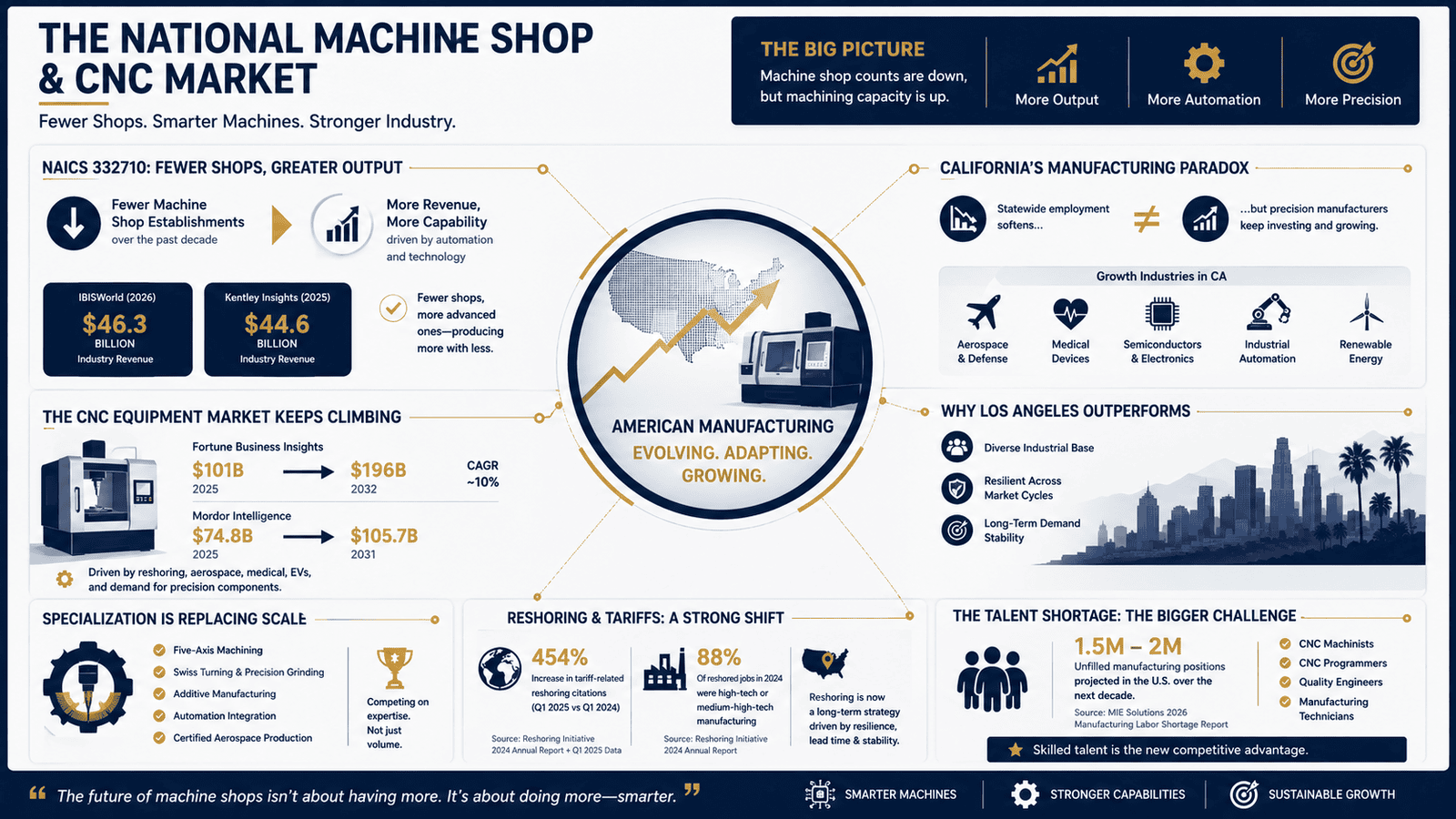
According to IBISWorld's Machine Shop Services in the United States (2026) report, the U.S. machine shop industry generates approximately $46.3 billion in annual revenue, despite a gradual decline in the number of establishments classified under NAICS 332710.
A separate Kentley Insights Machine Shops Market Report (2025) estimates industry revenue at approximately $44.6 billion, arriving at a similar conclusion despite using different research methodologies.
Rather than indicating industry weakness, these figures illustrate a structural transformation. Many smaller job shops have consolidated into larger organizations equipped with automation, pallet systems, lights-out machining, and advanced five-axis CNC equipment. These investments enable a single facility to complete work that previously required multiple independent shops.
For OEMs, this means supplier capability has become a more meaningful evaluation metric than supplier count. A region may have fewer registered businesses while simultaneously offering greater machining capacity, faster turnaround times, and more advanced manufacturing capabilities.
- The CNC Equipment Market Continues to Expand
While the number of machine shop businesses has remained relatively stable, investment in CNC technology continues to accelerate worldwide.
According to Fortune Business Insights, the global CNC machine tools market is expected to grow from approximately $101 billion in 2025 to nearly $196 billion by 2032, reflecting a compound annual growth rate approaching 10%.
Mordor Intelligence presents a more conservative forecast, estimating the market will grow from approximately $74.8 billion in 2025 to $105.7 billion by 2031. Although the exact figures differ, both reports identify the same long-term drivers: reshoring initiatives, aerospace expansion, medical manufacturing, electric vehicle production, and increasing demand for precision-engineered components.
The significance of this trend is that manufacturers are investing less in expanding factory footprints and more in increasing productivity through advanced equipment. Today's competitive advantage comes from machining smarter—not simply owning more machines.
California's Manufacturing Paradox
At first glance, California's manufacturing data appears contradictory. Statewide employment figures suggest manufacturing has softened over recent years, yet many precision machining companies continue reporting strong order books, equipment investments, and expanding customer pipelines.
The explanation lies in understanding that California is not a single manufacturing market—it is a collection of highly specialized regional economies. Industries experiencing decline are often very different from those driving growth.
Traditional commodity manufacturing, textile production, and labor-intensive consumer goods continue facing cost pressures from global competition. Meanwhile, aerospace, defense, semiconductors, medical devices, electronics, and precision engineering continue investing heavily in advanced manufacturing technologies.
This distinction is important because statewide statistics often mask regional specialization. For companies evaluating supplier locations, the performance of Southern California's precision manufacturing sector is far more relevant than statewide averages alone.
- Why Los Angeles Continues to Outperform
Unlike many manufacturing regions that depend heavily on one dominant industry, Los Angeles benefits from an unusually balanced industrial customer base. Aerospace may be its largest machining customer, but it is far from the only one.
Medical device manufacturers require complex precision components with demanding quality standards. Electronics companies rely on high-precision enclosures and thermal management components. Transportation, renewable energy, industrial automation, and semiconductor equipment manufacturers all contribute additional machining demand.
This diversity reduces dependence on any single market cycle. When commercial aerospace slows, defense programs, medical manufacturing, or industrial automation frequently help stabilize production demand. As a result, many Los Angeles machine shops experience greater resilience than suppliers operating in regions dominated by one industry alone.
Instead of measuring growth solely by the number of businesses, manufacturers should evaluate the diversity of industries creating long-term machining demand. That is where Los Angeles continues to distinguish itself.
- Specialization Is Replacing Scale
Another defining characteristic of California manufacturing is its shift toward specialization.
Rather than competing on high-volume commodity production, many Southern California suppliers have repositioned themselves around complex, low-volume manufacturing that demands advanced engineering expertise. Five-axis machining, Swiss turning, precision grinding, additive manufacturing, automation integration, and certified aerospace production now represent a growing share of regional manufacturing output.
This evolution allows suppliers to compete on technical capability rather than labor cost alone. Customers increasingly prioritize engineering collaboration, process reliability, traceability, and quality certifications over simply finding the lowest-priced machine shop.
In other words, California's competitive advantage is increasingly built on expertise instead of production volume. That shift helps explain why investment continues flowing into advanced machining despite broader employment fluctuations.
Reshoring, Tariffs, and the Skilled Labor Crunch
Regional specialization is only one piece of the story. External economic forces are also reshaping where manufacturers choose to source components and where suppliers decide to invest.
Supply chain disruptions experienced over the past several years exposed the risks of relying exclusively on overseas production. Longer shipping times, geopolitical uncertainty, tariff changes, and material shortages encouraged many manufacturers to reconsider domestic sourcing strategies.
As a result, reshoring has evolved from a short-term response into a long-term manufacturing strategy. Companies are increasingly evaluating suppliers based not only on price but also on resilience, lead time reliability, engineering support, and supply chain stability.
- What the Reshoring Data Actually Shows
According to the Reshoring Initiative's 2024 Annual Report Plus Q1 2025 Data, citations of tariff policy as a factor influencing reshoring decisions increased by 454% during the first quarter of 2025 compared with the same period in 2024. This represents one of the strongest shifts in domestic manufacturing sentiment observed in recent years.
The same report also notes that approximately 88% of jobs reshored during 2024 were classified as high-tech or medium-high-tech manufacturing, reflecting growing demand for industries such as aerospace, medical devices, industrial automation, electronics, and precision machining.
Industry compensation has also continued rising. According to IndustryWeek's 2025 Manufacturing Salary Survey, average annual manufacturing compensation increased significantly year over year, while hourly manufacturing wages continued climbing into 2026.
Although independent analyses such as IoT Analytics caution that national manufacturing employment has not increased uniformly across every sector, they also acknowledge that capital investment in advanced manufacturing continues growing. In practical terms, reshoring is changing the type of manufacturing being performed rather than simply increasing factory employment everywhere.
- The Talent Shortage May Be the Bigger Challenge
Ironically, demand may no longer be the industry's largest obstacle.
Research from MIE Solutions' 2026 Manufacturing Labor Shortage Report estimates that the United States could face between 1.5 and 2 million unfilled manufacturing positions during the coming decade if workforce development does not accelerate.
The shortage becomes even more pronounced within CNC machining. Advanced machine tools continue becoming more capable, but experienced machinists, CNC programmers, quality engineers, and manufacturing technicians remain in limited supply. Training pipelines have struggled to keep pace with technological advancement, creating hiring challenges even for companies with strong order books.
For Los Angeles manufacturers, the competition for skilled talent increasingly rivals the competition for customers. Shops capable of attracting, training, and retaining skilled employees may enjoy a greater long-term competitive advantage than those investing solely in additional equipment.
Reshoring, Tariffs, and the Skilled Labor Crunch
The trends discussed so far explain why Los Angeles remains a strong regional manufacturing hub, but they do not tell the entire story. The broader business environment has also changed dramatically over the past few years. Reshoring initiatives, evolving trade policies, supply chain disruptions, and workforce shortages are reshaping where companies source machined components and how suppliers compete for new business.
These macroeconomic forces are creating fresh opportunities for domestic machine shops, particularly those with advanced CNC capabilities and strong quality systems. At the same time, they are exposing one of manufacturing's greatest challenges: finding enough skilled machinists to keep pace with growing demand.
Rather than viewing reshoring and labor shortages as separate issues, manufacturers should recognize that both are influencing future investment decisions across the precision machining industry.
- What the Reshoring Data Actually Shows
Reshoring has become one of the strongest drivers of U.S. manufacturing investment, but the underlying data provides a more nuanced picture than many headlines suggest.
According to the Reshoring Initiative 2024 Annual Report and Q1 2025 Update, citations of tariff policy as a reason for reshoring decisions increased by 454% in Q1 2025 compared with Q1 2024. More importantly, 88% of the jobs reshored during 2024 were classified as high-tech or medium-high-tech manufacturing, reinforcing that modern reshoring is centered on precision manufacturing, automation, electronics, aerospace, and advanced machining—not simply bringing back low-cost assembly operations.
The impact is also reflected in compensation. IndustryWeek's 2025 Manufacturing Salary Survey reported average annual manufacturing compensation exceeding $135,000, while average hourly wages for production workers continued climbing into 2026. These figures highlight the increasing value companies place on highly skilled manufacturing talent.
However, reshoring should not be interpreted as uninterrupted growth across every manufacturing sector. IoT Analytics notes that overall U.S. manufacturing employment declined slightly following the 2025 tariff changes, even as manufacturing construction investment continued rising. This distinction matters because much of today's investment is flowing into advanced, capital-intensive manufacturing facilities rather than labor-intensive production lines.
Transition: This investment creates additional demand for precision machining suppliers—but only if enough skilled workers are available to support expanding production capacity.
- The Talent Bottleneck Behind Every Number
While reshoring creates new business opportunities, workforce availability remains the industry's biggest long-term constraint.
Research from MIE Solutions estimates that the United States could face between 1.5 and 2 million unfilled manufacturing positions by the early 2030s if current hiring and training trends continue. CNC machining is one of the occupations most heavily affected because experienced machinists require years of technical training and practical shop-floor experience.
The challenge extends beyond hiring operators. Shops increasingly need programmers, quality engineers, automation specialists, CAD/CAM experts, and manufacturing engineers who can work with advanced multi-axis equipment and digital production systems. These highly specialized roles are significantly harder to fill than traditional production positions.
For Los Angeles machine shops, the challenge becomes even greater because suppliers compete directly with aerospace OEMs, defense contractors, and space technology companies that often offer higher compensation packages. As a result, talent—not customer demand—may become the primary factor limiting future production growth across Southern California's machining industry.
What This Means If You Run or Supply a Machine Shop in LA
All of these trends—industry consolidation, aerospace investment, reshoring, automation, and workforce shortages—ultimately point toward one conclusion: competing successfully in Los Angeles requires much more than simply owning CNC machines.
Today's customers evaluate suppliers across a much broader set of capabilities. Engineering support, digital quoting, process control, quality certifications, production flexibility, and supply chain resilience increasingly influence sourcing decisions alongside price and machining capacity.
Rather than chasing growth through equipment purchases alone, successful suppliers are investing strategically in the systems, people, and technologies that improve long-term competitiveness.
- Invest Beyond Equipment
Purchasing another machining center may increase theoretical capacity, but it rarely solves the industry's biggest operational challenges by itself.
The highest-performing machine shops are investing in workforce development, automation, digital production monitoring, predictive maintenance, quoting software, and process optimization alongside new equipment. These improvements often generate greater productivity gains than simply expanding floor space.
Technology investments also help offset labor shortages by enabling fewer employees to manage more sophisticated manufacturing operations while maintaining consistent quality and delivery performance.
- Build Long-Term Competitive Advantages
Long-term growth increasingly depends on becoming a strategic manufacturing partner rather than simply another machine shop competing on price.
That means strengthening certifications such as AS9100, expanding engineering collaboration with customers, developing expertise in complex machining, improving inspection capabilities, and adopting advanced digital manufacturing systems.
Perhaps most importantly, suppliers should continue building resilience through diversified customer portfolios, continuous workforce development, and investments that improve operational efficiency. These competitive advantages are considerably more difficult for competitors to replicate than additional machine capacity alone.
Conclusion
The available evidence suggests that Los Angeles remains one of America's strongest precision manufacturing regions, even though no single dataset can fully capture the market's pace of change.
Official business counts, supplier directories, aerospace investment, employment statistics, port logistics, reshoring activity, and machine tool investment each provide only one piece of the picture. When these indicators are viewed together, they consistently point toward the same conclusion: precision manufacturing demand continues shifting toward higher-value, technology-driven production concentrated in regions with strong industrial ecosystems like Los Angeles.
The widely cited estimate of "100+ new machine shops" should therefore be understood as a directional indicator rather than a precise government statistic. While the exact number varies depending on the source and methodology, multiple independent datasets support the broader conclusion that machining capacity, supplier investment, and advanced manufacturing activity continue expanding throughout Southern California.
For manufacturers evaluating suppliers, investors assessing market opportunities, or machine shops planning future growth, the more important takeaway is not the exact business count. It is that success increasingly depends on specialization, automation, engineering expertise, workforce development, and the ability to support increasingly sophisticated manufacturing programs.
Los Angeles remains one of North America's most strategically important machining markets—not because of a single headline number, but because virtually every major manufacturing trend continues to reinforce its importance within the evolving U.S. industrial landscape.
Understanding manufacturing growth requires looking beyond simple business counts. Aerospace expansion, reshoring, automation investment, evolving supply chains, and workforce availability all influence where machining opportunities are emerging—and which suppliers are best positioned to capture them.
Whether you're an OEM searching for qualified manufacturing partners or a machine shop looking to strengthen your competitive position, making informed decisions requires access to accurate market intelligence rather than isolated statistics or outdated assumptions.
Vulcury helps manufacturers, OEMs, and precision machining suppliers navigate today's changing manufacturing landscape through data-driven supplier discovery, sourcing intelligence, and manufacturing market insights. By connecting buyers with qualified suppliers and helping manufacturers improve visibility within evolving supply chains, Vulcury supports stronger sourcing decisions and long-term manufacturing partnerships.
Explore how Vulcury can help you identify qualified machining partners, uncover new sourcing opportunities, and stay ahead of the trends shaping the future of precision manufacturing in Los Angeles and across North America.
Frequently Asked Questions
1. Did Los Angeles really add more than 100 new machine shops in the last five years?
The widely cited "100+ new machine shops" figure should be viewed as a directional estimate rather than a confirmed government statistic. Different organizations use different methodologies to classify machine shops, contract manufacturers, and CNC service providers. While no single dataset verifies the exact number, multiple sources indicate continued investment and growth in Los Angeles' precision manufacturing ecosystem.
2. Why is Los Angeles considered one of the strongest manufacturing hubs in the United States?
Los Angeles combines one of the nation's largest manufacturing workforces with a diverse industrial base that includes aerospace, defense, medical devices, electronics, transportation, and industrial equipment. Combined with the Ports of Los Angeles and Long Beach, advanced supplier networks, and growing reshoring activity, the region continues to attract investment in precision machining and advanced manufacturing.
3. Why don't government reports and industry databases show the same number of machine shops?
Government datasets such as County Business Patterns (CBP) and Statistics of U.S. Businesses (SUSB) are published with reporting delays and typically classify businesses using NAICS codes. Industry databases, supplier directories, and commercial market reports update more frequently and may include contract manufacturers, prototype shops, and diversified manufacturers. These differences explain why establishment counts often vary across sources.
4. What trends are shaping the future of machine shops in Los Angeles?
The biggest trends include reshoring, aerospace and defense investment, CNC automation, multi-axis machining, digital manufacturing, and growing demand for highly skilled machinists and programmers. Rather than simply increasing the number of machine shops, these trends are driving higher-value, technology-focused manufacturing and encouraging suppliers to compete through engineering expertise, automation, and production efficiency.