
An Illustrative Case Study: The Value of Understanding Your No Quotes
At Trustbridge, we work with a great network of manufacturers. In our discussions with them, we've learned that many of their marketing efforts have generated mixed results. Inbound requests are generated but many times, those requests are misaligned with the shop in one way or another. This misalignment can lead to the marketing program's ROI missing its target - or in certain occasions actually resulting in net negative outcomes due to related distraction and wasted time.
The following presents an illustrative composite case study that lays out this challenge and a few thoughts on where shops can gain advantage with a thorough analysis of the outcomes of their marketing efforts.
The Folder Nobody Opened
While most shops don't spend much time documenting why their shop declined to bid on inbound opportunities, Ruth's shop was an exception, almost by accident. Her lead estimator, Sam, saved every request they chose not to quote in a folder he called "No Quote."
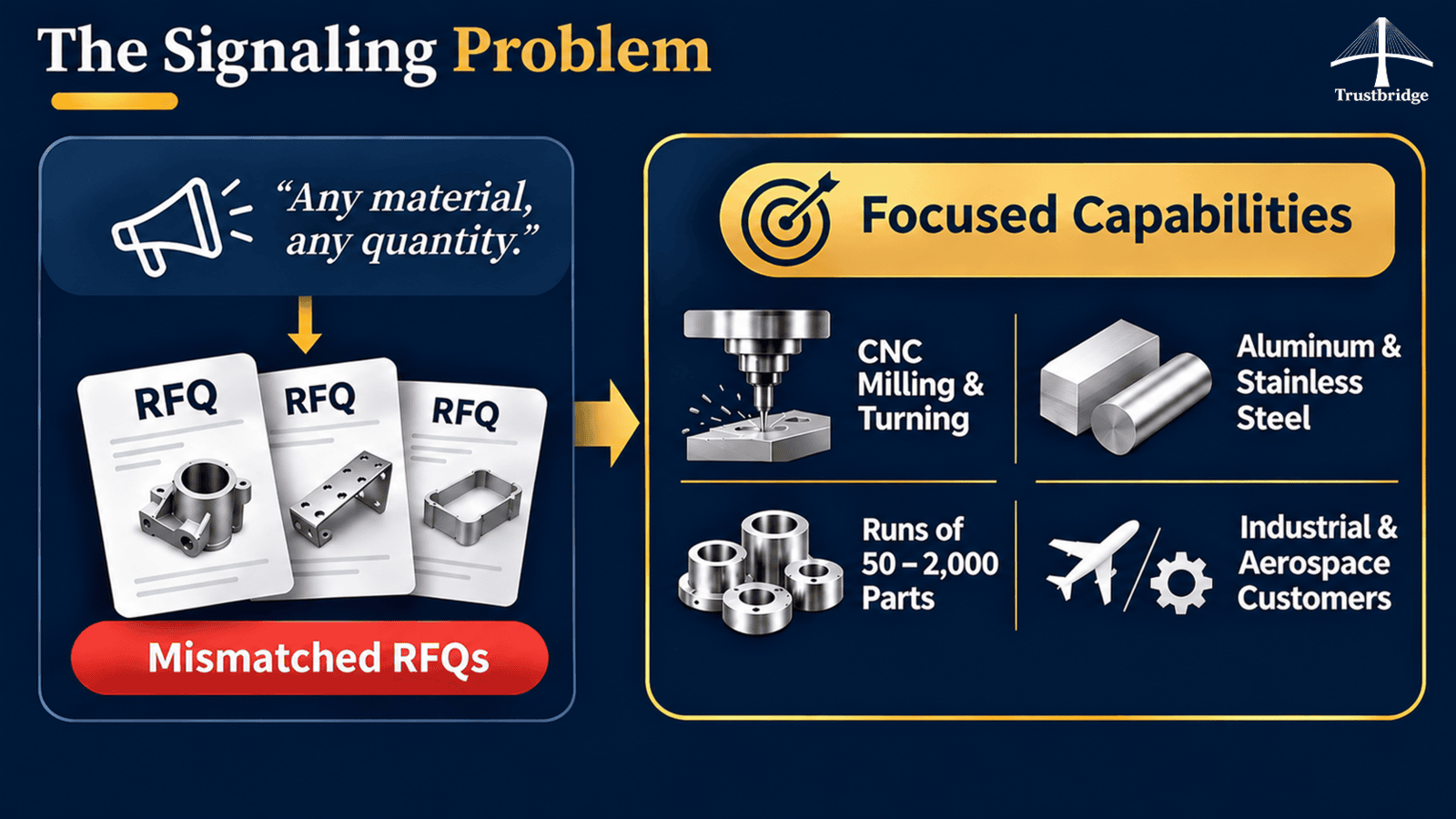
Her company is a precision machining shop with thirty people, CNC milling and turning, and a good reputation in industrial and aerospace work. Their sweet spot is runs of 50 to 2,000 parts in aluminum and stainless steel, for customers who value consistent quality more than rock-bottom prices.
The quarter had been frustrating. The estimators were busy all the time, yet the win rate was falling and the schedule still had gaps. One afternoon Sam said something that stuck with her. "I'm pretty good at turning down work that's not a fit for our shop, but it still feels like I spend an awful lot of time doing it."
That got Ruth thinking. How much time was "an awful lot of time?" So Ruth opened Sam's folder and started counting. These weren't quotes the shop had sent and lost. They were requests the shop had looked at and decided not to quote at all.
Fifty Requests, One Spreadsheet
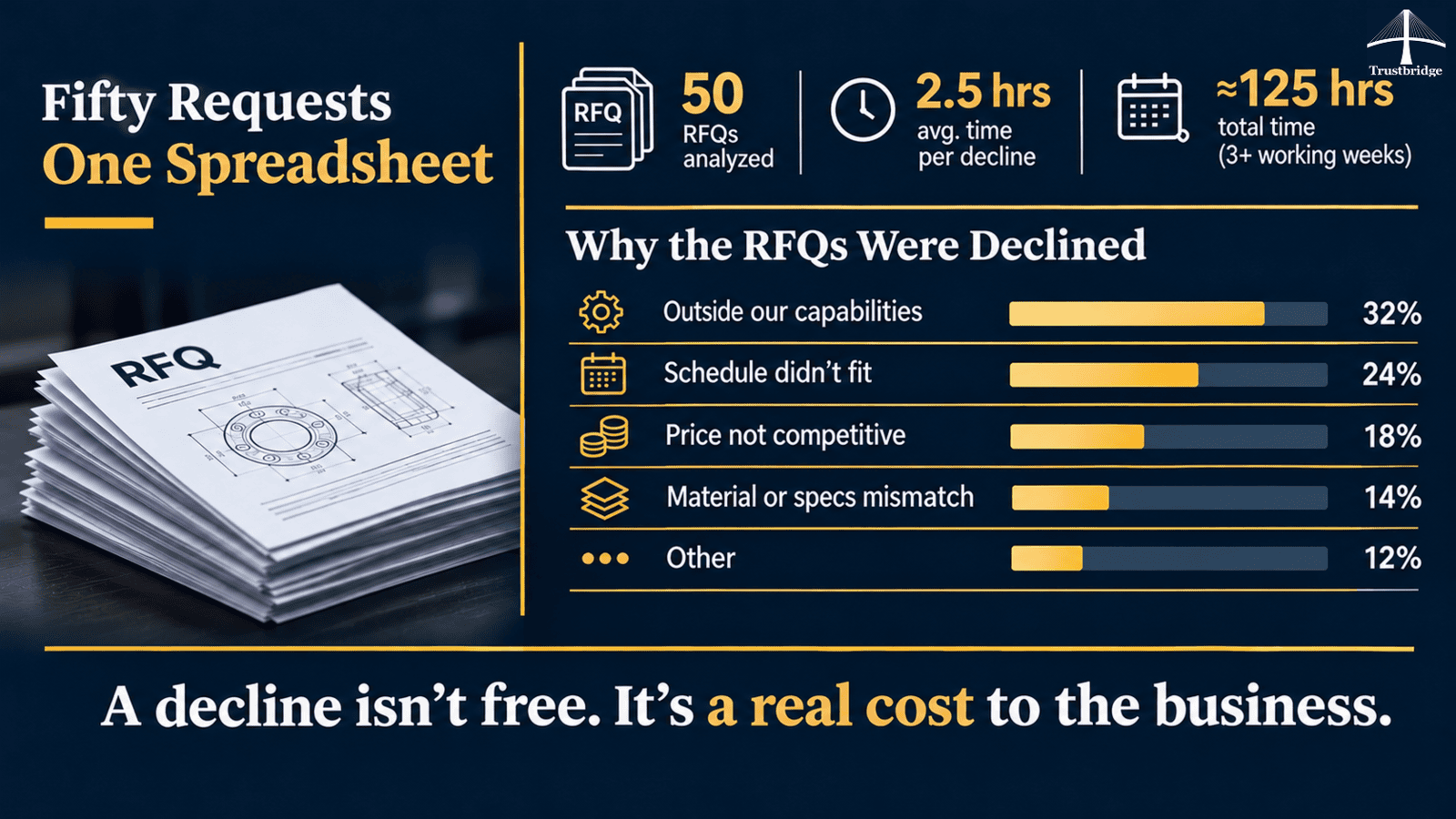
The folder held 50 RFQs from the past six months. Ruth and Sam spread them across the conference table over two afternoons, and built a simple spreadsheet. For each request they recorded who sent it, how it arrived, what it asked for, and the reason they had said no.
The first surprise was the time. Sam estimated that, on average, each declined RFQ had taken about two and a half hours before anyone said no. Someone had to read the drawings, check the material and the tolerances, look at the schedule and sometimes rough out a price before the problem became clear. Across 50 requests, that came to roughly 125 hours. That was more than three full working weeks of estimating, spent on work that never had a chance of becoming a job.
"I always thought of a decline as free," Ruth said. "It's not. We just never added it up."
The second surprise came when they sorted the reasons.
The Pattern
Once the reasons were sorted, the No Quote folder stopped looking random.
The clear mismatches were the smallest group, and the cheapest to deal with. A run of tens of thousands of parts, an alloy the shop didn't stock, a certification it didn't hold: Sam could spot those in minutes, and nobody lost sleep over turning them down. The price checks were nearly as quick to recognise. These came from buyers who never planned to switch suppliers, and wanted a quote to keep their current shop honest.
The real story was in the blue bars. Those requests used up the afternoons, because each one looked almost right.
Designed for another process. These parts wanted to be castings, molded plastic or formed sheet metal. They arrived at a machine shop because the drawing came from a CAD model and nobody had asked how the part would best be made. Machining them was possible. It would just never be competitive.
Not ready to quote. Some drawings had no released revision. Some models and drawings disagreed with each other. Others were missing materials, finishes or quantities. Sam would spend an hour chasing answers, only to learn that the design was still changing every week.
Over-specified for its function. One bracket that simply bolted to a frame carried a tolerance of ±0.0005". Other simple parts came with finishes and inspection requirements they didn't need. Quoted as drawn, the price was absurd. Quoting it any other way meant redesigning the customer's part for free.
Sam put down his pen. "Most of these aren't bad customers. They're good parts that reached us too early."
Where They Came From
The next question was the uncomfortable one. Why were these requests arriving at all?
Ruth added a column for how each RFQ had found the shop. The answer pointed straight back at her own company.
The website's headline promised precision machining in "any material, any quantity." Years ago, someone had decided that sounded more welcoming than listing what the shop actually did best. Online supplier directories listed the shop under casting, molding and sheet metal, because a former salesperson believed that more categories meant more leads. He was right. It just meant more of the wrong ones. The trade show banner read "Your One-Stop Manufacturing Partner."
In other words, the shop had been inviting exactly the work it kept turning down.
The requests from existing customers and their referrals told the opposite story. Almost none of them ended up in the No Quote folder. People who knew the shop sent it the right work. Strangers sent what the marketing told them to send.
"We thought we had a quoting problem," Ruth said. "We had a signaling problem."
What Ruth Changed
None of the fixes was expensive. Most took an afternoon.
The website now says what the shop does best, in plain numbers: CNC milling and turning, aluminum and stainless steel, runs of 50 to 2,000 parts, industrial and aerospace customers. It also says, just as plainly, what the shop doesn't do. The directory listings were cut back to the two categories that matched. The trade show banner was retired.
Six months later, the shop was receiving fewer RFQs. It was also winning more of them. Sam's week looked different, too. Most of his time now went to jobs the shop could actually win.
The No Quote folder still exists. But now, every quarter, Ruth and Sam spend an hour reviewing it with a few questions:
Why did we say no? Name the main reason for each request, not just "not a fit."
How did it find us? Track the source, whether that's the website, a directory, a show or a referral.
What did we tell them about ourselves? If one source keeps sending the wrong work, the message at that source is probably the problem.
How long did it take to say no? If the answer is hours, look for a way to spot the problem in minutes.
Who should have received it? If the same kind of request keeps arriving, find a shop to recommend for it.
The declined RFQs turned out to be the most honest feedback the shop had ever received about its own marketing.
Why We Tell This Story
Ruth is a composite, and her numbers are illustrative. In real life, most shops we talk to don't keep any record of the RFQs they decide not to quote. The reasons behind those decisions are some of the most useful information a shop has, and they're usually the first thing lost.
Trustbridge is a product design studio, and design for manufacturability is at the center of our work. We see Ruth's pattern from the design side, too. A part sent to the wrong process, or a design that hasn't yet met anyone who makes parts for a living, rarely starts at the right shop. Many of the requests in that folder were design questions that showed up looking like manufacturing requests.
That's why we bring manufacturers into our projects at a specific point: when a design is far enough along to be real, but early enough that feedback from the people who will make it can still shape it. And it's why fit matters to us. A shop that knows exactly what it does best gives the most useful feedback on the parts it's built to make.
We work with a group of manufacturing partners who know their sweet spot and say so. We're also building practical tools for the shops we work with, aimed at the everyday decisions that never make it onto a drawing.
If you run a shop and you know exactly what work belongs in your building, tell us about your shop.
And if you're designing a product headed for production, talk to us before the RFQs go out. The right shop is much easier to find when the design is ready for it.