
The Two Failures of Design for Manufacturability
Preamble
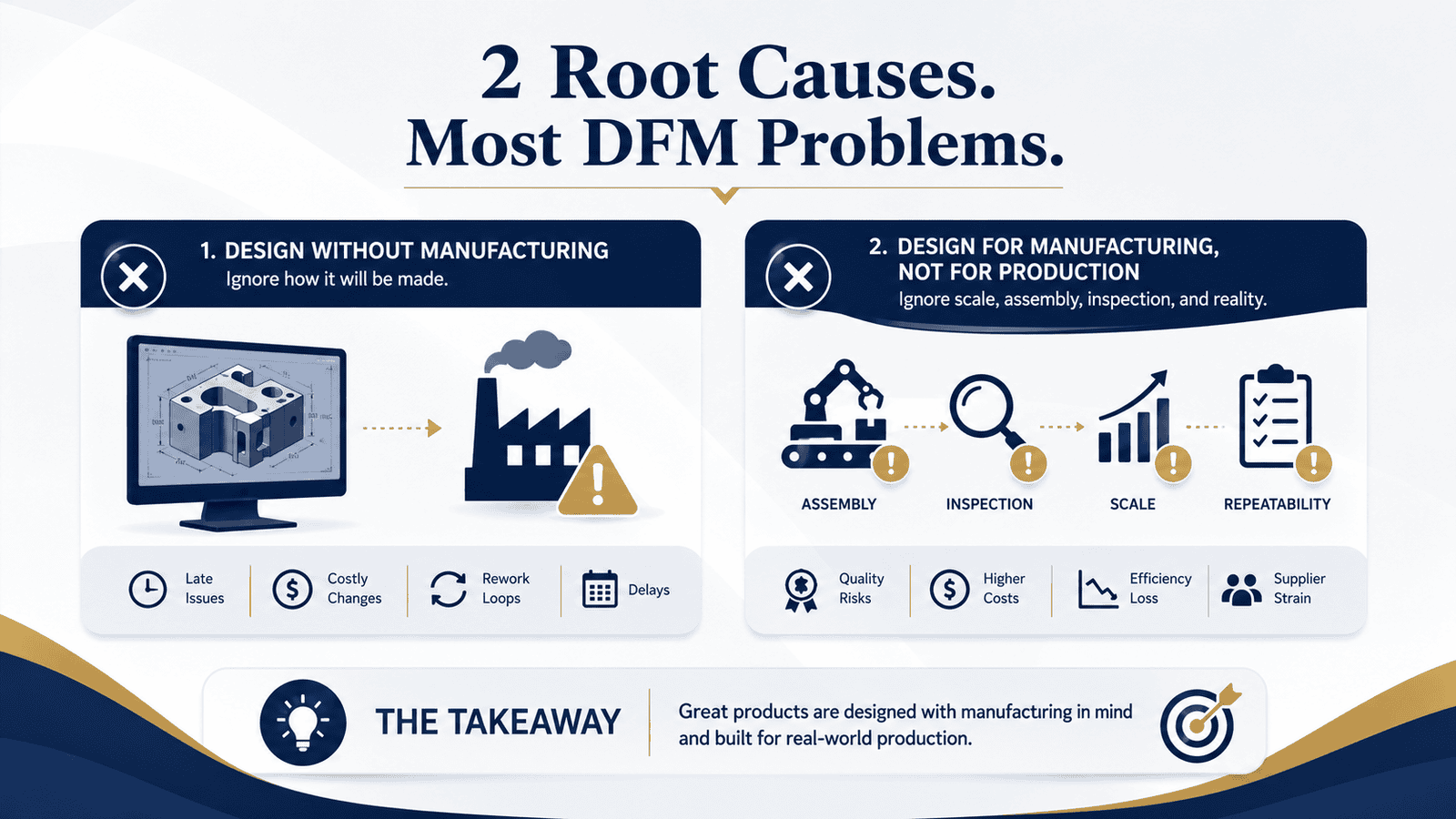
Most design for manufacturability problems do not originate from isolated engineering mistakes. They typically stem from two fundamental failures: designing products without considering how they will be manufactured, or designing for manufacturing without considering production scale, assembly efficiency, and operational realities. Both failures create manufacturing design errors, engineering-to-manufacturing handoff challenges, product development bottlenecks, and costly design revisions that delay commercialization. Understanding these two root causes helps product teams build stronger manufacturability assessment processes, improve supplier collaboration, and create products that transition into production more successfully.
Introduction
Design for Manufacturability (DFM) has become one of the most widely discussed concepts in modern product development. Most engineering teams understand that products should not only function correctly but also be practical to manufacture, inspect, assemble, and scale.
Despite this awareness, many organizations continue to experience production delays, unexpected tooling modifications, supplier feedback loops, quality issues, and cost overruns. These problems are often treated as isolated events—a difficult machining feature, an assembly issue, an injection molding defect, or a supplier capability gap.
In reality, most design for manufacturability problems can be traced back to two recurring failures that occur long before production begins.
The first failure occurs when teams design the product without designing the manufacturing process. The second failure occurs when teams design for manufacturing but fail to design for production realities such as assembly, scalability, inspection, and repeatability.
Understanding these two failures provides a framework for identifying risks earlier, improving cross-functional collaboration, and preventing expensive engineering changes later in development.
Why Design for Manufacturability Matters Earlier Than Most Teams Realize
Many organizations mistakenly treat manufacturability as a final validation step before production release. In reality, manufacturability decisions begin influencing project outcomes from the earliest stages of product development.
The geometry selected during concept design, the tolerances applied during detailed engineering, and the materials chosen during specification development all affect future manufacturing outcomes.
By the time suppliers identify a manufacturability problem, engineering teams may have already invested significant resources into CAD development, prototyping, sourcing activities, and validation testing.
This is why successful companies integrate manufacturability assessment throughout development rather than waiting until production preparation begins.
- Manufacturing Problems Often Start as Design Decisions
Many production challenges originate from design choices made months earlier.
Features that require difficult machining access, inconsistent wall thicknesses, excessive tolerances, or complex assembly operations are rarely manufacturing mistakes. They are design decisions whose consequences only become visible later.
The earlier these risks are identified, the easier they are to correct.
- Early DFM Reviews Reduce Development Risk
Early manufacturability reviews help teams evaluate whether product requirements align with manufacturing capability.
These reviews allow suppliers, manufacturing engineers, and production specialists to contribute feedback before major decisions become locked into the design. For example, identifying an undercut feature during an early design review may eliminate the need for complex side actions in an injection mold, preventing weeks of tooling modifications and thousands of dollars in avoidable costs.
Industry studies consistently show that engineering changes become exponentially more expensive as products move closer to production. By identifying manufacturability risks during design rather than after tooling release, organizations can reduce redesign effort, accelerate development timelines, and improve overall project efficiency.
Failure One: Designing the Product Without Designing the Manufacturing Process
The most common DFM failure occurs when teams focus heavily on product functionality, appearance, performance, and user requirements while giving little attention to how the design will actually be manufactured.
The product may perform perfectly in simulation. It may receive positive stakeholder feedback. It may even pass prototype testing successfully.
However, none of those achievements guarantee efficient production.
Manufacturing introduces constraints involving tooling, machine accessibility, process capability, cycle time, inspection requirements, and supplier limitations that often remain invisible during design.
- When CAD Perfection Creates Manufacturing Design Errors
Modern CAD software gives engineers extraordinary design freedom.
Complex geometries, organic surfaces, intricate internal features, and highly customized components can be modeled quickly and accurately.
The problem is that CAD software does not automatically evaluate manufacturability.
A feature that appears simple on-screen may require custom cutting tools, multiple machining setups, side actions in molding tools, or expensive secondary operations.
These manufacturing design errors often remain hidden until suppliers begin reviewing the design for production.
- The Cost of Ignoring Manufacturing Constraints
When manufacturing realities are overlooked, the consequences extend far beyond production.
Immediate operational consequences often include increased machining time, complex tooling requirements, longer production cycles, higher scrap rates, and increased quality control effort.
The strategic consequences can be even more significant. Organizations frequently encounter elevated production costs, delayed product launches, reduced profit margins, and supplier relationships strained by reactive redesign cycles. These issues can slow commercialization and create unnecessary pressure across development teams.
Because these problems are discovered late, they frequently trigger costly design revisions that consume engineering resources and extend development timelines.
- Why Prototypes Can Be Misleading
Prototype success often creates a false sense of manufacturing readiness.
A CNC-machined prototype may validate performance while hiding challenges associated with injection molding.
A 3D-printed component may prove functionality without revealing assembly difficulties or production scalability issues.
Prototypes answer important design questions, but they do not always answer manufacturability questions.
Successful DFM requires evaluating how a design behaves during production—not just during prototyping.
Failure Two: Designing for Manufacturing Without Designing for Production
The second DFM failure is more subtle and often more difficult to recognize.
Some teams focus so heavily on whether a part can be manufactured that they overlook how the product will behave within a complete production environment.
Manufacturing and production are not identical concepts. Manufacturing focuses on whether a part can be produced successfully, while production focuses on whether that part can be assembled, inspected, scaled, shipped, and repeatedly manufactured efficiently. A design may be technically manufacturable yet still create bottlenecks that increase labor requirements, reduce throughput, or complicate quality control.
True manufacturability extends beyond making a single component successfully. It includes producing that component consistently, repeatedly, and economically over time.
- The Engineering-to-Manufacturing Handoff Problem
One of the most common examples of this failure occurs during the engineering-to-manufacturing handoff.
Engineering teams may deliver technically manufacturable designs, but production teams encounter difficulties achieving repeatability, throughput targets, or quality objectives.
The design itself is not necessarily defective.
Instead, manufacturing requirements were considered without evaluating broader production system requirements.
This creates product development bottlenecks that slow commercialization and increase operational complexity.
- Assembly Is Often the Missing Variable
Many products fail not because parts cannot be manufactured, but because they cannot be assembled efficiently.
Assembly challenges frequently include misaligned fastening locations, poor cable routing paths, limited tool access, insufficient assembly clearance, difficult fixture requirements, and excessive manual labor steps.
While each issue may seem minor independently, together they can dramatically reduce production efficiency and increase manufacturing cost.
- Scaling Reveals Hidden Weaknesses
A product that performs well during prototype production may struggle at higher volumes.
As production scales, small process variations become magnified.
Material variation, tooling wear, operator differences, supplier capability limits, and assembly inconsistencies all begin influencing product performance.
Designs that have not been evaluated for production scalability often encounter unexpected challenges during growth.
To prevent these issues, teams should evaluate scalability during DFM reviews by considering anticipated production volumes, process capability studies, automation opportunities, fixture strategies, and supplier capacity constraints. Planning for scale early significantly reduces the likelihood of costly surprises when demand increases.
How the Two Failures Create Product Development Bottlenecks
Although these failures originate differently, they often reinforce one another throughout development.
A design that ignores manufacturing constraints creates downstream process problems. A design that ignores production realities creates scaling and operational problems.
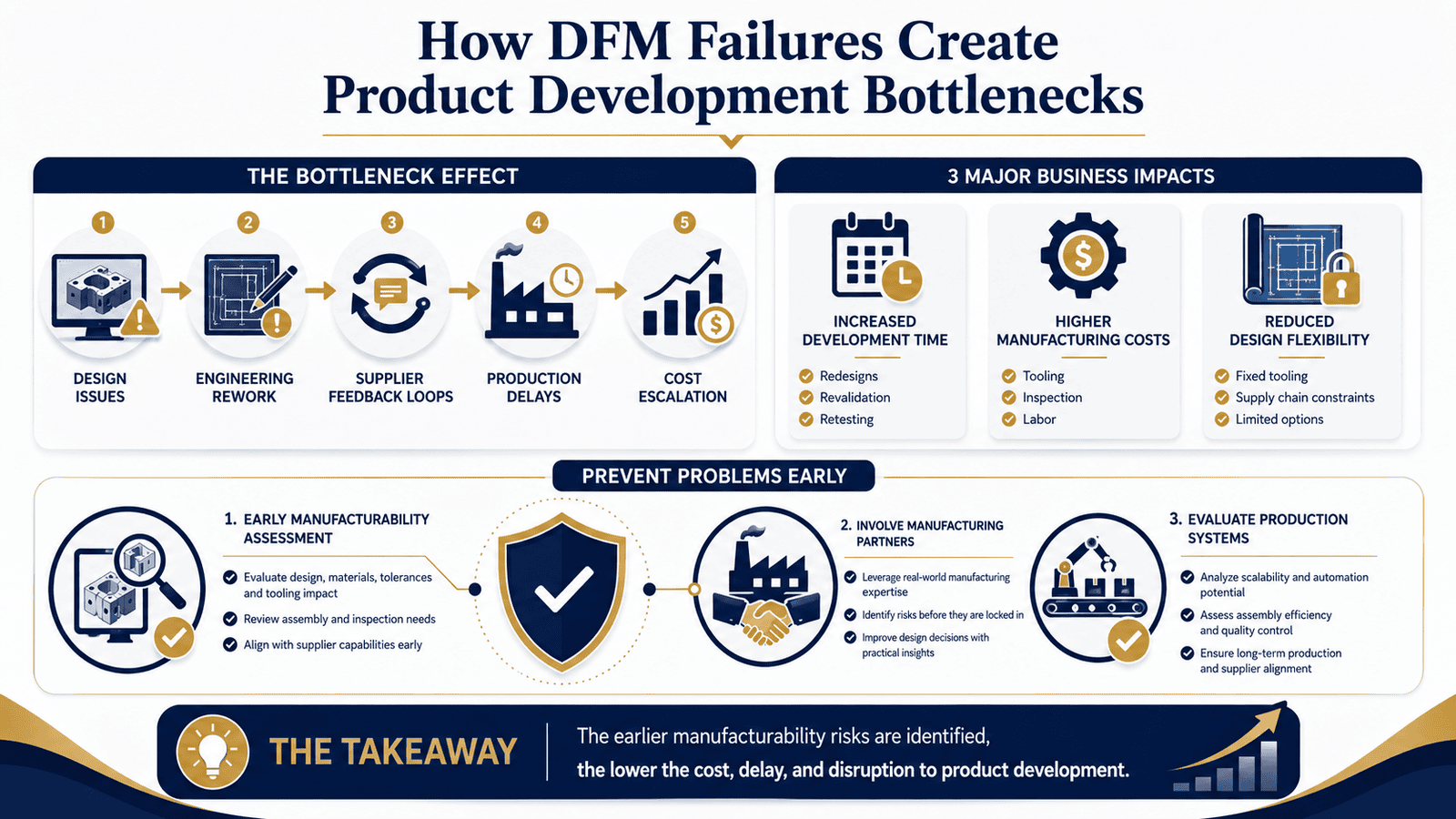
Together, these failures generate recurring product development bottlenecks that impact engineering teams, suppliers, manufacturing operations, and business objectives.
The longer these issues remain unresolved, the more expensive they become.
These bottlenecks rarely appear all at once. Instead, they accumulate gradually throughout development, increasing costs, extending timelines, and reducing flexibility. Understanding how these failures affect different stages of the product lifecycle helps organizations prioritize preventative action.
- Increased Development Time
Every redesign introduces additional engineering effort.
Drawings must be updated. Prototypes must be rebuilt. Validation tests must be repeated. Suppliers must re-evaluate manufacturing approaches.
What should have been a straightforward product launch becomes an extended development cycle.
- Higher Manufacturing Costs
Manufacturing inefficiencies rarely exist in isolation.
A difficult-to-machine feature may increase tooling costs, cycle time, inspection effort, assembly labor, and quality control requirements simultaneously.
The cumulative financial impact can significantly affect profitability.
- Reduced Design Flexibility
Late-stage engineering changes limit available options.
Once tooling investments have been made and supply chains established, design flexibility decreases dramatically.
This makes reactive problem-solving more expensive and more disruptive than proactive DFM planning.
Preventing Design for Manufacturability Problems
The most effective DFM strategies focus on prevention rather than correction.
Organizations that consistently launch successful products build manufacturability thinking directly into their development process.
Rather than treating DFM as a final review, they integrate manufacturing expertise into decision-making from the beginning.
This proactive approach reduces uncertainty and improves development outcomes.
- Conduct Manufacturability Assessments Early
A comprehensive manufacturability assessment should occur before production release and ideally before design architecture becomes fixed. Rather than focusing on individual components alone, reviews should evaluate how design decisions influence tooling complexity, production efficiency, quality consistency, assembly requirements, and long-term scalability.
Reviews should evaluate geometry complexity, material suitability, tolerance strategy, tooling implications, assembly requirements, and supplier capability alignment.
Early feedback is significantly less expensive than late-stage redesign.
- Include Manufacturing Partners During Development
Manufacturing partners provide practical knowledge that cannot be replicated through CAD software alone.
Their experience helps identify manufacturing design errors before they become embedded in product architecture.
Early collaboration improves design quality while reducing project uncertainty.
- Evaluate Production Systems, Not Just Individual Parts
Every component exists within a larger production ecosystem.
Effective DFM reviews should evaluate production scalability, assembly efficiency, inspection processes, supplier capabilities, automation opportunities, and long-term quality control requirements.
This broader perspective helps eliminate both categories of DFM failure.
The Real Goal of Design for Manufacturability
DFM is often viewed as a cost reduction tool, but its real purpose is reducing uncertainty across the product lifecycle.
Effective DFM aligns design intent with manufacturing capability, supplier performance, and production requirements, improving predictability in quality, delivery, and cost.
- Better Alignment Creates Better Products
When design and manufacturing teams work together early, products move through development with fewer surprises.
Engineering decisions become more informed, supplier engagement becomes more productive, and manufacturing outcomes become more reliable.
- DFM Is Ultimately a Risk Management Strategy
At its core, DFM is about eliminating avoidable risk.
The earlier risks are identified, the less expensive they become to address.
Organizations that embrace DFM as a strategic discipline consistently outperform those that treat manufacturability as a final checkpoint.
Conclusion
Most design for manufacturability problems originate from one of two fundamental failures.
The first occurs when products are designed without considering how they will be manufactured. The second occurs when parts are designed for manufacturing but not for production realities such as assembly, scalability, inspection, and repeatability.
Together, these failures create manufacturing design errors, engineering-to-manufacturing handoff issues, product development bottlenecks, and costly design revisions that delay commercialization and increase risk.
Organizations that perform manufacturability assessments early, collaborate closely with suppliers, and evaluate complete production systems—not just individual parts—are significantly more likely to achieve successful manufacturing outcomes. These practices help eliminate risk before it becomes embedded in tooling, production processes, or supply chain decisions.
Effective DFM is not about fixing production problems after they appear.
It is about preventing them before they ever occur.
Many manufacturability issues are discovered only after prototypes have been approved, suppliers have been selected, or tooling investments have already been committed. At that stage, even small engineering changes can result in significant cost increases, schedule delays, and operational disruption.
Organizations that consistently achieve successful product launches integrate manufacturability assessment, supplier collaboration, and production planning early in development. Evaluating manufacturing constraints, assembly requirements, and scalability before production begins helps reduce risk and improve long-term outcomes.
Whether you are preparing for supplier engagement, validating a new product architecture, or reviewing a challenging engineering-to-manufacturing handoff, a structured DFM process can help uncover hidden risks before they become expensive production problems.
Ready to move from design confidence to manufacturing confidence? Build manufacturability into your development process before production begins.
This version incorporates all substantive senior comments while preserving the original structure and heading hierarchy.
Frequently Asked Questions
1. What are the two main failures in Design for Manufacturability (DFM)?
The two fundamental DFM failures are:
Designing products without considering how they will be manufactured.
Designing for manufacturing without considering full production realities like assembly, scalability, inspection, and repeatability.
Both failures lead to manufacturing design errors, engineering-to-manufacturing handoff issues, and costly production delays.
2. Why do most manufacturability problems only appear late in development?
Most manufacturability issues appear late because early design stages focus on function, performance, and appearance rather than production feasibility. Problems like tooling complexity, assembly difficulty, or tolerance issues often surface only during supplier review, prototyping, or tooling preparation.
3. How does ignoring manufacturing constraints during design create production issues?
When manufacturing constraints are ignored, designs may include complex geometries, tight tolerances, or difficult machining features that increase tooling cost, cycle time, scrap rates, and inspection effort. These design decisions later translate into higher production costs and delayed product launches.
4. Why is designing for manufacturing not enough without considering production scale?
Even if a part is manufacturable, it may still fail in real production environments due to poor assembly efficiency, limited scalability, or inspection bottlenecks. True DFM must account for full production systems—including assembly, repeatability, supplier capability, and long-term scalability—not just individual part manufacturability.