
The Tradeoffs of Manufacturing Growth: Four Common Ways Suppliers Find New Customers
Preamble
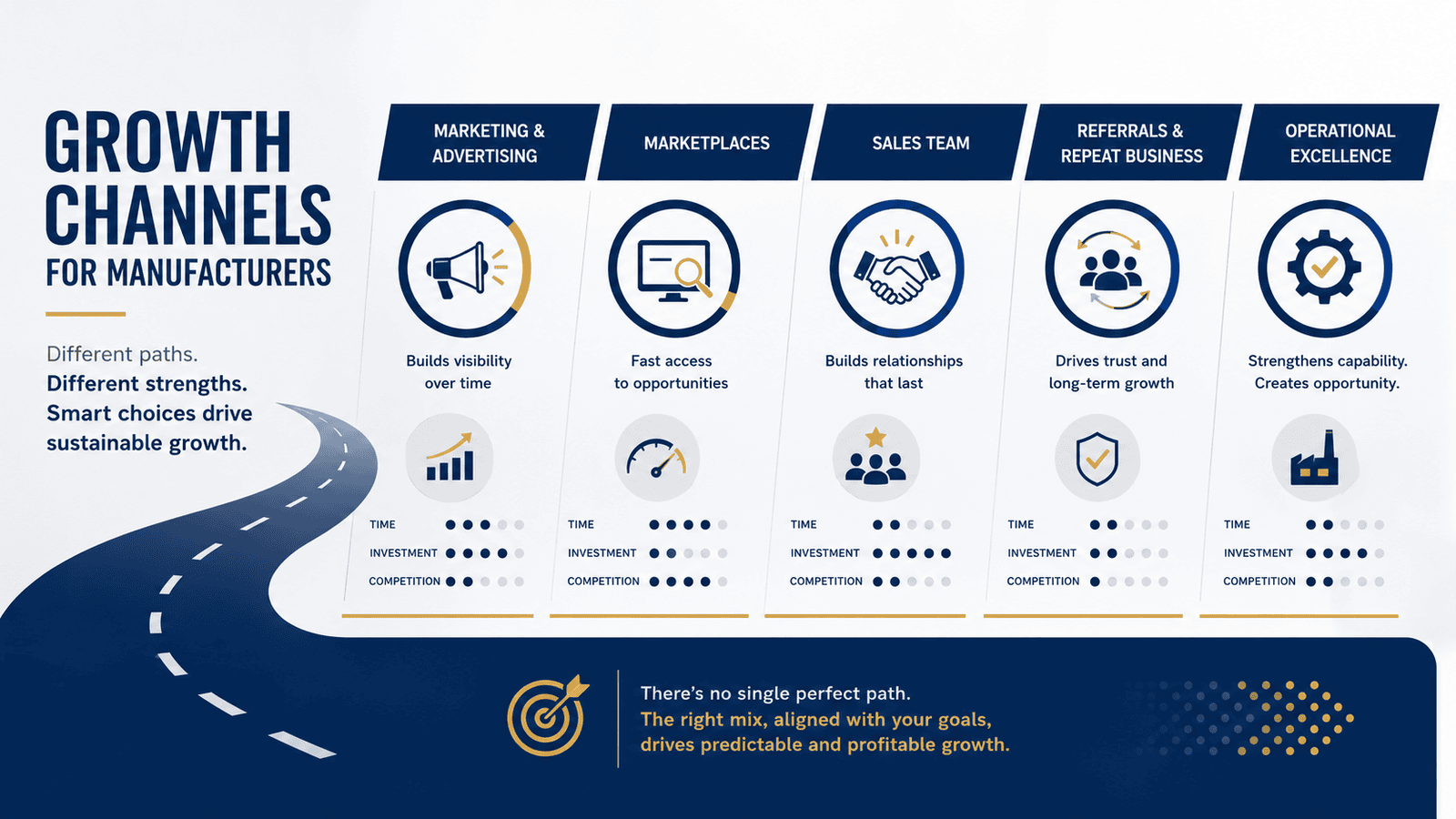
Every manufacturer wants a reliable pipeline of qualified customers, but the pathways available to achieve that goal often involve tradeoffs. Some suppliers invest heavily in marketing and advertising to build visibility. Others use manufacturing marketplaces to access opportunities quickly. Many rely on sales teams to develop relationships, while others grow primarily through referrals and repeat business.
Introduction
Every manufacturing supplier faces the same challenge: finding a consistent flow of qualified customers. Whether the business specializes in CNC machining, sheet metal fabrication, injection molding, contract manufacturing, or precision components, long-term growth depends on connecting with buyers who have genuine sourcing needs.
Despite the growing number of customer acquisition channels available today, many suppliers still struggle with one fundamental question: how manufacturers find new customers. The challenge is not a lack of available options. Rather, each growth strategy comes with its own costs, requirements, and tradeoffs.
Some approaches require significant upfront investment. Others provide access to work more quickly but may introduce additional competition. Some prioritize long-term relationship building, while others focus on maintaining machine utilization and production volume.
Understanding these tradeoffs is critical for suppliers seeking sustainable business development and more effective manufacturing lead generation. The suppliers that achieve long-term success are often those that understand not only how each growth channel works, but also when each channel aligns with their operational capabilities and business goals.
Every manufacturer wants a reliable pipeline of qualified customers, but the pathways available to achieve that goal often involve tradeoffs. Some suppliers invest heavily in marketing and advertising to build visibility. Others use manufacturing marketplaces to access opportunities quickly. Many rely on sales teams to develop relationships, while others grow primarily through referrals and repeat business.
Growth Path #1: Advertising and Marketing
One of the most common ways manufacturers pursue growth is through marketing and advertising. This can include search engine optimization, content marketing, paid advertising, trade show participation, email campaigns, and website development.
For many suppliers, marketing serves as a way to increase visibility among buyers who may not otherwise discover their capabilities. In increasingly competitive markets, visibility can become a significant advantage, particularly for suppliers with specialized expertise or unique manufacturing capabilities.
- Why Suppliers Invest in Visibility
Marketing can help manufacturers showcase their expertise, highlight certifications, communicate technical capabilities, and position themselves in front of prospective customers.
Over time, strong marketing efforts can create brand awareness and generate inbound opportunities from buyers actively searching for suppliers. Effective marketing also allows manufacturers to educate potential customers about their capabilities before direct sales conversations begin, helping build credibility and trust early in the buyer journey.
- The Investment Required to Build Awareness
The primary tradeoff is that marketing often requires significant investment before measurable results appear.
Manufacturing buying cycles tend to be long and involve engineering reviews, procurement approvals, and supplier qualification processes. As a result, suppliers may invest substantial time and resources before new business opportunities materialize.
For organizations with patience and long-term growth objectives, marketing can be highly valuable. However, it typically requires ongoing commitment rather than producing immediate results. Companies that expect quick returns often become frustrated, while those that maintain consistency are more likely to benefit from compounding visibility and brand recognition over time.
Growth Path #2: Manufacturing Marketplaces and Aggregator Services
Another increasingly common option involves participating in manufacturing marketplaces, sourcing platforms, and aggregator services that connect suppliers with buyers.
These platforms can provide access to projects that suppliers may not have found independently. For manufacturers looking to expand beyond their existing network, marketplaces can offer a convenient way to discover opportunities without building a large internal business development function.
- Access to Opportunities Without Heavy Sales Effort
One of the biggest advantages of marketplaces is their ability to introduce suppliers to available work without requiring extensive prospecting activities.
For suppliers seeking to maintain machine utilization or fill open production capacity, these platforms can create valuable opportunities. They can also help smaller manufacturers gain exposure to buyers that may otherwise be difficult to reach through traditional sales efforts.
- The Tradeoff Between Volume and Margin
While marketplaces can provide access to work, suppliers often find themselves competing alongside multiple manufacturers for similar opportunities.
In some cases, this can create pricing pressure and make it more difficult for suppliers to differentiate themselves based on engineering expertise, quality systems, or customer service. As competition increases, buyers may focus heavily on cost comparisons, making it harder for suppliers to communicate value beyond price.
- Customer Ownership Considerations
Another consideration is the relationship between suppliers and end customers.
Depending on the platform model, suppliers may have limited direct interaction with buyers. For example, some platforms simply introduce buyers and suppliers, allowing both parties to build a direct relationship. Other models may act as intermediaries, managing communication, project coordination, or customer interactions throughout the engagement.
For some manufacturers, this is an acceptable tradeoff in exchange for opportunity volume. For others, direct customer relationships remain a critical component of their long-term growth strategy because they support repeat business, customer loyalty, and deeper collaboration over time.
Growth Path #3: Sales Teams and Sales Representatives
Sales professionals continue to play a central role in manufacturing business development.
Whether suppliers build internal sales teams or partner with independent representatives, relationship-driven selling remains an important growth channel across many manufacturing sectors. Complex manufacturing purchases often involve technical discussions, supplier evaluations, and long decision cycles, making human relationships especially valuable.
- The Value of Internal Sales Teams
An in-house sales team focuses exclusively on representing a single company and its capabilities.
Because these individuals work closely with engineering, operations, and leadership teams, they often develop a deep understanding of customer needs and company strengths. This can help create stronger relationships and more tailored business development efforts.
The tradeoff, of course, is cost. Recruiting, training, and supporting a dedicated sales organization requires ongoing investment. However, for suppliers pursuing strategic growth, internal teams can provide greater control over messaging, customer experience, and long-term account development.
- The Role of Independent Sales Representatives
Independent sales representatives offer a different model.
Rather than hiring full-time employees, suppliers can leverage existing networks and industry relationships developed by experienced representatives.
This approach can reduce upfront investment, but independent representatives often work with multiple suppliers simultaneously. Success depends heavily on the quality of the relationship and the representative's ability to effectively position the supplier's capabilities. Manufacturers must also ensure that expectations, communication processes, and target markets are clearly aligned.
Growth Path #4: Referrals and Existing Relationships
When manufacturers discuss their most valuable customers, referrals are often part of the conversation.
Referrals bring a level of trust and credibility that many other customer acquisition channels struggle to replicate. Because the introduction comes from a trusted source, both parties often begin the relationship with greater confidence.
- Why Referrals Are So Effective
Referred customers often enter the relationship with greater confidence because they have already received positive feedback from a trusted source.
This trust can shorten qualification cycles, improve communication, and create stronger long-term business relationships. Referrals can also reduce the amount of time suppliers spend proving their credibility, allowing conversations to focus more quickly on technical requirements and project fit.
- The Challenge of Scaling Referral Growth
The limitation of referral-based growth is predictability.
While referrals can generate exceptional opportunities, they are difficult to scale consistently. Suppliers rarely have complete control over when referrals occur or how frequently they enter the sales pipeline.
For this reason, many manufacturers view referrals as an important growth channel, but not necessarily the only channel they rely upon. Successful companies often complement referral-driven growth with other strategies that provide greater consistency and visibility.
Why Supplier Growth Is Ultimately About Tradeoffs
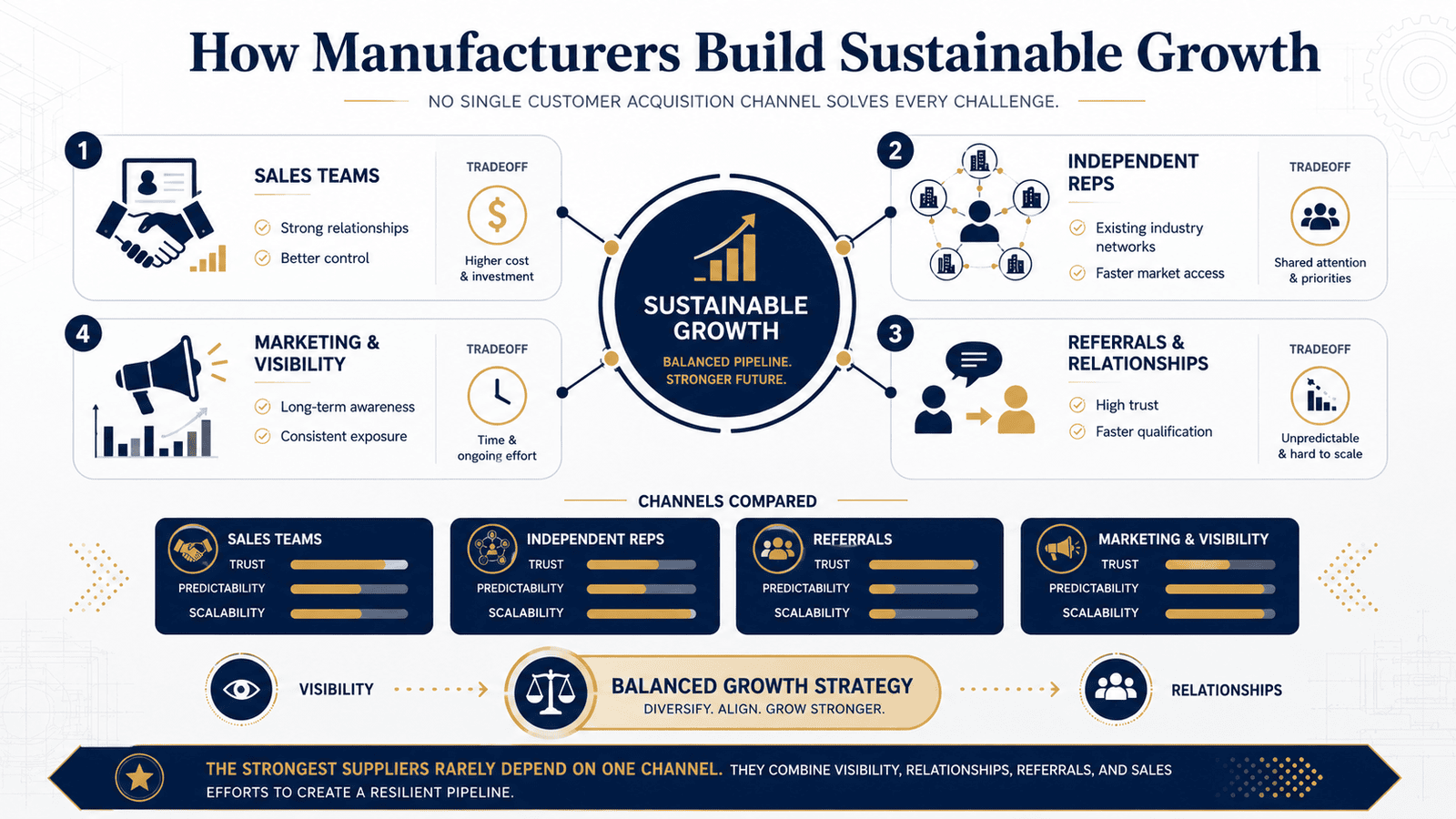
One of the realities of manufacturing business development is that no single customer acquisition strategy solves every challenge.
Marketing creates visibility but requires investment. Marketplaces can provide access to opportunities but may introduce competitive pressures. Sales teams build relationships but require resources. Referrals generate trust but are difficult to predict.
As a result, many successful suppliers use a combination of growth channels rather than relying exclusively on one approach. Diversification helps create a more balanced pipeline and reduces dependence on any single source of opportunities.
The right mix often depends on factors such as production capacity, target markets, technical specialization, sales resources, and long-term business objectives. What works for a high-volume contract manufacturer may be very different from what works for a specialized precision machining supplier.
What Manufacturers Should Consider When Evaluating Growth Channels
Choosing a growth strategy is not simply about finding the fastest way to generate leads. It is about identifying the channels that align most effectively with the supplier's capabilities, resources, and long-term objectives.
Many manufacturers evaluate growth channels based solely on opportunity volume. While volume is important, it should also be balanced against customer quality, relationship potential, profitability, and operational fit. A growth channel that generates numerous opportunities may not be beneficial if those opportunities do not align with the supplier's strengths.
- What Type of Customers Are You Trying to Reach?
Different channels attract different buyer segments. Understanding the ideal customer profile helps determine which acquisition strategies are most appropriate.
Suppliers serving highly regulated industries may benefit from different growth channels than suppliers focused on general industrial manufacturing. Identifying the right audience helps ensure that supplier business development efforts remain focused and efficient.
- How Quickly Do You Need New Opportunities?
Some growth channels require patience, while others can generate opportunities more quickly. Suppliers should align their strategy with current business needs and capacity requirements.
A company experiencing excess capacity may prioritize channels that provide faster access to work, while a company focused on strategic expansion may invest in long-term brand development and relationship building.
- How Important Are Direct Customer Relationships?
For some suppliers, owning the customer relationship is essential. Others may prioritize throughput and production utilization over direct engagement.
Understanding this preference can significantly influence channel selection. Direct relationships often create opportunities for repeat business, engineering collaboration, and long-term account growth, while indirect channels may prioritize efficiency and volume.
Conclusion
The challenge of how manufacturers find new customers is not a question of choosing between good and bad options. Rather, it is a matter of understanding the tradeoffs associated with each growth strategy.
Advertising and marketing can create long-term visibility. Manufacturing marketplaces can provide access to opportunities. Sales professionals help build relationships and uncover new business. Referrals generate trust and often lead to strong customer partnerships.
Each approach offers meaningful advantages, and each introduces its own limitations. The most effective growth strategies are rarely built around a single channel. Instead, they combine multiple approaches to create a balanced and resilient customer acquisition system.
As the manufacturing industry continues to evolve, suppliers are increasingly looking for ways to combine the strengths of these channels while minimizing their inherent tradeoffs. New approaches are beginning to emerge that may help quality-focused manufacturers build stronger connections with buyers while preserving the value of trust, service, technical expertise, and long-term relationships.
Manufacturing growth rarely comes from a single source. The most successful suppliers understand the strengths and limitations of every customer acquisition channel and build strategies that align with their capabilities, goals, and market position.
By evaluating growth opportunities through the lens of long-term fit rather than short-term volume alone, manufacturers can create more resilient pipelines, stronger customer relationships, and more sustainable business development outcomes.
Organizations that take a thoughtful approach to customer acquisition are better positioned to adapt to changing market conditions, maintain production stability, and achieve sustainable growth over time.
Today, newer manufacturing-focused platforms are emerging that aim to combine the advantages of traditional growth channels while reducing some of their limitations. These solutions seek to help qualified suppliers connect with serious buyers, improve opportunity quality, and build stronger long-term business relationships without relying exclusively on advertising, sales outreach, or referrals alone.
The goal is not simply to find more customers—it is to build a repeatable system for attracting the right customers, creating lasting partnerships, and supporting sustainable manufacturing growth.
Frequently Asked Questions
1. How do manufacturers find new customers in today’s competitive market?
Manufacturers typically acquire new customers through four primary channels: marketing and advertising, manufacturing marketplaces, sales teams or representatives, and referrals from existing relationships. Each approach offers different advantages in terms of visibility, lead quality,
relationship building, and manufacturing lead generation.
2. Are manufacturing marketplaces a good way for suppliers to grow?
Manufacturing marketplaces can help suppliers access new opportunities quickly without building a large internal sales team. However, they often involve increased competition and pricing pressure. The best results typically come when suppliers use marketplaces as part of a broader growth strategy rather than relying on them exclusively.
3. Why do many manufacturers still invest in sales teams and referrals?
Sales teams and referrals help build trust, strengthen customer relationships, and support long-term account growth. While marketing and marketplaces can generate opportunities, relationship-driven channels often create higher-quality business opportunities and increase the likelihood of repeat work and long-term partnerships.
4. What is the most effective manufacturing lead generation strategy?
There is no single best approach for every supplier. The most successful manufacturers typically combine multiple growth channels—including marketing, sales, marketplaces, and referrals—to create a balanced customer acquisition system. The right mix depends on factors such as production capacity, target industries, technical capabilities, and long-term business goals.