6061 vs 7075 Aluminum for Product Development: The Tradeoffs No One Explains Until You Have Made the Wrong Call
Choosing between 6061 vs 7075 aluminum is one of the most important material decisions in product development. While both alloys are widely used across industries, they serve different engineering priorities. Selecting the wrong material can lead to unnecessary manufacturing costs, excessive machining time, premature part failure, or over-engineered designs that exceed project requirements. Understanding the differences between 6061 aluminum and 7075 aluminum allows engineering teams to balance strength, machinability, corrosion resistance, weight, and cost before production begins. This guide explores the practical tradeoffs that influence engineering material selection and helps designers choose the right alloy for successful product development.
Introduction
Material selection is rarely as simple as choosing the strongest available option. In real-world product development, engineers must balance structural performance, manufacturing cost, machinability, lead times, and long-term durability.
Few material decisions illustrate this challenge better than choosing between 6061 vs 7075 aluminum. Both alloys are common CNC machining materials, both offer excellent strength-to-weight ratios, and both appear capable of producing high-performance components. Yet their differences become significant once a design enters manufacturing.
Selecting the wrong alloy can increase machining costs, complicate finishing processes, shorten tool life, or create unnecessary production expenses without delivering meaningful performance improvements. On the other hand, choosing the appropriate alloy early simplifies manufacturing and supports better engineering outcomes.
Understanding these tradeoffs helps product teams make informed engineering material selection decisions that improve performance while keeping projects commercially viable.
Why Material Selection Matters Early in Product Development
The material selected during the design phase influences nearly every downstream manufacturing decision. It affects machining strategies, tooling requirements, finishing options, inspection methods, assembly processes, and overall production costs.
Rather than viewing materials purely through the lens of strength, successful engineering teams evaluate them based on the entire product lifecycle. This broader perspective ensures that material properties align with functional requirements instead of simply exceeding them.
H3: Material Decisions Shape Manufacturing Success
Choosing the right alloy reduces unnecessary complexity throughout production. Better material selection leads to predictable machining behavior, improved dimensional stability, and more efficient manufacturing workflows.
When designers evaluate materials early, they minimize redesigns, reduce supplier challenges, and improve confidence before production begins.
Performance Must Match Application Requirements
Not every component requires maximum mechanical strength. Some products prioritize corrosion resistance, weldability, or cost efficiency over ultimate tensile strength.
Selecting materials according to actual operating conditions creates more balanced engineering solutions.
Understanding 6061 Aluminum
6061 aluminum remains one of the most versatile engineering alloys available. It combines good mechanical properties with excellent corrosion resistance, weldability, and machinability, making it suitable for countless commercial and industrial applications.
Its balanced performance explains why it is often the default choice during early product development.
H3: Strength with Excellent Manufacturability
6061 aluminum provides sufficient strength for many structural applications while remaining relatively easy to machine.
Its stable machining behavior produces consistent surface finishes, predictable tool wear, and shorter machining times compared to many higher-strength alloys.
H3: Corrosion Resistance Supports Long-Term Reliability
One of the biggest advantages of 6061 aluminum is its natural resistance to corrosion.
Products used outdoors, marine environments, industrial equipment, and consumer products benefit from this durability without requiring extensive protective treatments.
Understanding 7075 Aluminum
7075 aluminum was developed for demanding structural applications where maximum strength is essential. Often associated with aerospace aluminum, it delivers significantly higher mechanical performance than many conventional aluminum alloys.
However, these performance gains come with important manufacturing tradeoffs.
Exceptional Strength for High-Load Applications
7075 aluminum offers outstanding tensile strength and fatigue resistance.
This makes it suitable for aerospace components, defense equipment, motorsports, high-performance robotics, and precision mechanical systems where weight reduction and structural integrity are critical.
Increased Manufacturing Complexity
Higher strength also means greater machining forces.
Cutting tools experience more wear, machining parameters become more demanding, and manufacturing costs generally increase compared to 6061 aluminum.
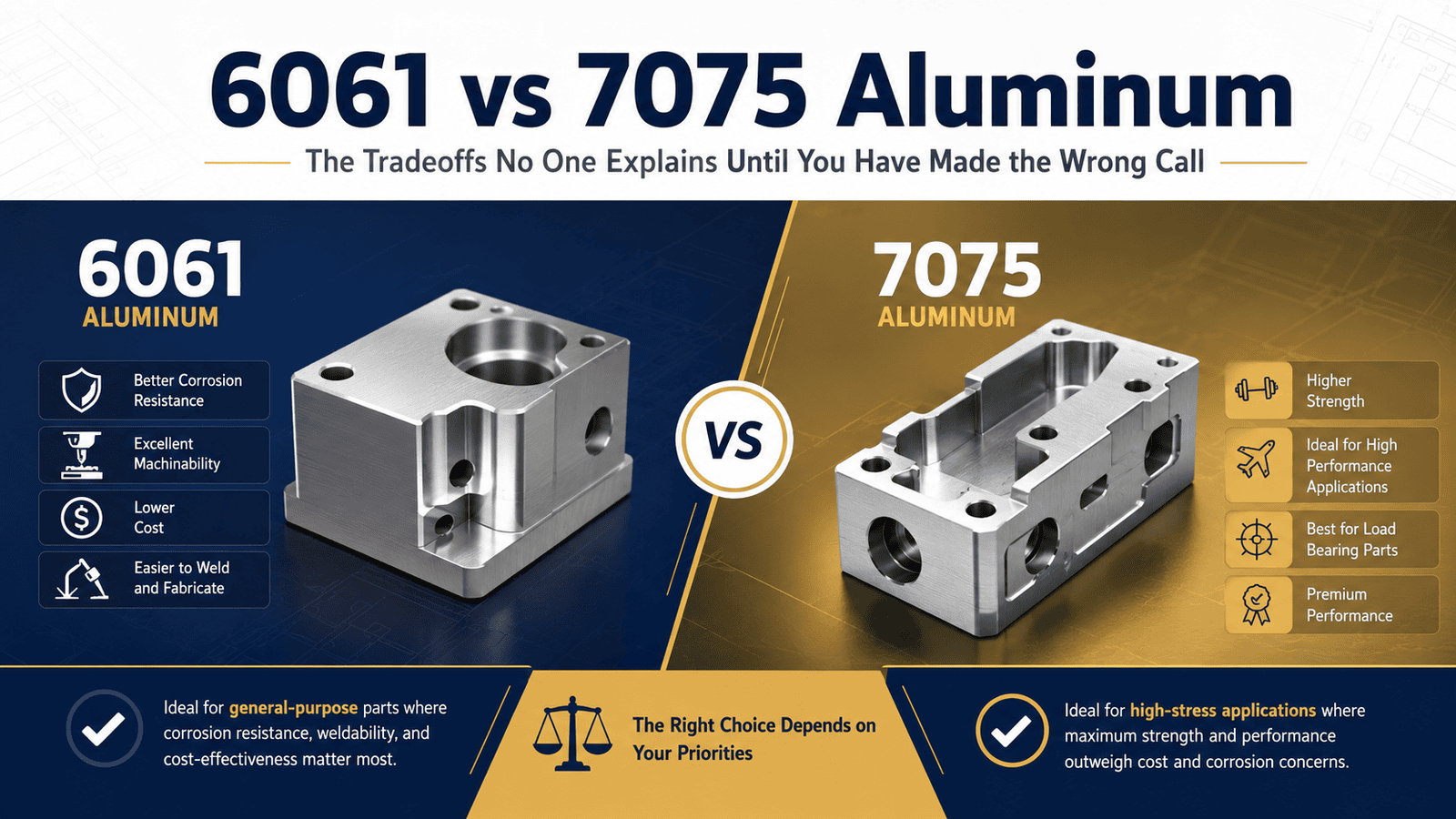
6061 vs 7075 Aluminum Comparison Across Key Engineering Factors
While both alloys belong to the aluminum family, their practical performance differs across several critical engineering criteria.
Evaluating these characteristics helps product teams select the most appropriate material for each application rather than relying solely on strength specifications.
Mechanical Strength
7075 aluminum clearly outperforms 6061 aluminum in ultimate tensile strength, yield strength, and fatigue resistance.
For highly loaded structural parts, these properties provide measurable engineering advantages.
Machinability
Although both are effective CNC machining materials, 6061 aluminum generally machines more easily.
It produces smoother cutting conditions, lower tool wear, and more economical cycle times.
7075 remains highly machinable but typically requires more optimized tooling and cutting parameters.
Corrosion Resistance
6061 aluminum performs better in corrosive environments.
7075 aluminum often requires anodizing or protective coatings because its higher zinc content reduces natural corrosion resistance.
Weldability
6061 aluminum welds exceptionally well using conventional welding processes.
7075 aluminum is considerably more difficult to weld because heat affects its mechanical properties and increases the likelihood of cracking.
Cost Considerations
7075 aluminum generally costs more due to both raw material pricing and higher machining expenses.
For applications where additional strength offers little functional benefit, 6061 often provides a significantly better return on investment.
When 6061 Aluminum Is the Better Choice
Many engineering projects perform exceptionally well using 6061 aluminum because it delivers balanced performance without unnecessary manufacturing complexity.
Choosing 6061 often improves both production efficiency and overall project economics.
Commercial and Industrial Equipment
Machine frames, brackets, automation systems, consumer products, and industrial enclosures commonly benefit from the versatility of 6061 aluminum.
These applications rarely require the extreme strength offered by aerospace-grade alloys.
Products Requiring Secondary Operations
Because 6061 aluminum welds, machines, and finishes easily, it supports flexible manufacturing processes that include fabrication, assembly, and surface treatment.
When 7075 Aluminum Justifies Its Higher Cost
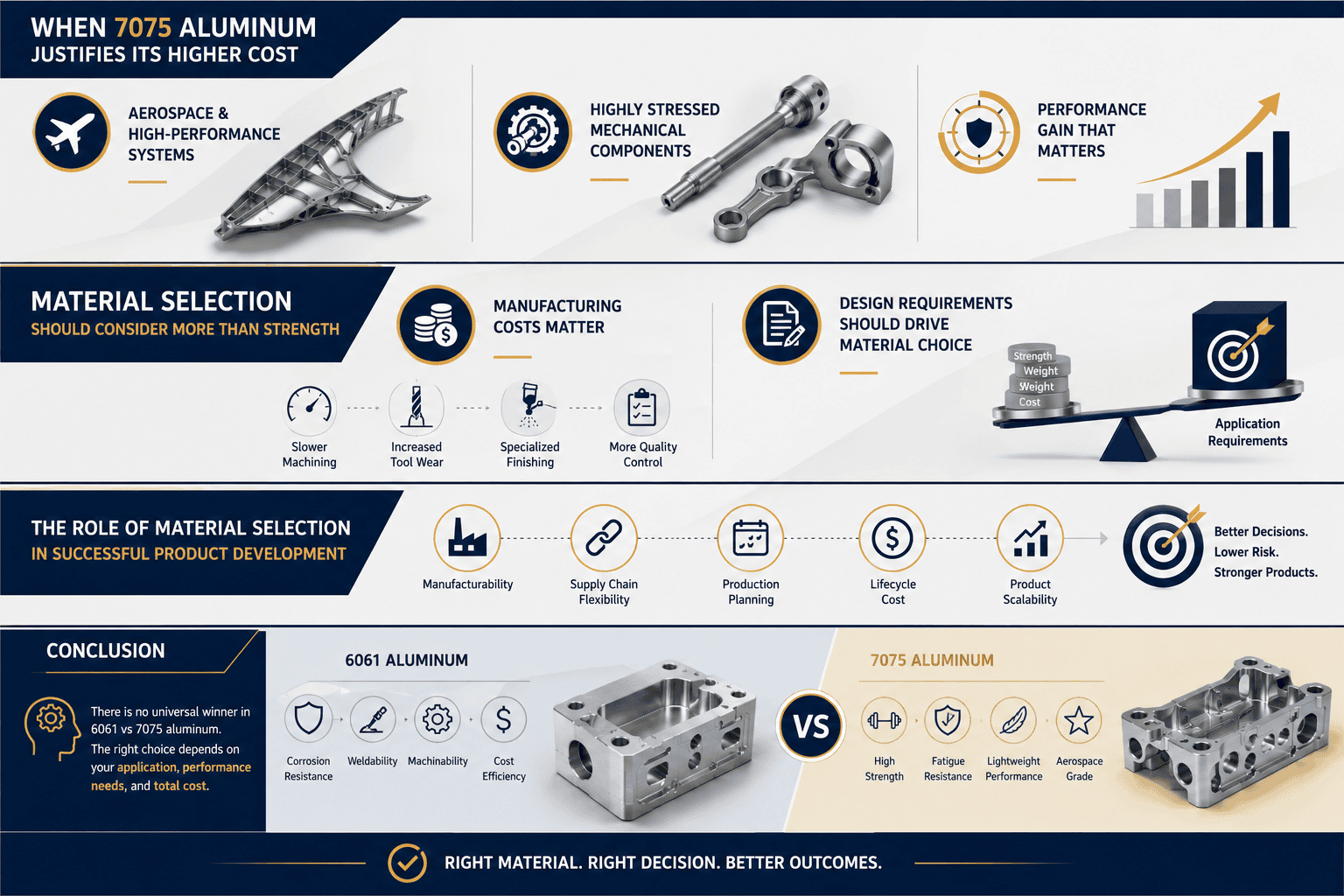
Although more expensive, 7075 aluminum becomes the preferred option when structural performance directly influences product safety or competitive performance.
In these situations, the additional investment produces measurable engineering value.
Aerospace and High-Performance Systems
Aircraft structures, UAV components, racing assemblies, and defense equipment frequently specify aerospace aluminum because weight savings combined with superior strength improve system performance.
Highly Stressed Mechanical Components
Precision shafts, suspension components, tooling fixtures, and structural load-bearing assemblies often benefit from the higher fatigue resistance of 7075 aluminum.
Engineering Material Selection Should Consider More Than Strength
One of the most common mistakes during product development is assuming that stronger materials automatically create better products.
Successful engineering material selection considers the complete manufacturing and operational environment.
Manufacturing Costs Matter
Higher-strength materials often require slower machining, increased tool replacement, specialized finishing, and additional quality control.
These costs accumulate throughout production and may outweigh performance gains.
Design Requirements Should Drive Material Choice
Every engineering decision should begin by defining functional requirements.
Selecting the lightest, strongest, or most expensive material rarely produces the best commercial outcome unless those properties directly support product objectives.
The Role of Material Selection in Successful Product Development
Material selection influences much more than component performance. It shapes manufacturability, supply chain flexibility, production scheduling, lifecycle cost, and future product scalability.
Engineering teams that evaluate materials strategically reduce project risk while improving long-term manufacturing success.
Whether developing industrial equipment, consumer electronics, medical devices, or aerospace systems, selecting the right alloy early simplifies the transition from concept to production.
Conclusion
The debate between 6061 vs 7075 aluminum is not about identifying a universally superior material. It is about understanding which alloy best supports the technical and commercial objectives of a specific product.
6061 aluminum offers an outstanding balance of strength, corrosion resistance, weldability, and manufacturing efficiency, making it the preferred choice for many commercial and industrial applications. 7075 aluminum, meanwhile, delivers exceptional mechanical performance for highly demanding structural applications where maximum strength and fatigue resistance justify increased manufacturing costs.
Successful engineering material selection requires engineers to evaluate the complete picture—from machining and finishing to product performance and lifecycle cost. When material decisions align with real application requirements rather than assumptions, companies reduce production risk, optimize costs, and create products that perform reliably throughout their service life.
Selecting the right material is one of the most important decisions in product development, but the best choice depends on far more than a material data sheet. Manufacturing methods, machining efficiency, product performance, lifecycle requirements, and cost all need to work together from the beginning.
At Trustbridge, our engineering and manufacturing specialists help product teams evaluate 6061 vs 7075 aluminum, optimize engineering material selection, and choose the right CNC machining materials for every application. From prototype development through full-scale production, we ensure that material decisions support performance, manufacturability, and long-term commercial success.
If you're developing your next product and want confidence that your material selection will deliver the right balance of performance, cost, and manufacturability, connect with Trustbridge today and build smarter from the very first design decision.
Frequently Asked Questions
1. What is the difference between 6061 and 7075 aluminum?
The primary difference between 6061 vs 7075 aluminum is the balance between strength and manufacturability. 6061 aluminum offers excellent corrosion resistance, weldability, and machinability, making it ideal for many commercial and industrial applications. 7075 aluminum provides significantly higher strength and fatigue resistance but is more expensive, harder to machine, and less suitable for welding.
2. When should I choose 6061 aluminum instead of 7075 aluminum?
Choose 6061 aluminum when your product requires a balance of strength, corrosion resistance, ease of machining, and cost efficiency. It is commonly used for machine frames, brackets, consumer products, automation equipment, and components that require welding or secondary manufacturing operations.
3. Is 7075 aluminum worth the higher cost?
7075 aluminum is worth the additional cost when maximum strength, fatigue resistance, and weight reduction are critical to product performance. It is commonly specified for aerospace, defense, motorsports, robotics, and other high-load applications where the mechanical benefits outweigh the increased machining and material costs.
4. How do engineers decide between 6061 and 7075 aluminum during product development?
Engineers evaluate factors beyond strength, including manufacturability, machining cost, corrosion resistance, weldability, lifecycle performance, and project budget. The best engineering material selection aligns the alloy's properties with the product's functional requirements rather than choosing the strongest material by default.