
Silicone vs. Urethane Casting: When Each Is the Right Call
A urethane casting service and a stock of silicone rubber get lumped into the same sentence constantly. Here's what actually separates them — and how to tell which one your next part needs.
Introduction
Ask five people what "silicone vs. urethane casting" means, and you'll often get five different mental pictures. Some are thinking about silicone rubber as a finished part material — gaskets, seals, soft-touch grips, medical components. Others are thinking about urethane casting as a process. Polyurethane resin gets poured into a silicone mold to produce a batch of plastic-like prototypes. Both are right, which is exactly why the comparison is confusing.
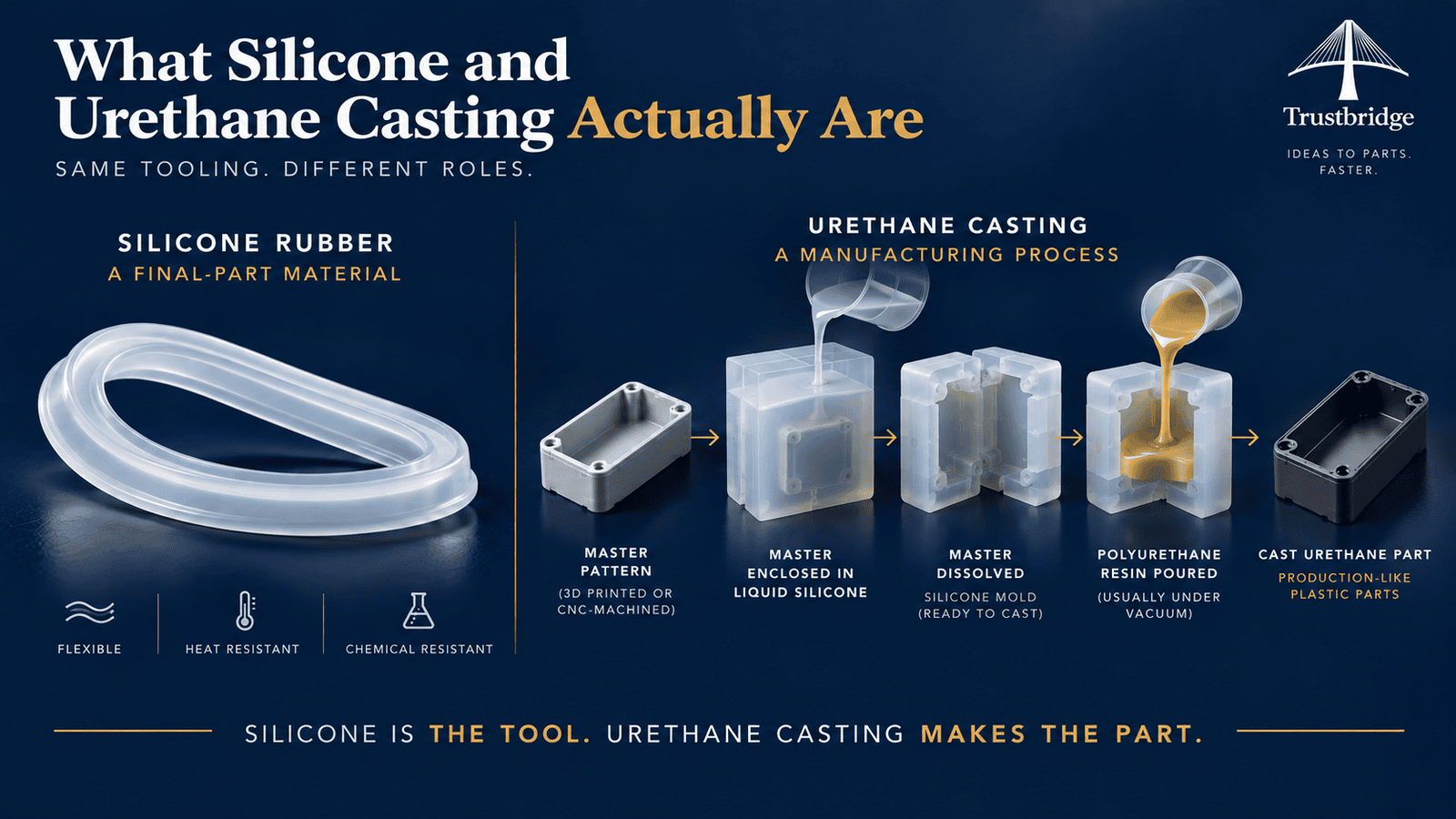
Silicone is usually a material choice for flexible, heat- and chemical-resistant parts. Urethane casting is a process that uses silicone tooling to produce rigid or semi-rigid, injection-molded-looking parts in low volumes. They're closely related, but they're rarely competing for the same job. Knowing where these overlap and where they diverge is the fastest way to pick the right approach for a given part. That's better than defaulting to whatever a template or a previous project happened to use.
What silicone and urethane casting actually are
Start with the process everyone is usually asking about: urethane casting, also called vacuum casting or cast urethane. A master pattern, typically 3D printed or CNC-machined, is encased in liquid silicone. That silicone cures into a soft, reusable mold split into two halves. Polyurethane resin is then poured or injected into the mold, usually under vacuum, to remove trapped air and capture fine surface detail. The result can look and feel remarkably close to an injection-molded plastic component. It comes without the cost or lead time of a metal tool. Some mold-makers switch to a tougher, high-temperature-vulcanized silicone instead of the usual RTV grade, for higher part counts than a standard room-temperature-cured mold can handle.
That role splits into two paths once it becomes the finished part rather than the tool. It's made either as small RTV silicone castings, or, at higher volumes, through liquid silicone rubber (LSR) injection molding. When people ask "silicone or urethane casting?", they're often really asking something narrower. Should this part be a flexible silicone rubber component, or a rigid-to-semi-rigid part produced via urethane casting? That's a materials-and-application question as much as a process one. It's worth separating from questions about the vacuum-casting process itself, which typically uses silicone tooling either way.
Volume and iteration speed
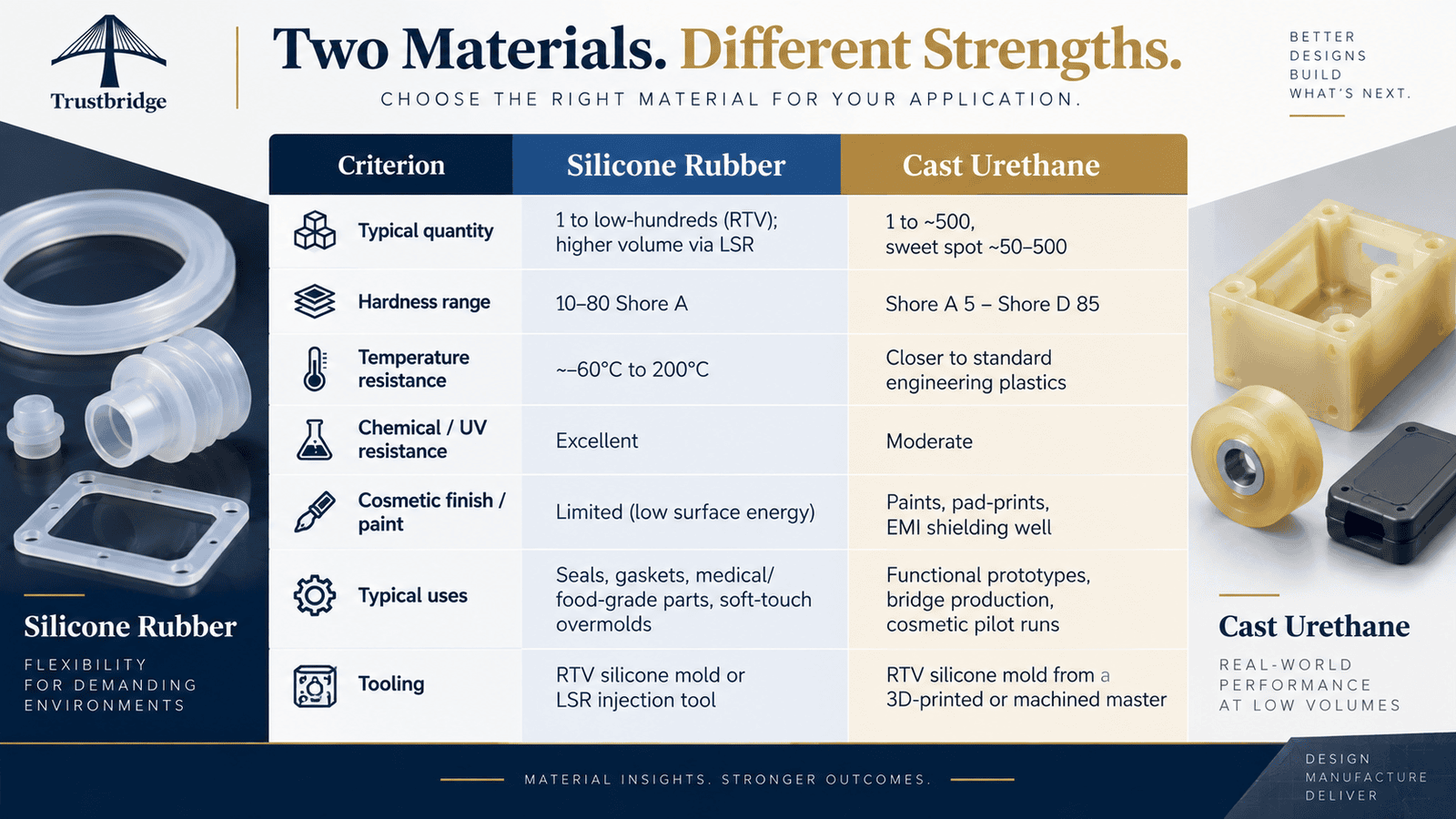
Urethane casting exists because silicone molds are fast and inexpensive to build. Hard steel or aluminum injection tooling can cost tens of thousands of dollars and take weeks to machine. A silicone tool, by contrast, can typically be built in a matter of days. That speed comes at the cost of longevity. Estimates vary by source and part geometry. A single RTV silicone mold commonly yields somewhere between 20 and 50 pulls. Wear shows up past that point as dimensional drift or surface degradation. Some sources cite a tighter 20-to-30-pull window before a $500–$3,000 replacement mold is needed. Others report 50 or more pulls for simpler geometries.
That range makes urethane casting a strong fit for quantities roughly between 1 and a few hundred units. A commonly cited sweet spot is 50 to 500 parts once a design is frozen. Below that range, injection molding's tooling cost can't yet be justified. Above it, 3D printing's slower per-unit output and rougher surface finish start to work against it instead.
If the goal is a final silicone rubber part rather than a urethane-cast one, volume changes the calculus differently. Low-volume runs can still use RTV silicone tooling in a broadly similar way. Higher-volume silicone parts move to LSR injection molding instead. That trades a larger upfront tooling investment for fast, repeatable cycle times better suited to production quantities.
Material properties: what actually drives the decision
Cost and speed matter. But the real choice between silicone and urethane casting comes down to what the part has to survive, and how it needs to look. Silicone rubber is hard to beat on environmental resilience. Depending on grade, it holds its properties across a temperature range roughly from -60°C to 200°C (about -76°F to 392°F). It resists UV, ozone, and a wide range of chemicals. Platinum-cured, medical- and food-grade formulations are available too, for parts that contact skin or the body. Its hardness typically spans 10 to 80 Shore A — tunable from something as soft as a pacifier to something as firm as a phone case or gasket. Either way, it stays an elastomer throughout that range, with tensile strength generally in the single digits to low teens of MPa.
Cast urethane resins cover much more ground on hardness. Commercially available formulations run from roughly Shore A 5 up to Shore D 85. The same basic process can produce a soft, rubber-like bumper or a rigid, ABS-like enclosure. Urethane-cast parts also take paint, pad printing, and EMI shielding well. That's why cast urethane services are a common choice for investor demos, trade-show units, and functional prototypes that need to look production-ready. What they don't offer is silicone's extreme temperature range or long-term chemical resistance. Rigid cast urethanes can approximate certain engineering plastics, while flexible formulations behave more like polyurethane elastomers. Neither should be assumed to match the long-term performance of whatever production material it's standing in for.
Bridge production and cosmetic requirements
This is where cast urethane earns its other common name: bridge production. It sits between a 3D-printed prototype and a full injection-molding program. That lets a team validate a design with parts that feel, weigh, and finish like the real thing. They can do this before committing to steel or aluminum tooling. Urethane resins can be clear, color-matched, filled with additives, or finished with inserts. That's why cast urethane parts routinely stand in for the finished product in investor pitches, user testing, and pilot production runs, typically 1 to 100 units, sometimes more. Most urethane casting service providers quote turnaround in a matter of days once the mold itself exists.
Silicone parts play a related but distinct bridging role. An elastomeric component — a seal, a gasket, a soft-touch overmold — can be produced via RTV tooling at low volume. It can then transition to LSR injection molding once volumes justify the tooling investment. The production-grade LSR should be requalified rather than assumed identical, though. Its properties can differ from the prototype silicone even at the same nominal durometer. Either way, the tooling investment scales with the plan for production, not just the immediate need for a handful of parts.
When to look beyond both
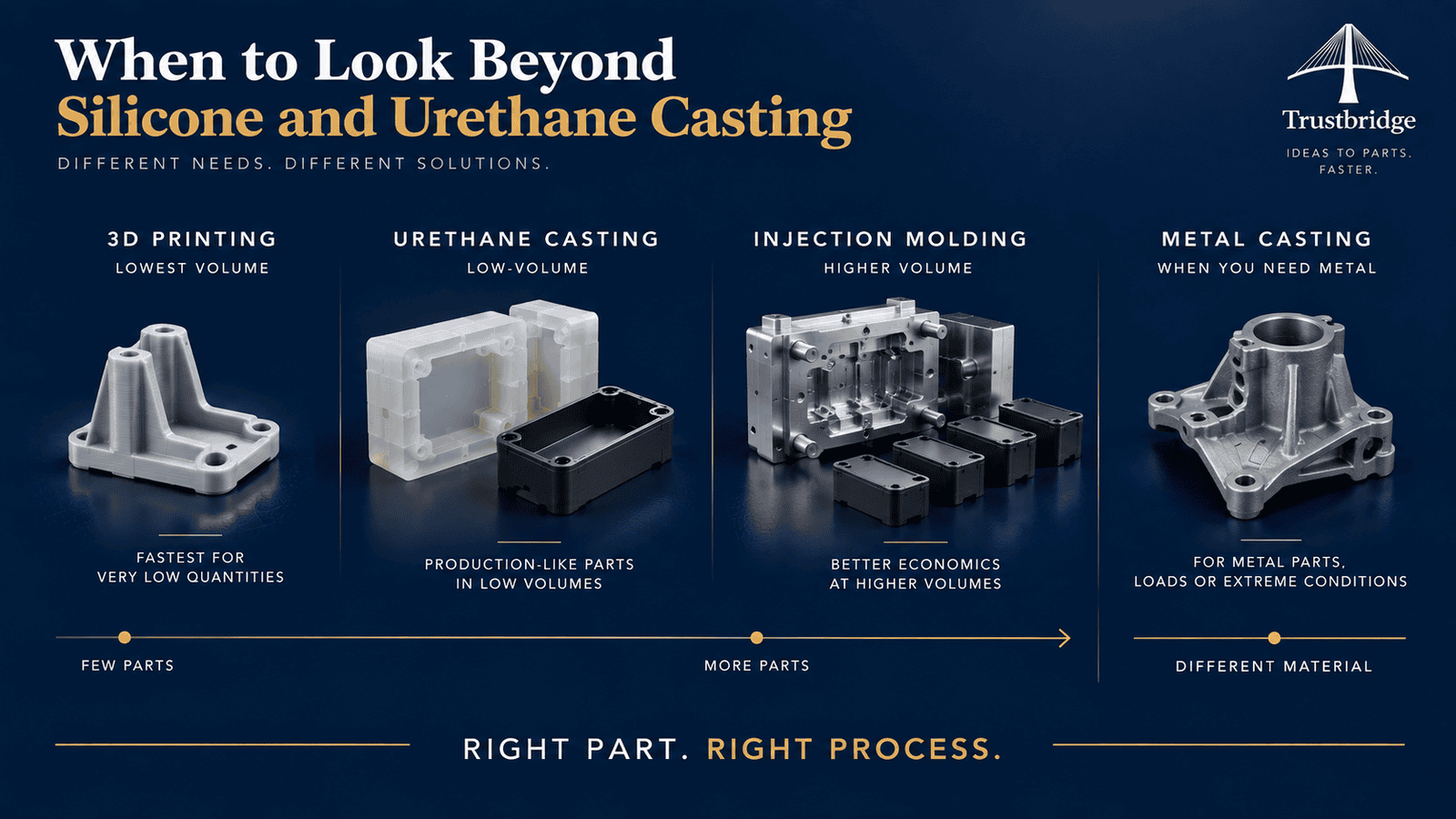
Silicone and urethane casting solve a specific range of problems well, but neither is the right call for every part. If the true quantity is small, under about 20 units, and the part doesn't need elastomeric properties or an injection-molded look, 3D printing services are usually faster and cheaper. There's no tooling to build at all. Lead times for 3D printing stay competitive up to roughly 50 parts for some processes, and considerably higher for others. The trade-off is a rougher as-printed surface and, depending on the process, layer lines that need secondary finishing. Beyond roughly 500 units, urethane casting's silicone tooling wears out faster than the economics justify. At that point, it's usually time to look at low-volume injection molding or a hard aluminum tool instead.
If the part needs to be metal, neither silicone nor cast urethane is the right family of processes at all. That's true whether the part has to bear a structural load, survive conditions no plastic or elastomer can, or simply needs the application to call for it. Metal casting services are the answer instead. Sand casting accommodates a broad range of ferrous and nonferrous alloys. It's often the choice for larger parts, complex internal passages, or volumes that don't justify permanent tooling. Investment casting suits smaller, more intricate components, or exotic, high-temperature alloys where surface finish and precision matter more than raw size. A metal casting service and a urethane casting service solve fundamentally different problems, even though the word "casting" makes them sound related.
The takeaway
Silicone and urethane casting get compared constantly. They share tooling, vocabulary, and often the same conversation about a part that hasn't shipped yet. But they usually answer different questions. One is mostly about what the part is made of. The other is about how a batch of production-like parts gets made without committing to hard tooling. Matching the process to what the part actually needs to do — not just what a previous project used — is what makes the choice straightforward.
Not sure which process fits your part?
Share your geometry, target quantity, and end-use requirements. Get a straight recommendation on whether silicone, a urethane casting service, or another process entirely is the right starting point. Get a process recommendation before any tooling gets built around the wrong one.
Frequently Asked Questions
1. What is the difference between silicone and urethane casting?
Silicone is typically a flexible elastomer used for parts such as seals, gaskets, grips, and soft-touch components, while urethane casting is a manufacturing process that uses silicone molds to produce rigid, semi-rigid, or flexible polyurethane parts. The choice depends on whether you need a silicone rubber component or production-like parts made from polyurethane resin.
2. When should you use silicone instead of urethane casting?
Silicone is generally the better choice when a part needs flexibility, high temperature resistance, chemical resistance, UV resistance, or long-term elastomeric performance. Common applications include gaskets, seals, medical components, and soft-touch parts. Urethane casting is more suitable when the goal is to reproduce the appearance and mechanical characteristics of an injection-molded plastic part.
3. How many parts can you make with urethane casting?
Urethane casting is generally suited to low-volume production, prototypes, and bridge production, often ranging from a few parts to several hundred units. The exact output depends on the silicone mold, part geometry, resin, and molding conditions. For larger production volumes, injection molding or other production processes may become more economical.
4. Should I use 3D printing, urethane casting, or silicone for my prototype?
The right process depends on the part's material requirements, quantity, geometry, and intended use. 3D printing is often practical for very small quantities and rapid design iterations, urethane casting is useful when you need production-like plastic parts in low volumes, and silicone is appropriate when the finished component needs elastomeric properties such as flexibility and temperature resistance.