
6 Ways Providing Effective DFM Feedback to Smart Home & Consumer Hardware Engineering Teams
Preamble
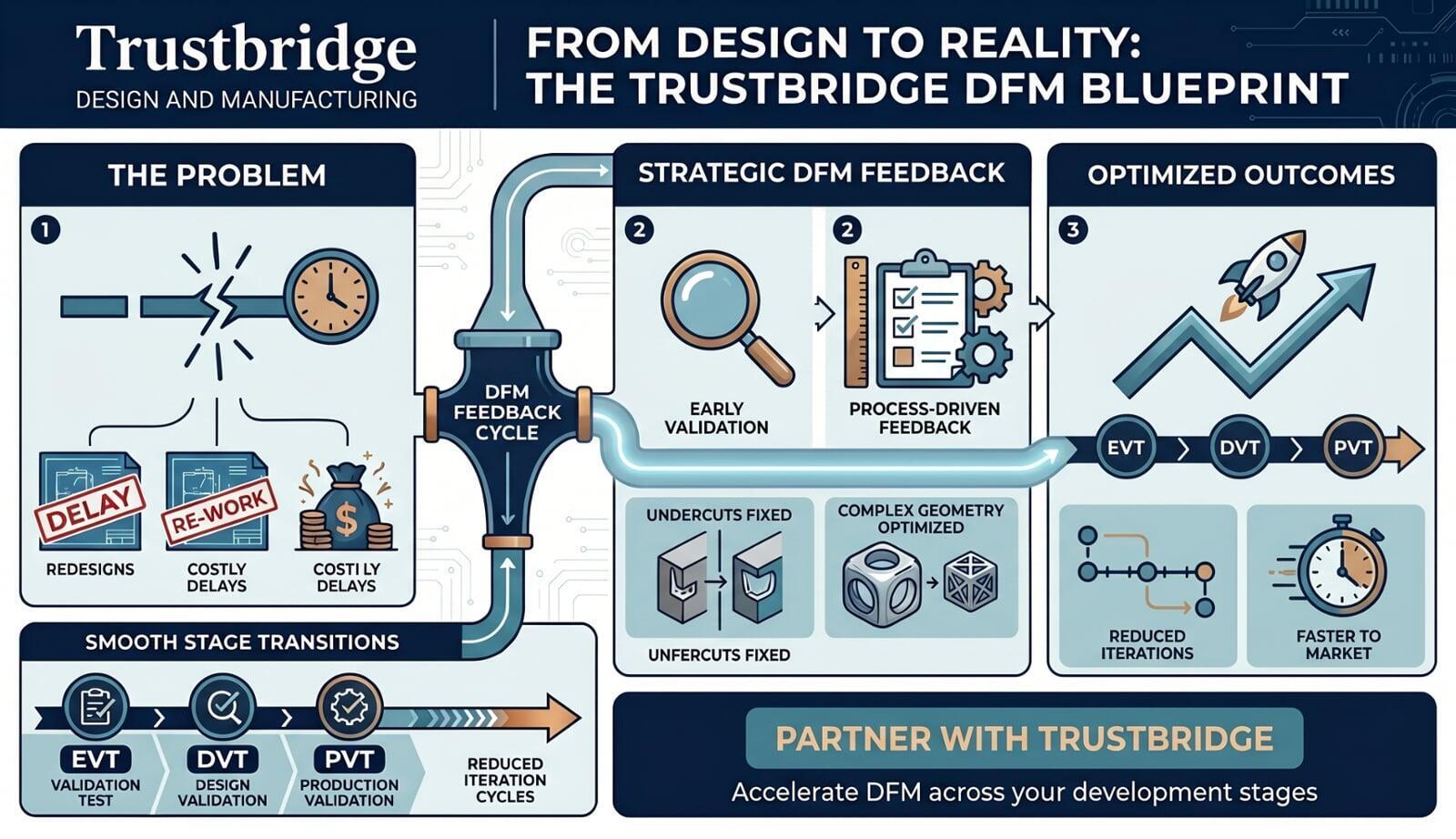
The most effective way to reduce cost, accelerate timelines, and improve product quality in smart home and consumer hardware is through structured Design for Manufacturability (DFM) feedback. When aligned with real production processes like CNC machining and injection molding and integrated early across EVT, DVT, and PVT stages—DFM transforms design decisions into scalable, production-ready outcomes while minimizing iteration cycles and manufacturing risk.
Introduction
Why DFM Feedback Matters in Smart Home & Consumer Hardware
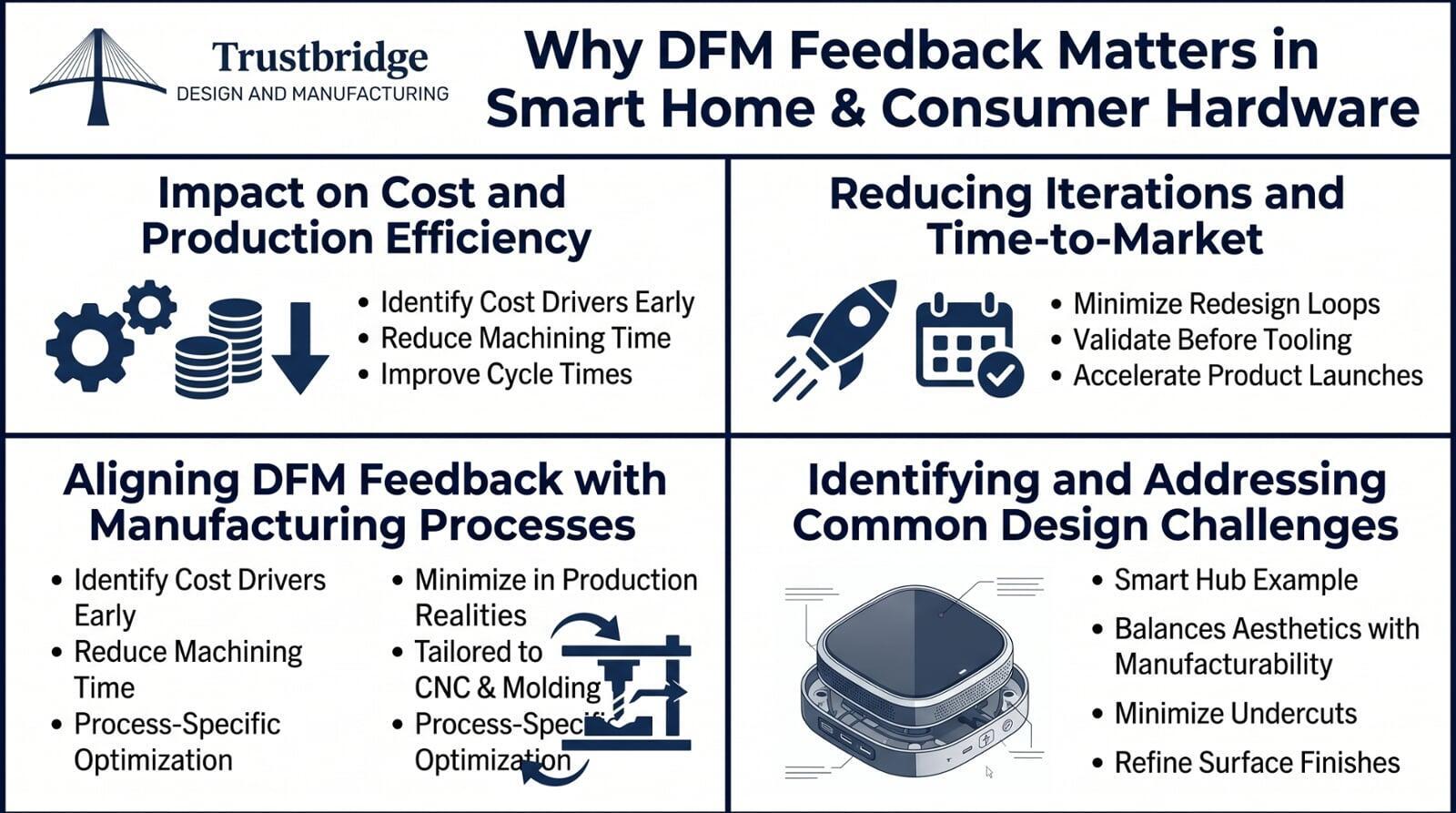
Smart home and consumer hardware products operate within tight design constraints—compact form factors, strict tolerances, and high cosmetic expectations. These requirements make manufacturability a defining factor in product success, particularly during EVT and DVT phases where iteration costs are highest.
Without structured DFM feedback, engineering teams may unknowingly design features that are difficult to machine, mold, or assemble. This results in repeated redesign cycles, tooling changes, and delays during production ramp-up.
Impact on Cost and Production Efficiency
DFM feedback helps identify cost drivers early in the design phase. Features such as deep cavities, thin walls, and complex geometries can significantly increase machining time or tooling complexity.
Deep cavities may require longer cutting tools, which increase vibration and reduce machining speed, leading to higher cycle times and lower part accuracy. Similarly, inconsistent wall thickness in injection molding can cause uneven cooling, resulting in defects that require rework or scrap.
Addressing these issues early enables optimization of production processes, reduced material waste, and improved cycle times. This has a direct impact on profitability and scalability, especially when transitioning from prototype builds to PVT.
Cost of Ignoring DFM:
Ignoring DFM feedback often leads to exponential cost increases later in the lifecycle. A design flaw caught during EVT may cost hundreds of dollars to fix, but the same issue discovered after tooling in DVT or PVT can result in tens of thousands of dollars in tooling rework, production delays, and missed market windows. Additionally, poor manufacturability can reduce yield rates, increase scrap, and inflate per-unit costs at scale—directly impacting margins.
Reducing Iterations and Time-to-Market
Each design revision during production adds both time and cost. DFM feedback ensures designs are validated against manufacturing constraints before tooling investment begins.
By minimizing redesign loops, companies accelerate product launches and maintain competitive timelines in fast-moving markets where DVT readiness directly influences go-to-market success.
Aligning DFM Feedback with Manufacturing Processes
Effective DFM feedback must be grounded in the realities of production. Generic recommendations often fail because they don’t reflect actual manufacturing constraints or capabilities.
Engineering teams benefit most when feedback is tailored to specific processes such as CNC machining, injection molding, and low-volume validation builds aligned with EVT/DVT cycles.
CNC Machining Considerations
Sharp internal corners, deep pockets, and limited tool access paths slow machining and reduce accuracy. DFM feedback helps optimize geometries for better tool accessibility and reduced machining time—critical during EVT where rapid iteration is required.
Injection Mold Parts Optimization
Identifying and Addressing Common Design Challenges
Many manufacturability issues stem from recurring design patterns that do not align with production constraints. Identifying these early allows teams to make proactive adjustments.
Common problematic design patterns include:
- Uniformly thin walls that compromise structural strength or cause molding defects
- Deep ribs and bosses that create sink marks or require complex tooling
- Sharp internal corners that are incompatible with standard cutting tools
- Overly tight tolerances applied universally instead of functionally
- Complex part geometries that require multi-axis machining or side actions in molds
DFM feedback highlights these risks and provides actionable solutions that balance design intent with manufacturing feasibility across EVT, DVT, and PVT stages.
Managing Undercuts and Complex Geometries
Undercuts introduce additional tooling requirements or secondary operations, increasing both cost and complexity.
DFM feedback helps redesign parts to minimize or eliminate undercuts where possible. When unavoidable, alternative approaches can be recommended to maintain feasibility and cost control before DVT approval.
Alternative approaches include:
- Using side actions or lifters in injection molds only where absolutely necessary
- Redesigning parts into multiple components to eliminate undercuts and simplify tooling
- Switching to flexible materials that allow part deformation during ejection
- Reorienting part geometry to align with the mold opening direction
- Using secondary operations (e.g., machining post-molding) selectively instead of complex tooling
Balancing Aesthetics with Manufacturability
Consumer hardware demands high aesthetic quality, but achieving sleek designs often introduces production challenges.
DFM feedback helps balance visual requirements with manufacturing constraints by refining surface finishes, parting lines, and assembly methods—ensuring designs meet both cosmetic and production standards.
How Do Top Smart Home and Consumer Hardware Engineers Design Products That Scale Efficiently from Prototype to Mass Production?
Integrating Custom Manufacturing for Flexible Production
Custom manufacturing enables adaptability in both design and production strategy—an essential advantage in iterative, validation-driven environments like smart home and consumer electronics.
DFM feedback becomes significantly more powerful when paired with flexible manufacturing capabilities, allowing tailored solutions rather than rigid process limitations.
Supporting Design Adaptability
Custom manufacturing partners can adjust tooling strategies, processes, and material selection as designs evolve.
DFM feedback ensures these adjustments improve manufacturability rather than introduce new risks, particularly during iterative EVT and DVT cycles.
Enabling Scalable Production Strategies
Products must transition from prototype to mass production efficiently. Custom manufacturing supports this shift by aligning early-stage designs with scalable methods. DFM (Design for Manufacturability) feedback ensures that prototype designs translate seamlessly into production without major redesigns, reducing friction between DVT completion and PVT ramp-up.
A smart thermostat enclosure initially prototyped using CNC machining may include sharp internal corners and variable wall thickness. During EVT, DFM feedback identifies these features as non-optimal for scalable manufacturing, leading to design refinements such as uniform wall thickness and added draft angles that make the part suitable for injection molding. As a result, when transitioning to PVT, the same design can be tooled without major changes—avoiding costly redesign cycles and accelerating mass production readiness.
Leveraging Small Batch Manufacturing for Early Validation
Small batch manufacturing plays a critical role in validating designs before full-scale production. It allows teams to test manufacturability, performance, and quality under real conditions.
DFM feedback during this phase is especially valuable, as it is based on actual production data rather than theoretical assumptions.
Rapid Iteration and Feedback Loops
Small batch production enables fast iteration cycles. Engineering teams can test and refine designs based on real manufacturing outcomes.
DFM feedback accelerates this loop by identifying improvement opportunities after each iteration, reducing risk before mass production.
Reducing Production Risk
Validating designs through small batches helps identify defects, tolerance issues, and assembly challenges early.
This proactive approach minimizes costly errors during large-scale production and ensures smoother progression into PVT and full manufacturing.
Building Strong Collaboration Between Engineering and Manufacturing Teams
DFM feedback is not a one-time input—it requires continuous collaboration between engineering and manufacturing teams throughout the product lifecycle.
Structured communication ensures alignment on design intent, production constraints, and optimization opportunities across EVT, DVT, and PVT milestones.
Establishing Clear Communication Channels
Regular design reviews, technical discussions, and shared documentation ensure DFM feedback is clearly understood and implemented.
This reduces misalignment and enables faster decision-making, particularly during validation checkpoints.
Creating Feedback-Driven Development Cycles
Integrating DFM into development workflows creates a continuous improvement loop where designs evolve based on real manufacturing insights.
This leads to higher product quality, reduced variability, and stronger alignment between engineering output and production readiness.
Conclusion
Providing effective DFM feedback is essential for bridging the gap between design and production in smart home and consumer hardware development. Without it, even well-engineered products can encounter delays, increased costs, and quality issues during manufacturing.
By aligning DFM feedback with CNC machining, optimizing injection-molded components, leveraging custom manufacturing, and validating designs through small batch production, companies can significantly improve production outcomes. Addressing challenges like undercuts and complex geometries early ensures smoother transitions across EVT, DVT, and PVT stages.
Ultimately, organizations that treat DFM as a strategic function—not a reactive step—are better positioned to deliver scalable, high-quality products.
Frequently Asked Questions (FAQs)
1. What is Design for Manufacturability (DFM) in smart home hardware development?
Design for Manufacturability (DFM) is the process of optimizing product designs so they can be efficiently produced using methods like CNC machining and injection molding. In smart home hardware, DFM ensures designs meet tight tolerances, aesthetic requirements, and scalability needs across EVT, DVT, and PVT stages.
2. How does structured DFM feedback reduce product development iterations?
Structured DFM feedback identifies manufacturability issues early—before tooling or production begins. By addressing constraints related to geometry, materials, and processes upfront, engineering teams can avoid repeated redesign cycles, reducing both development time and cost.
3. Why is DFM critical during EVT, DVT, and PVT phases?
Each validation stage introduces increasing levels of production commitment. DFM ensures that designs are feasible and optimized before moving from EVT prototypes to DVT validation and finally PVT production, minimizing costly late-stage changes and delays.
4. How does DFM feedback improve CNC machining and injection molding outcomes?
DFM feedback optimizes part geometry, material selection, and production parameters for both CNC machining and injection molding. This improves tool access, ensures proper material flow, reduces defects, and leads to better part quality, faster cycle times, and lower manufacturing costs.