
Designing Components for Consumer Electronics: CNC and Fabrication Considerations
Consumer electronics products are expected to deliver high performance, sleek aesthetics, and reliable durability while being manufactured at scale. From aluminum device enclosures to internal structural components and thermal management parts, precision manufacturing processes such as CNC machining and fabrication play a major role in bringing electronic products to life.
For industrial designers and engineering teams, designing components for consumer electronics requires more than creating visually appealing products. Every design decision—from geometry and tolerances to material choice—must support efficient manufacturing. If these considerations are ignored early in development, teams often encounter delays, expensive redesigns, or production inefficiencies when moving from prototype to production.
Successful consumer electronics development depends on applying design for manufacturability, selecting appropriate materials, preparing accurate CAD models, and maintaining strong industrial designer manufacturer collaboration throughout the product lifecycle. By integrating these practices early, companies can develop components that meet both performance and manufacturing requirements.
Why Manufacturing Considerations Matter in Consumer Electronics Design
Modern consumer electronics are built with extremely tight tolerances and compact assemblies. Devices such as wearables, smart home products, and portable electronics rely on precision-machined parts that must fit together seamlessly with internal components like PCBs, connectors, and thermal systems.
Because of these requirements, manufacturing constraints must be considered during the early stages of product development. Designers who focus solely on form without understanding fabrication processes may unintentionally create geometries that are difficult or expensive to machine.
When manufacturing considerations are incorporated early, companies can reduce development risk and accelerate product launch timelines. Applying design for manufacturability principles ensures that parts are optimized not only for performance but also for efficient CNC machining and fabrication processes.
The Role of CNC Machining in Consumer Electronics Components
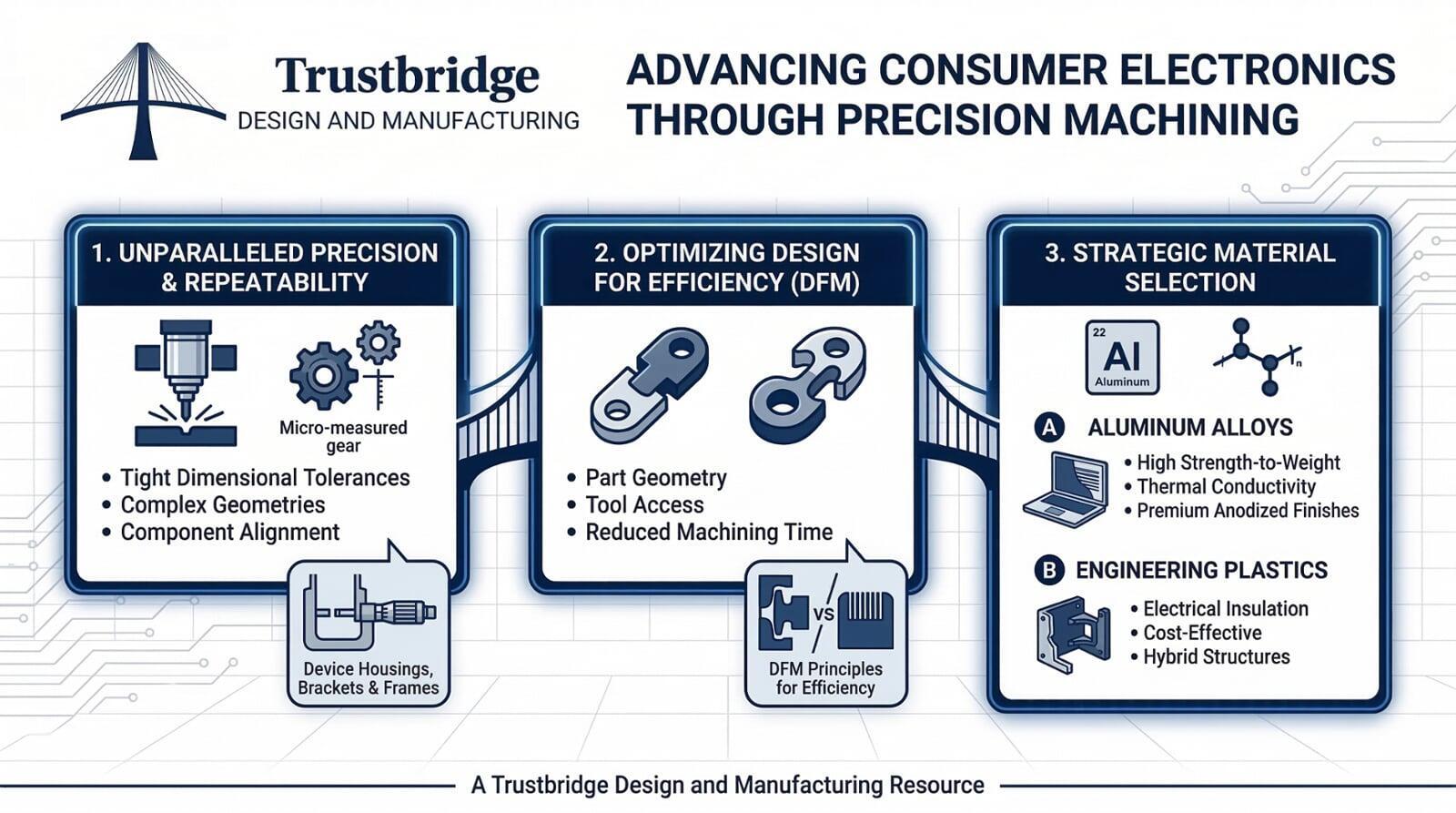
CNC machining is widely used in consumer electronics manufacturing because it provides the precision and repeatability needed for high-performance products. Components such as device housings, brackets, internal frames, and thermal components are often machined from aluminum, stainless steel, or engineering plastics.
CNC machining allows manufacturers to produce complex geometries while maintaining tight dimensional tolerances. This capability is particularly valuable in electronics, where internal space is limited and component alignment must be precise.
- Precision Enclosures and Structural Components
Many premium consumer electronics products use machined metal enclosures. These enclosures provide structural strength, aesthetic appeal, and heat dissipation capabilities.
Machined aluminum housings are especially common in devices such as laptops, audio equipment, and smart devices because they combine lightweight properties with high durability. Precision machining ensures that these enclosures maintain consistent dimensions and surface quality.
- Machined Thermal Management Components
Heat management is critical in consumer electronics design. As devices become smaller and more powerful, managing heat generated by processors and power components becomes increasingly important.
CNC machining is often used to produce heat sinks, thermal plates, and other cooling components that help regulate device temperature. Designing these parts with proper airflow pathways and thermal conductivity in mind improves overall device reliability.
Applying Design for Manufacturability in Electronics Components
Design for manufacturability (DFM) ensures that products can be manufactured efficiently without unnecessary complexity or cost. In consumer electronics, DFM principles help engineers create components that are compatible with CNC machining and fabrication processes.
When teams prioritize design for manufacturability, they can reduce machining time, improve part consistency, and simplify assembly.
- Optimizing Part Geometry for Machining
Certain geometric features can significantly affect machining efficiency. Deep cavities, sharp internal corners, and thin walls may require specialized tooling or additional machining operations.
Designers should consider how tools will access each feature of the part. Avoiding unnecessary complexity allows manufacturers to machine parts more efficiently while maintaining precision.
- Designing for Assembly and Integration
Electronics products typically consist of multiple components that must fit together accurately. CNC-machined parts often serve as structural frames or housings that support other components.
Designing parts with proper clearances and alignment features helps ensure that assemblies can be produced consistently. This also simplifies the transition from prototype to production by reducing assembly errors and manufacturing variation.
Material Selection in Product Design for Consumer Electronics
Choosing the right materials is a critical step in designing consumer electronics components. The materials used must balance structural performance, aesthetics, weight, thermal performance, and manufacturability.
Effective material selection in product design ensures that components perform reliably while remaining compatible with CNC machining and fabrication processes.
- Aluminum and Metal Alloys
Aluminum is one of the most commonly used materials in consumer electronics. It offers an excellent balance of strength, lightweight properties, and thermal conductivity.
Aluminum components can also be finished with processes such as anodizing to improve durability and create premium surface finishes that enhance product appearance.
- Engineering Plastics and Hybrid Materials
Many internal components in electronics products are made from engineering plastics. These materials provide electrical insulation, lightweight properties, and cost efficiency.
Plastics are often used alongside metal components to create hybrid structures that balance performance and manufacturing efficiency. Selecting the appropriate material helps ensure compatibility with both CNC machining and other manufacturing processes.
Preparing CAD Models for CNC Manufacturing
A well-prepared CAD model is essential for successful CNC machining. The digital model serves as the foundation for programming toolpaths and guiding machining operations.
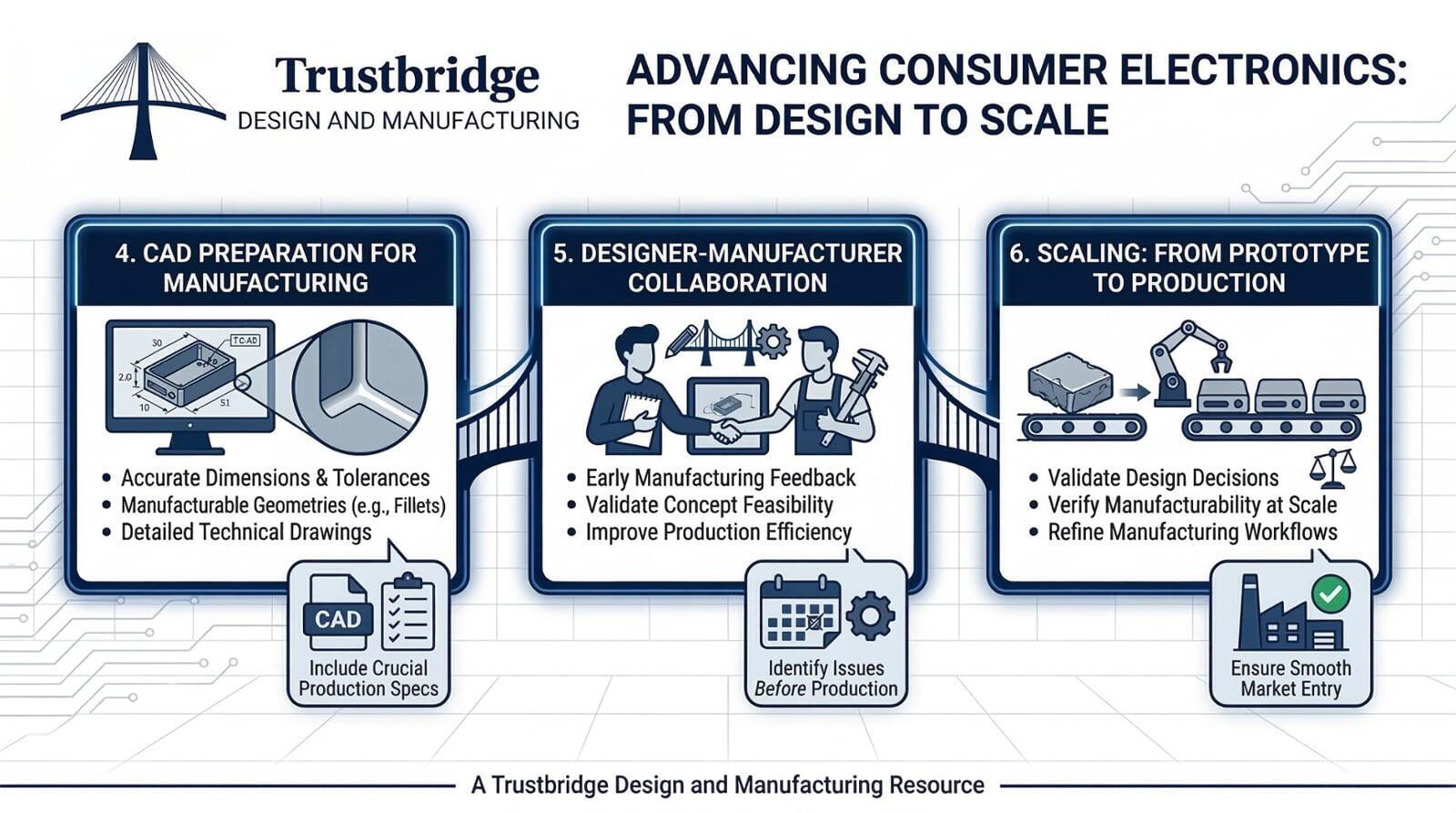
Designers must prepare CAD for manufacturing by ensuring that models contain accurate dimensions, tolerances, and manufacturable geometries.
- Designing with Machining Constraints in Mind
CAD models should reflect the realities of CNC machining processes. For example, internal corners typically require fillets because cutting tools cannot create perfectly sharp internal edges.
Similarly, designers should avoid extremely deep or narrow cavities that may be difficult for machining tools to reach. Adjusting these features in the design stage helps reduce machining complexity and cost.
- Clear Documentation and Technical Drawings
Accurate technical drawings help manufacturers interpret the design intent correctly. These drawings typically include critical dimensions, tolerance requirements, and material specifications.
Providing clear documentation improves communication between designers and manufacturing teams and reduces the likelihood of errors during production.
Industrial Designer Manufacturer Collaboration
Developing consumer electronics products requires close collaboration between design teams and manufacturing partners. Industrial designers focus on user experience, product aesthetics, and ergonomics, while manufacturers ensure that designs can be produced efficiently.
Strong industrial designer manufacturer collaboration helps bridge the gap between creative design and production feasibility.
- Early Manufacturing Feedback
Involving manufacturing experts early in the design process helps identify potential issues before production begins. Manufacturers can provide insights on machining capabilities, tooling limitations, and material behavior.
This feedback helps designers adjust their concepts while development is still flexible, preventing costly redesigns later in the process.
- Improving Development Efficiency
When designers and manufacturers work together throughout the development cycle, teams can move more smoothly from concept to production. This collaboration reduces misunderstandings, improves manufacturing efficiency, and helps ensure consistent product quality.
Moving From Prototype to Production in Consumer Electronics
The transition from prototype to full-scale manufacturing is a critical stage in electronics product development. Prototypes are often produced using flexible manufacturing processes, but production environments require greater consistency and efficiency.
Successfully scaling from prototype to production requires validating design decisions, verifying manufacturability, and refining manufacturing workflows.
Engineers must ensure that machining operations, materials, and assembly methods can support higher production volumes. Addressing these factors early helps reduce delays and ensures a smoother path to market-ready products.
Conclusion
Designing components for consumer electronics requires a careful balance between aesthetics, functionality, and manufacturing practicality. CNC machining and fabrication processes enable the production of high-precision components, but their success depends heavily on thoughtful design decisions.
Applying design for manufacturability, choosing the right materials, and ensuring that engineers prepare CAD for manufacturing are all essential steps in developing reliable electronic products. These practices help reduce production risks, improve part consistency, and support efficient scaling from prototype to production.
Equally important is strong industrial designer manufacturer collaboration, which ensures that design intent aligns with manufacturing capabilities throughout the development process.
By integrating these principles early in development, companies can create consumer electronics products that are both innovative and manufacturable at scale.
Accelerate Your Consumer Electronics Product Development
Designing high-quality consumer electronics components requires close coordination between product designers, engineers, and manufacturing specialists. Without proper alignment between design intent and production capabilities, even well-designed products can face costly delays and manufacturing challenges.
Trustbridge helps companies bridge the gap between product design and global manufacturing. By supporting teams with engineering coordination, supplier alignment, and production readiness, Trustbridge helps businesses reduce development risk and streamline the journey from concept to production.
If your team is developing the next generation of consumer electronics products, partnering with experienced manufacturing specialists can help ensure that your designs are optimized for both performance and scalable production.
Frequently Asked Questions (FAQs)
1. Why is design for manufacturability important when designing consumer electronics components?
Design for manufacturability ensures that components are created with manufacturing processes such as CNC machining and fabrication in mind. When engineers consider machining constraints, tolerances, and tooling access early in the design stage, they can reduce production complexity, avoid costly redesigns, and improve manufacturing efficiency.
2. How does CNC machining benefit consumer electronics product development?
CNC machining allows manufacturers to produce highly precise components with tight tolerances, which is essential for compact electronic devices. It is commonly used to create metal housings, internal frames, and thermal management parts that require both structural strength and consistent dimensional accuracy.
3. Why is material selection important in consumer electronics component design?
Material selection in product design affects durability, weight, thermal performance, and manufacturability. Materials such as aluminum, stainless steel, and engineering plastics are commonly used in electronics because they provide the necessary balance of strength, heat dissipation, and machinability required for reliable product performance.
4. How can teams move efficiently from prototype to production in consumer electronics manufacturing?
Moving from prototype to production requires validating designs for manufacturing readiness. This includes preparing CAD models for machining, confirming material choices, and ensuring that components can be produced consistently at scale. Early collaboration between designers and manufacturers helps reduce delays and ensures smoother production ramp-up.