
7 Ways a Finite Element Model Improves Product Performance Before Manufacturing
Introduction
In modern product development, simulation is no longer optional—it is a competitive advantage.
A finite element model (FEM) is a digital representation of a physical product that divides complex geometry into thousands or even millions of small elements. Using mathematical equations, each element is analyzed to predict how the product will respond to real-world forces such as stress, vibration, heat, and pressure. This process—known as finite element analysis FEA—allows engineers to evaluate structural and thermal performance before any physical part is manufactured.
Finite element models are built from CAD geometry, material properties, boundary conditions, and defined load cases. The accuracy of results depends on mesh density, constraint definition, solver selection, and the precision of input data. When constructed properly, simulation outputs can closely correlate with physical validation testing, turning digital prototyping into a reliable engineering validation framework rather than a theoretical exercise.
Instead of relying on assumptions or excessive safety margins, design teams can simulate real-world behavior with measurable precision.
For companies balancing innovation, cost, and speed, this capability significantly reduces engineering risk. At the intersection of industrial design and mechanical engineering, finite element modeling bridges aesthetics and structural performance. It enables teams to validate strength, stiffness, thermal behavior, and fatigue life while designs are still digital.
From early concept validation to the transition from prototype to production, structural simulation plays a decisive role in improving product performance and manufacturability. Below are seven impactful ways it transforms engineering outcomes before manufacturing begins.
1. Predicts Real World Structural Performance Before Tooling
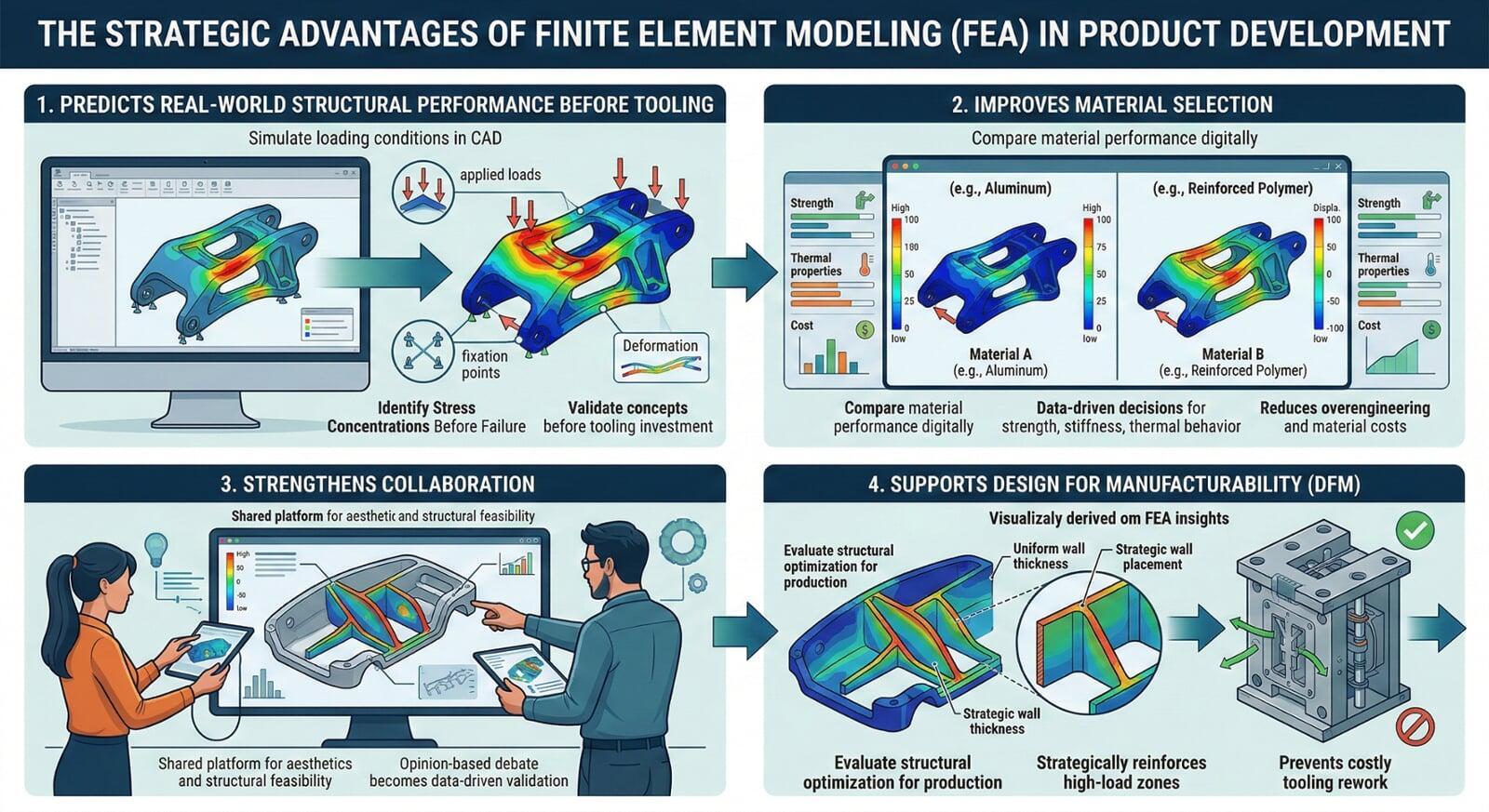
One of the most powerful advantages of a finite element model is the ability to simulate real-world loading conditions before physical testing or tooling investment. Instead of relying solely on assumptions or overdesigning for safety, engineers can analyze stress distribution, deformation, and load paths directly within the CAD environment.
This predictive capability allows teams to validate concepts before committing to expensive molds, dies, or CNC programs.
- Identifying Stress Concentrations Before Failure
Finite element analysis reveals stress concentrations around sharp corners, thin walls, holes, rib intersections, and snap features. These areas often become failure points during physical testing. By identifying them early, designers can refine geometry before prototypes fail in validation.
- Reducing Overengineering
Without simulation, teams often add unnecessary thickness or reinforcement as a safety buffer. A finite element model enables precise reinforcement only where required, reducing excess weight and material cost while still meeting safety factors and performance targets.
2. Improves Material Selection in Product Design
Material decisions directly influence strength, stiffness, thermal resistance, durability, and cost. A finite element model allows engineers to simulate how different materials respond under identical load conditions before procurement decisions are finalized.
This makes material selection in product design a data-driven process aligned with real performance metrics.
H3: Comparing Material Performance Digitally
Engineers can simulate aluminum versus reinforced polymers, ABS versus Nylon, or glass-filled materials under identical structural conditions. Differences in stress distribution, displacement, and safety factors become measurable long before physical samples are ordered.
- Evaluating Thermal and Fatigue Behavior
Beyond static loads, finite element analysis supports evaluation of heat dissipation, vibration exposure, and cyclic fatigue. This is critical for products exposed to continuous mechanical stress or elevated temperatures during use.
3. Strengthens Collaboration Between Industrial Design and Mechanical Engineering
In many organizations, aesthetic intent and structural feasibility operate in separate workflows. A finite element model serves as a shared platform for industrial design and mechanical engineering collaboration.
Instead of debating assumptions, teams evaluate simulation results together and refine geometry based on measurable data.
- Preserving Aesthetic Intent While Improving Strength
Industrial designers can maintain visual form and surface language while engineers optimize internal structures such as ribs, gussets, or wall transitions to meet load requirements.
- Enabling Data Driven Engineering Validation
When simulation outputs are integrated early, design decision making shifts from opinion-based debate to engineering validation supported by quantifiable stress and displacement data.
4. Supports Design for Manufacturability
Performance alone does not guarantee production success. Designs must align with design for manufacturability principles to avoid tooling challenges and production inefficiencies. A finite element model helps teams evaluate structural optimization without compromising manufacturability.
Simulation insights often influence wall thickness uniformity, draft angles, rib spacing, and transition radii.
- Optimizing Wall Thickness and Rib Placement
By analyzing stress maps, engineers strategically reinforce high-load zones while maintaining manufacturable geometry. This reduces mold complexity and improves production consistency.
- Preventing Tooling Rework
Validating geometry digitally before mold cutting or CNC programming reduces the risk of costly tooling corrections. Early structural validation supports smoother release to manufacturing.
5. Accelerates the Transition from Prototype to Production with Digital Validation
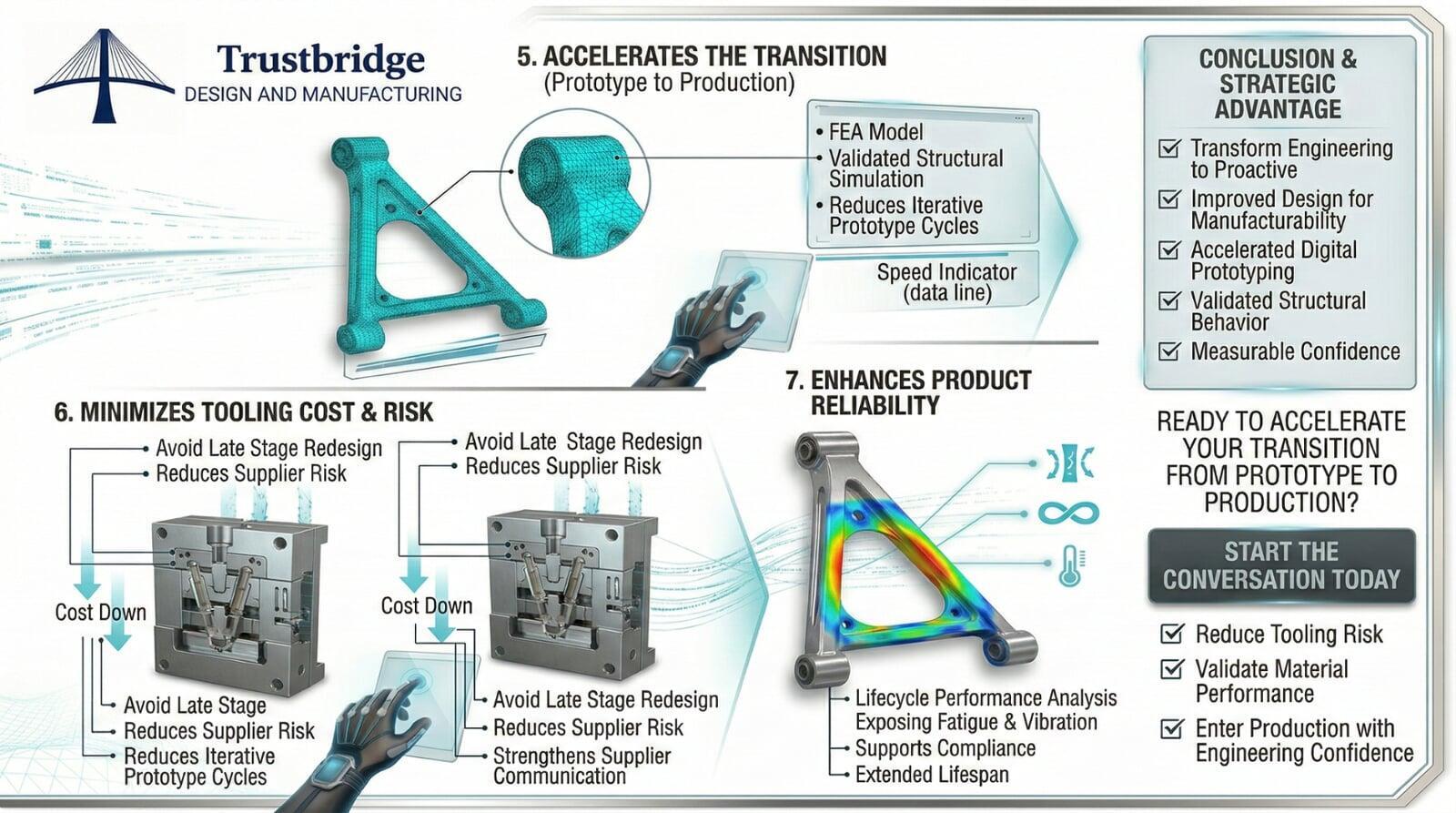
Physical prototypes remain essential, but relying on trial-and-error significantly slows iteration cycles. A finite element model refines geometry before prototypes are built, ensuring that each physical iteration is informed by validated structural simulation.
This section focuses on speed, iteration efficiency, and digital prototyping effectiveness.
- Reducing Iterative Prototype Cycles
Simulation-backed refinements reduce the number of physical revisions required to meet strength targets. Teams enter prototype testing with higher confidence, compressing development timelines.
- Improving Prototype Validation Accuracy
When physical testing closely aligns with digital predictions, engineering confidence increases. This alignment accelerates the shift from prototype to production by minimizing uncertainty.
6. Minimizes Tooling Cost, Supplier Risk, and Production Delays
Manufacturing risk extends beyond iteration speed. Late-stage failures can disrupt tooling schedules, increase supplier costs, and extend lead times. A validated finite element model reduces this financial and operational exposure.
This section focuses specifically on cost control, schedule protection, and supplier alignment.
- Avoiding Late Stage Redesign and Tooling Corrections
Discovering structural weaknesses after tooling release can cause major delays. Structural simulation shifts risk discovery to the digital stage, where adjustments are faster and significantly less expensive.
H3: Strengthening Supplier Communication and Confidence
Suppliers benefit from receiving validated CAD models with documented load cases and engineering assumptions. Simulation-supported documentation improves clarity, reduces ambiguity, and increases production readiness.
7. Enhances Product Reliability and Long Term Performance
Beyond initial validation, a finite element model supports lifecycle performance analysis. Engineers can simulate fatigue cycles, vibration environments, impact loads, and thermal cycling to predict durability.
This proactive engineering validation strengthens long-term product reliability before market launch.
H3: Extending Product Lifespan
By eliminating weak zones early in development, products are less likely to experience premature structural failure. This reduces warranty risk and enhances long-term brand credibility.
- Supporting Compliance and Certification
In regulated industries, digital validation data can supplement physical testing documentation. A well-documented finite element model strengthens technical justification during certification and compliance reviews.
Conclusion
A finite element model is not just a simulation output—it is a decision-making framework. It transforms engineering from reactive problem-solving into proactive risk prevention.
From improving material selection in product design to enabling stronger collaboration between industrial design and mechanical engineering, structural simulation improves product confidence before tooling investment. It strengthens design for manufacturability, accelerates digital prototyping, and reduces risk across the transition from prototype to production.
By validating structural behavior digitally, teams reduce uncertainty, compress development timelines, and enter manufacturing with measurable confidence rather than assumptions. In competitive product environments, that confidence becomes a strategic advantage.
If your team is moving from concept to production, simulation should not be an afterthought.
Partner with an engineering and manufacturing team that integrates finite element modeling directly into product development—from CAD preparation and structural validation to production-ready optimization.
Reduce tooling risk.
Validate material performance before procurement.
Enter production with engineering confidence.
Ready to accelerate your transition from prototype to production? Start the conversation today.
Frequently Asked Questions (FAQs)
1. What is a finite element model and why is it important before manufacturing?
A finite element model is a digital simulation method used to predict how a product will respond to real-world forces such as stress, vibration, heat, and load. It allows engineers to identify weaknesses, optimize geometry, and validate performance before any physical prototype is built. This reduces costly design errors and accelerates the prototype to production transition.
2. How does a finite element model support industrial design and mechanical engineering teams?
A finite element model creates alignment between industrial design and mechanical engineering by validating structural performance without compromising aesthetics or functionality. Designers can refine form, material thickness, and internal structures while engineers ensure the product meets load, durability, and compliance requirements.
3. Can finite element modeling improve material selection in product design?
Yes. Finite element analysis helps compare different materials under identical load conditions, making material selection in product design more data-driven. Engineers can evaluate strength, weight, flexibility, thermal resistance, and cost impact before finalizing specifications, improving both performance and manufacturability.
4. How does a finite element model reduce manufacturing risk?
By simulating stress concentrations, deformation, fatigue points, and thermal behavior early in development, a finite element model identifies design weaknesses before tooling investment. This supports design for manufacturability, minimizes rework, reduces tooling changes, and improves production predictability.