
7 Ways 3D Printer Platen Adhesion Impacts Print Quality and Dimensional Accuracy
In additive manufacturing, first-layer performance determines everything that follows. A poorly adhered first layer can cause warping, dimensional drift, surface defects, and even complete print failure. Common failure modes include elephant’s foot distortion, curling at corners, layer shifting, rippling along the base, and complete detachment during the first 5–10 layers of printing. This is where 3D printer bed adhesive plays a critical role. Different adhesives serve different material behaviors—what works for PLA may be insufficient for ABS, while Nylon often requires stronger or temperature-tuned solutions.
While many teams focus on slicer settings, layer height, or infill strategies, the stability of the build platform is often underestimated. Bed adhesion affects dimensional accuracy, repeatability, and production reliability—especially in environments using 3D printing for rapid prototyping and functional validation. Teams frequently overlook adhesion-related variables such as bed temperature uniformity, surface cleanliness, adhesive thickness, airflow, and first-layer compression. Repeatability suffers because varying adhesion strength influences shrinkage and warping differently from print to print.
Understanding how adhesive selection interacts with materials, CAD preparation, and downstream production requirements is essential for achieving consistent part quality from prototype to production. Adhesive choice can affect raft removal behavior, first-layer compression, and bottom-surface tolerances. CAD features such as thin walls, large flat surfaces, sharp corners, and wide bases are particularly sensitive to adhesion stability.
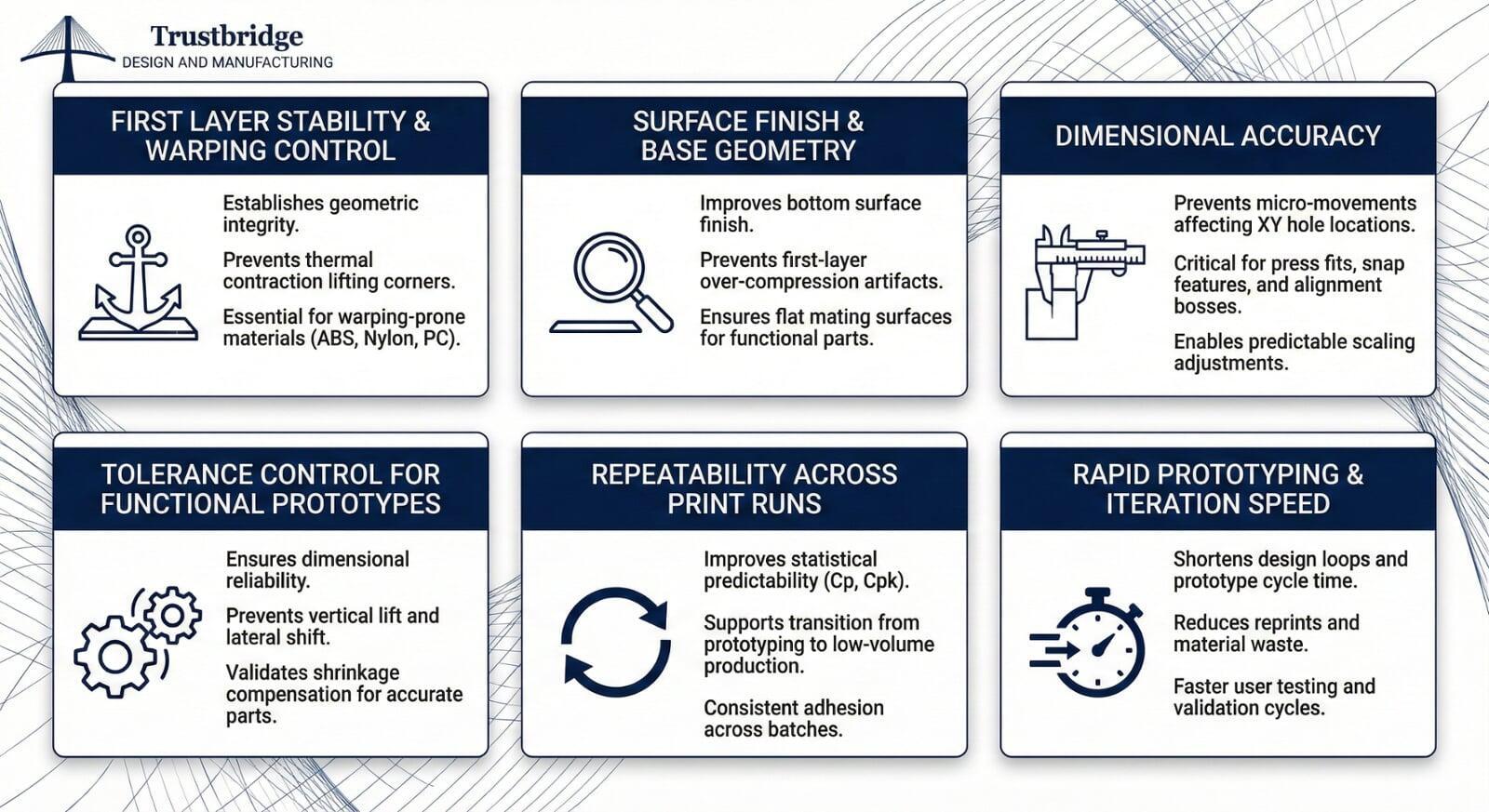
Why 3D Printer Bed Adhesive Is Critical to Print Quality
The first layer establishes geometric integrity for the entire build. If adhesion is inconsistent, thermal contraction during cooling can lift corners, introduce internal stress, and distort final dimensions. Even small deviations at the base can cascade into measurable dimensional inaccuracy across the part. First-layer height calibration directly interacts with adhesive performance; too little compression reduces bonding, while too much creates over-extrusion artifacts. Thermal contraction rates differ significantly by polymer type, making adhesion control especially important for engineering applications.
For engineering teams focused on tolerance control and repeatability, bed adhesion is not just a convenience—it is a controlled process variable within a validated build environment. Stable adhesion ensures predictable shrinkage, flatness, and bonding between layers. This is especially critical for tolerance-sensitive components such as snap-fit features, press-fit housings, alignment bosses, and enclosure interfaces.
When adhesion is optimized, the result is smoother bottom surfaces, improved Z-axis consistency, reduced first-layer over-extrusion artifacts, and stronger interlayer bonding. These benefits are particularly important for warping-prone materials such as ABS, Nylon, and polycarbonate.
- First Layer Stability and Warping Control
Thermoplastics expand when heated and contract as they cool. If the first layer does not maintain firm contact with the build plate, thermal contraction forces can pull edges upward, causing warping or curling. Large flat bases, sharp corners, and long unsupported edges are especially prone to distortion. Adhesive selection interacts with bed temperature and cooling rates to control these stresses.
Engineering-grade materials introduce higher stress due to elevated glass transition temperatures, uneven shrinkage, and in Nylon’s case, crystalline behavior. Composite blends such as carbon-fiber-reinforced Nylon and glass-filled ABS are even more sensitive to adhesion instability due to anisotropic shrinkage and fiber reinforcement.
- Surface Finish and Base Geometry
A consistent adhesive layer improves bottom surface finish and geometric stability. Uneven adhesion can cause first-layer over-compression, altering base thickness and edge definition. Visible defects may include glossy-to-matte transitions, rippling textures, and exaggerated elephant’s foot distortion. For functional prototypes requiring flat mating surfaces or assembly validation, these defects directly impact usability and measurement accuracy.
The Role of Bed Adhesive in Dimensional Accuracy
Dimensional accuracy in 3D printing is influenced by temperature control, material shrinkage, machine calibration, and adhesion stability. Mechanical vibrations or gantry motion can amplify even minor base shifts. XY hole locations, flatness, and perpendicularity are especially sensitive to these micro-movements.
A secure bond prevents micro-movements that distort circular features into ovals or shift hole centers. For parts with press fits, snap features, or alignment holes, even fractions of a millimeter matter. Repeatability across batches is heavily influenced by adhesion consistency.
Consistent adhesion enables predictable scaling adjustments within the slicer, allowing engineers to compensate accurately for shrinkage. Shrinkage compensation varies by polymer type, making controlled baseline adhesion conditions essential.
- Tolerance Control for Functional Prototypes
Functional components such as housings, brackets, or enclosures require dimensional reliability. If bed lift occurs, hole positions can shift and walls may taper subtly. Inconsistent adhesion invalidates scaling corrections because shrinkage becomes unpredictable. Reliable adhesion prevents both vertical lift and lateral shift, ensuring geometry remains anchored throughout the print cycle.
- Repeatability Across Print Runs
In production-oriented environments, repeatability is measured through dimensional variance, flatness metrics, and Z-height drift. Consistent adhesion improves statistical predictability, supporting Cp and Cpk analysis. This becomes especially important when transitioning from rapid prototyping to low-volume production.
Impact on Rapid Prototyping and Iteration Speed
Rapid prototyping depends on speed, accuracy, and confidence in iteration cycles. Adhesion failures frequently occur within the first 5–10 layers and are often linked to inadequate surface preparation, dust contamination, skin oils, or inconsistent adhesive thickness.
When adhesives are properly selected and applied, iteration cycles become more predictable. Predictable builds shorten design loops, reduce prototype cycle time, and maintain alignment between design, engineering, and testing teams. Stable printing conditions also support parallel development, allowing mechanical, electrical, and industrial design teams to progress simultaneously.
- Reducing Reprints and Material Waste
Repeated warping wastes not only filament but also machine time and operator labor for cleanup and re-leveling. High-cost materials such as Nylon 12, PC blends, and carbon-fiber-reinforced composites amplify these losses. Strong adhesion reduces scrap rates and improves resource efficiency.
- Faster Validation Cycles
Consistent prints enable earlier user testing, ergonomic trials, and functional load testing. Stable adhesion reduces the need for repeated slicer tuning and profile adjustments, allowing teams to focus on refining geometry rather than troubleshooting instability.
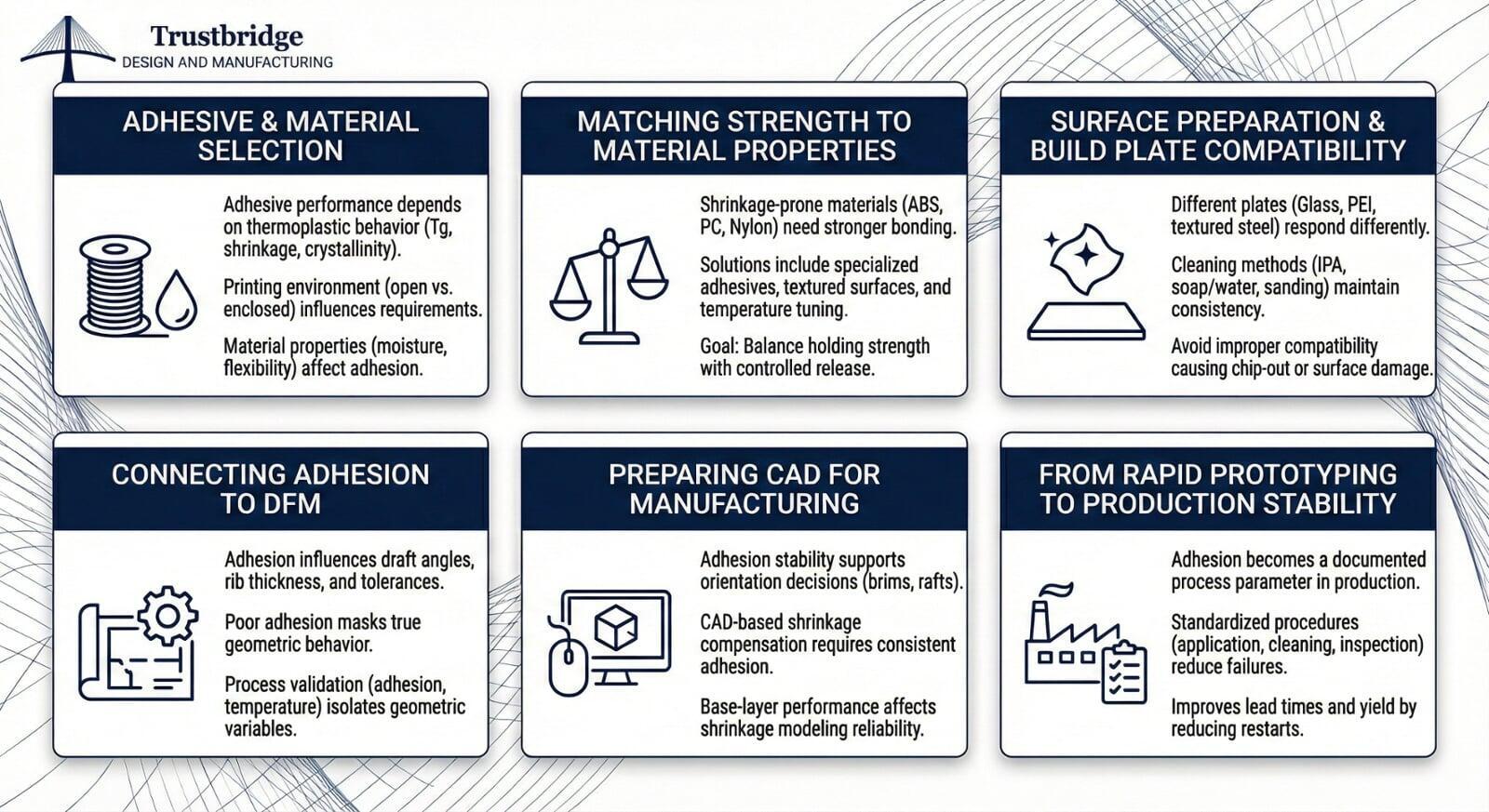
Adhesive Selection and Material Selection in Product Design
Adhesive performance varies depending on thermoplastic behavior. Glass transition temperature, shrinkage rate, and crystallinity influence adhesive requirements. Printing environment also matters—open-frame printers behave differently than enclosed heated chambers.
Material properties directly affect adhesion. Nylon’s moisture absorption reduces stickiness, while flexible materials deform easily and may lift without strong bonding. Improper adhesive compatibility can cause chip-out on corners, surface tearing, fused first layers, or even damage to the build plate such as scratches or coating removal.
- Matching Adhesive Strength to Material Properties
Shrinkage-prone materials such as ABS, PC, and Nylon require stronger bonding solutions, which may include specialized adhesives, textured surfaces, or temperature-tuned bed settings. The goal is balancing holding strength with controlled release.
H3: Surface Preparation and Build Plate Compatibility
Glass, PEI, textured steel, and coated plates respond differently to adhesives. Cleaning methods such as IPA wipes, soap and water, or light sanding for PEI surfaces maintain bonding consistency. PETG may bond excessively to PEI, while Nylon may struggle on glass without assistance.
Connecting Bed Adhesion to Design for Manufacturability
Bed adhesion directly influences design for manufacturability. Accurate prototypes guide decisions regarding draft angles, rib thickness, and tolerance stack-ups. Poor adhesion can mask true geometric behavior, leading to misdiagnosed issues such as tapering walls mistaken for CAD errors or warped housings blamed on poor fit design.
Process validation—including adhesion testing, temperature verification, and airflow checks—should occur before altering geometry. Stabilizing adhesion, temperature, and build-plate conditions allows engineers to isolate geometric variables from process variables.
- Accurate Data for Engineering Decisions
Reliable prototypes support evaluation of snap-fits, screw bosses, alignment bosses, and sliding interfaces. Accurate prints reduce the need for iterative mold adjustments later in development.
- Smoother Transition from Prototype to Production
Repeatable adhesion ensures consistent geometry across multiple prototypes, reducing variation during validation testing. Accurate prototypes minimize tooling errors and shorten time to production.
Preparing CAD for Manufacturing and Adhesion Considerations
Dimensional accuracy begins at the CAD stage. Adhesion stability supports orientation decisions that maximize contact area and minimize unsupported overhangs. CAD-based shrinkage compensation only works when adhesion is consistent between runs.
Base-layer performance directly affects shrinkage modeling reliability. Tolerance allowances assume minimal distortion, making adhesion a prerequisite. Without reliable adhesion, poor results may lead engineers to incorrect conclusions about geometry rather than process.
- Orientation and Base Contact Area
Brims increase surface area for improved bonding, while rafts add a sacrificial base layer—useful for highly warp-prone geometries. Orientation changes may alter strength, support requirements, and internal stress patterns.
H3: Shrinkage Compensation and Calibration
Unpredictable adhesion leads to variable shrinkage, invalidating calibration routines. Stable adhesion is essential for calibrating dimensional offsets, stepper accuracy, and XY compensation.
From Rapid Prototyping to Production Stability
As additive manufacturing moves toward end-use production, adhesion becomes a documented process parameter. Adhesives must be integrated into work instructions, quality checks, and material control lists—just like temperature validation and filament conditioning.
Failed first layers can reduce yield by 10–30% depending on geometry and material. Adhesion stability reduces restarts and operator intervention, improving lead times.
Standardization may include measured adhesive application amounts, defined cleaning intervals, surface inspection criteria, photo documentation, and controlled adhesive inventories.
Conclusion
3D Printer bed adhesive may appear to be a small detail, but its influence spans print quality, dimensional accuracy, prototyping efficiency, and production readiness. Adhesion control reduces noise in test data, improving engineering decision quality.
For teams engaged in rapid prototyping and transition from prototype to production, stable adhesion results in fewer reprints, faster feedback loops, and more accurate DFM decisions. It is foundational for testing new materials, validating load-bearing prototypes, and reducing dimensional uncertainty through consistent CAD preparation.
If your team relies on additive manufacturing for functional prototypes or low-volume production, evaluate suppliers beyond sample quality. Ask about their adhesion SOPs, calibration routines, surface preparation standards, and repeatability metrics.
A production-ready partner should provide documented build procedures, controlled workflows, and inspection processes supported by metrology tools not informal practices.
Ready to improve print reliability and dimensional consistency? Partner with a supplier that treats bed adhesion as a controlled engineering parameter, ensuring confidence from first layer to final production part.
Frequently Asked Questions (FAQs)
1. How does 3D printer bed adhesive directly affect dimensional accuracy?
3D printer bed adhesive stabilizes the first layer, preventing lifting or lateral shifting during thermal contraction. Without consistent adhesion, XY hole positions, flatness, and perpendicularity can drift. Even minor base movement can distort circular features or alter tolerance-critical dimensions.
2. Why do some materials require stronger bed adhesion than others?
Materials like ABS, Nylon, and PC shrink more aggressively due to higher glass transition temperatures and thermal contraction rates. Crystalline materials such as Nylon also introduce uneven shrinkage. These behaviors create internal stresses that require stronger or temperature-tuned adhesive solutions to prevent warping.
3. Can inconsistent adhesion invalidate scaling and shrinkage compensation?
Yes. CAD-based shrinkage compensation assumes predictable contraction. If adhesion varies from print to print, shrinkage becomes inconsistent, making scaling corrections unreliable. Stable adhesion creates the controlled baseline required for accurate dimensional calibration.
4. How does bed adhesion impact the transition from prototype to production?
Inconsistent adhesion increases reprints, dimensional variance, and yield loss. In production environments, first-layer failures can reduce yield by double-digit percentages. Standardized adhesive processes improve repeatability, statistical predictability, and time-to-production reliability.