
The Real Cost of a Bad Design-to-Manufacture Handoff
A handoff isn't a formality between finishing a design and starting production. It's the single most expensive moment to get wrong in the entire process and most teams only find out after it's too late to fix cheaply.
Introduction
A design-to-manufacture handoff is the point where a completed (or nearly completed) design stops being the design team's problem and starts being the manufacturing partner's problem. Done well, it's barely noticeable a clean set of drawings, a model that matches them, and a shared understanding of what actually matters on the part. Done poorly, it's where rework, delay, and blown budgets quietly originate, even though the bill for all three usually arrives weeks later and gets blamed on something else entirely: a slow supplier, a difficult part, a tight schedule. The handoff itself rarely gets named as the cause, which is exactly why it keeps happening project after project, at company after company, without anyone ever tracing the pattern back to its actual source. This piece covers what a bad handoff actually costs, how to catch the problem before it's expensive, and why the fix has more to do with when design and manufacturing talk to each other than with any single document or checklist.
What actually breaks when the handoff is poor
The damage from a poor handoff rarely looks like one dramatic failure. It looks like a string of small, expensive surprises that compound, and the compounding follows a well-established pattern in product development: the cost of fixing a design issue doesn't rise steadily as a project moves forward, it rises exponentially. Product development researcher Donald Reinertsen, in his widely referenced Managing the Design Factory, found that a change caught early in a design process can be hundreds of times cheaper than the identical change caught late. Manufacturing-specific analysis backs up just how much that adds up to in practice: engineering change orders alone are estimated to consume a third to half of a team's total engineering capacity, and 20 to 50% of tooling cost, on large development programs. Every missing assumption, undocumented rationale, or ambiguous callout becomes a question once it reaches manufacturing, and every one of those questions becomes a delay while someone waits for an answer, then very possibly a redo once the real intent finally surfaces.
The cost also compounds because of when it shows up. A tolerance choice, a decision to machine a feature instead of casting it, a material substitution each of these takes an engineer minutes to decide during design and hours to unwind once tooling, quotes, or a production run are already committed to the earlier choice. That asymmetry is why the same mistake costs so much more depending on when it's caught: cheap as a redline on a drawing, expensive as a change order once a supplier has already started cutting metal. A bad handoff doesn't create new mistakes so much as it guarantees that whatever mistakes already exist in the design get discovered at the most expensive possible moment instead of the cheapest one.
Where the damage actually starts
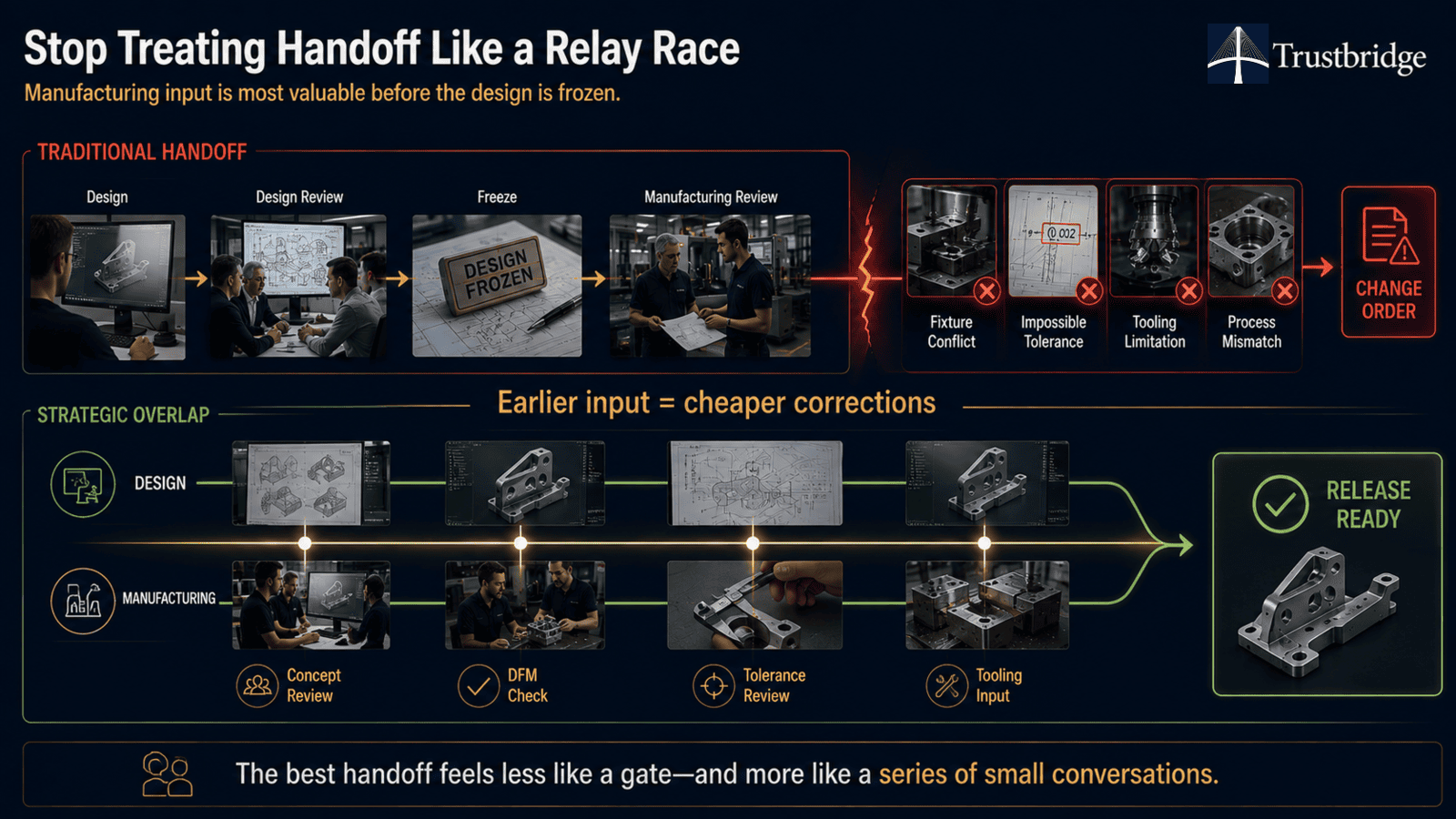
Most bad handoffs trace back to the same structural cause: manufacturing input arrives too late to be cheap. In many product development processes, formal design reviews follow a predictable sequence a preliminary review that tests the overall approach, a critical design review that freezes the detailed design, and only after that, a manufacturing readiness review where the people who actually have to build the part get their first real look at it. By design, that sequence means manufacturing's first substantive feedback often arrives after the design is already frozen, which means every issue they raise is now a change to something "finished," not an input to something still in progress.
This isn't a communication failure in the usual sense nobody forgot to send an email. It's a structural one: the process itself schedules manufacturing's involvement for a point where most of the cheap opportunities to fix something have already closed. Teams that treat this sequence as fixed keep discovering the same category of problem at the same expensive stage, project after project, and keep treating each instance as a one-off surprise rather than the predictable output of how the handoff itself is structured. The frustrating part is that none of this requires anyone to have made an obvious mistake. A design can pass every internal review, look complete on paper, and still arrive at manufacturing with exactly this kind of problem baked in, simply because the people who would have caught it were never in the room early enough to say so.
Diagnosing the problem before the gate, not after
The fix isn't more meetings after the fact it's running a lightweight manufacturability check before the design is released, while a fix is still a redline instead of a rebuild. As engineering design review platform CoLab puts it, formal design reviews exist precisely so each class of error gets caught while it's still cheap: a tolerance or interference problem flagged at the pre-release design review is a quick correction, while the same problem discovered after release reaches a supplier as scrap or a costly engineering change. That review typically confirms the drawings carry complete callouts, the model and drawing agree, tolerance stack-ups actually close, and nothing has been left for someone downstream to guess at.
Pre-gate diagnosis just means asking manufacturing-shaped questions before manufacturing is formally in the room: would a shop we haven't briefed yet be able to build this from the drawing alone? Is there a decision on this print that only makes sense because of context that lives in someone's head and nowhere else? Some industries make this explicit injection-molding programs, for instance, often define a formal gate objective along the lines of "the design is tooling-ready," with exit criteria requiring DFM sign-off and locked materials and tolerances before a single dollar goes into a mold. Running that same kind of check before the design is called final, even informally, catches exactly the category of problem that would otherwise surface for the first time at handoff except now it's a conversation instead of a change order. It doesn't require a new department or a heavyweight process; it requires treating the question "could this actually be built as drawn, by someone who's never seen it before" as something worth answering before release, not after a supplier asks it for you.
Strategic whitespace between design and manufacturing
The deeper fix isn't a better checklist at the gate it's rethinking whether the handoff should be a single gate at all. Most of the cost described above comes from treating design-to-manufacture as a relay race: design runs its leg, then hands off a finished baton to manufacturing, who runs theirs starting from a dead stop. The alternative is building deliberate overlap into the process itself: a manufacturing partner sitting in on a mid-design review instead of seeing the print for the first time at release, a running conversation about process constraints instead of a single DFM memo delivered at the end, informal check-ins that happen because the relationship allows for them rather than because a gate requires them. It's precisely in that kind of ongoing overlap that a fixturing detail, a tooling interface, or a process limitation gets caught while the design still has room to absorb it, rather than in a single scheduled review that either happens to catch it or doesn't.
This is a different kind of whitespace than leaving a dimension deliberately open on a drawing it's whitespace in the process itself: time and access built in for the two functions to see each other's work before either side considers their piece finished. A design-to-manufacture handoff with well-placed whitespace doesn't feel like a single dramatic event at all. It feels like a series of small, low-stakes conversations that happened early enough to never become an expensive one later, spread across the design process rather than crammed into a single review meeting right before release.
What a good handoff actually includes
Concretely, a handoff that holds up under pressure usually includes a few specific things, not just good intentions. The drawing and the model need to actually match, with no hand-edits made to one without updating the other. The rationale behind anything unusual a tight tolerance, an exotic material, a specific process call-out needs to be written down somewhere a manufacturing partner can actually find it, not left as tribal knowledge in the original designer's head. A DFM review needs to have actually happened, with its findings incorporated rather than filed away. And there needs to be a clear, named point of contact on the design side who can answer a question in hours, not days, because the value of everything else collapses if a manufacturing partner hits a question and has nowhere fast to take it.
None of this is exotic. It's the difference between a handoff that's a genuine transfer of understanding and one that's just a transfer of files and the second kind is almost always where the expensive surprises hide, precisely because it looks complete without actually being complete.
A quick way to diagnose your own handoff
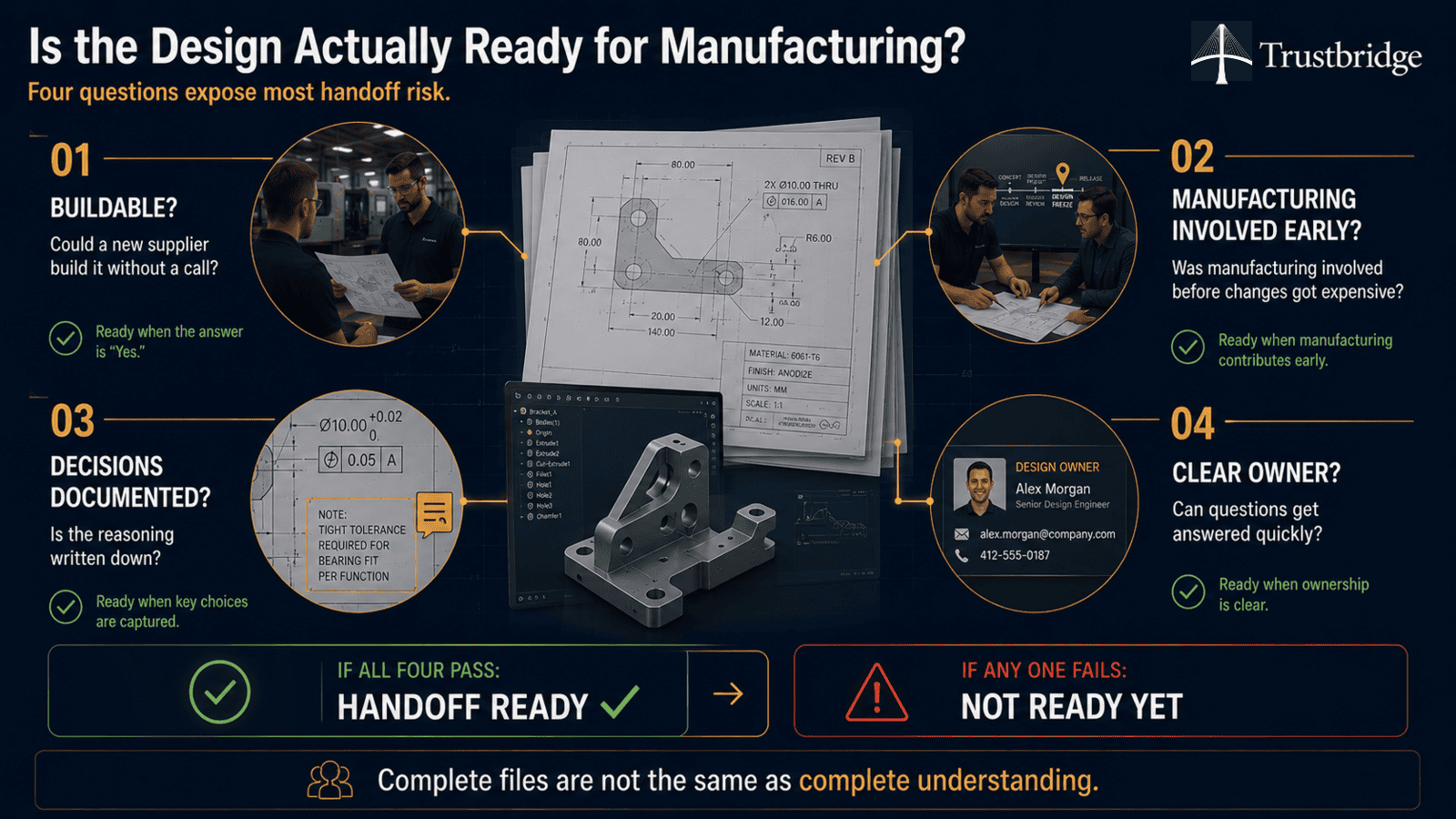
A few questions tend to reveal whether a handoff is actually ready, before it becomes someone else's expensive problem to solve rather than a quick fix on this side of the release:
Could a shop that has never seen this part before build it correctly from the drawing alone, with no follow-up call?
Has manufacturing seen this design before the point where changing it becomes expensive, or only after?
Is there a decision on this drawing whose reasoning lives only in a conversation nobody wrote down?
If a question comes back from the shop, is there a specific person who can answer it quickly, or does it have to find its way through several people first?
A handoff that can't clear these questions isn't ready yet, regardless of how complete the drawing package looks on the surface.
Conclusion
The real cost of a bad design-to-manufacture handoff was never really about the handoff document itself it's about the exponential cost curve a poor handoff runs straight into, and how much of that cost was sitting there, avoidable with a five-minute conversation weeks earlier. Diagnosing the problem before the gate, rather than after, and building genuine whitespace into the process instead of treating the handoff as one hard cutover, is what turns an expensive surprise into a routine conversation. The teams that get this right don't have fewer problems with their designs. They just find out about them while they're still cheap, at a point in the process where a fix is still a conversation instead of a change order, a redesign, or a missed launch date.
Not sure whether your next handoff is actually ready?
A handoff that looks complete on paper can still be hiding the exact gaps that turn into rework three weeks later an undocumented assumption, a drawing that's drifted from the model, a tolerance nobody can explain anymore, a finish note nobody double-checked. Share the design package before it goes out, and get a straight read on whether it's genuinely ready for manufacturing or just looks that way on the surface. Get a handoff readiness check before a gap that would have taken five minutes to close today costs a redesign, a missed date, or an awkward conversation about the budget next month.
Frequently Asked Questions
1. What should be included in a design-to-manufacturing handoff?
A complete design-to-manufacturing handoff should include accurate CAD models and drawings, clearly defined tolerances and specifications, material and finish requirements, relevant DFM feedback, and documented decisions that affect manufacturing. It should also identify a clear engineering contact who can quickly resolve questions that arise during production.
2. How can you tell if a design is ready for manufacturing?
A design is ready for manufacturing when the CAD model and drawings match, critical dimensions and tolerances are clearly defined, manufacturing constraints have been reviewed, and there are no unresolved decisions that require the manufacturer to make assumptions. A useful test is whether a manufacturer seeing the part for the first time could build it correctly from the released package without needing significant clarification.
3. Why should manufacturing be involved before the design is finalized?
Early manufacturing involvement helps identify problems with tolerances, materials, tooling, fixturing, assembly, and production processes while changes are still inexpensive. Addressing these issues before design release can reduce redesigns, rework, production delays, and costly engineering changes later in the manufacturing process.
4. What are the most common problems with a design-to-manufacturing handoff?
Common problems include discrepancies between CAD models and drawings, unclear tolerances, undocumented design decisions, missing manufacturing requirements, and designs that have not received a proper DFM review. These gaps can force manufacturers to make assumptions, resulting in clarification delays, rework, scrap, and unexpected production costs.