The Material and Process Universe: Why the Best Design Partners Deliver Greater Manufacturing Flexibility
Preamble
Successful products are rarely the result of choosing a single material or manufacturing process. Instead, they are built through a series of engineering decisions that balance performance, cost, manufacturability, and production scalability. As products become more complex and development timelines become shorter, manufacturers need partners who can evaluate multiple materials and production methods rather than relying on a single area of expertise.
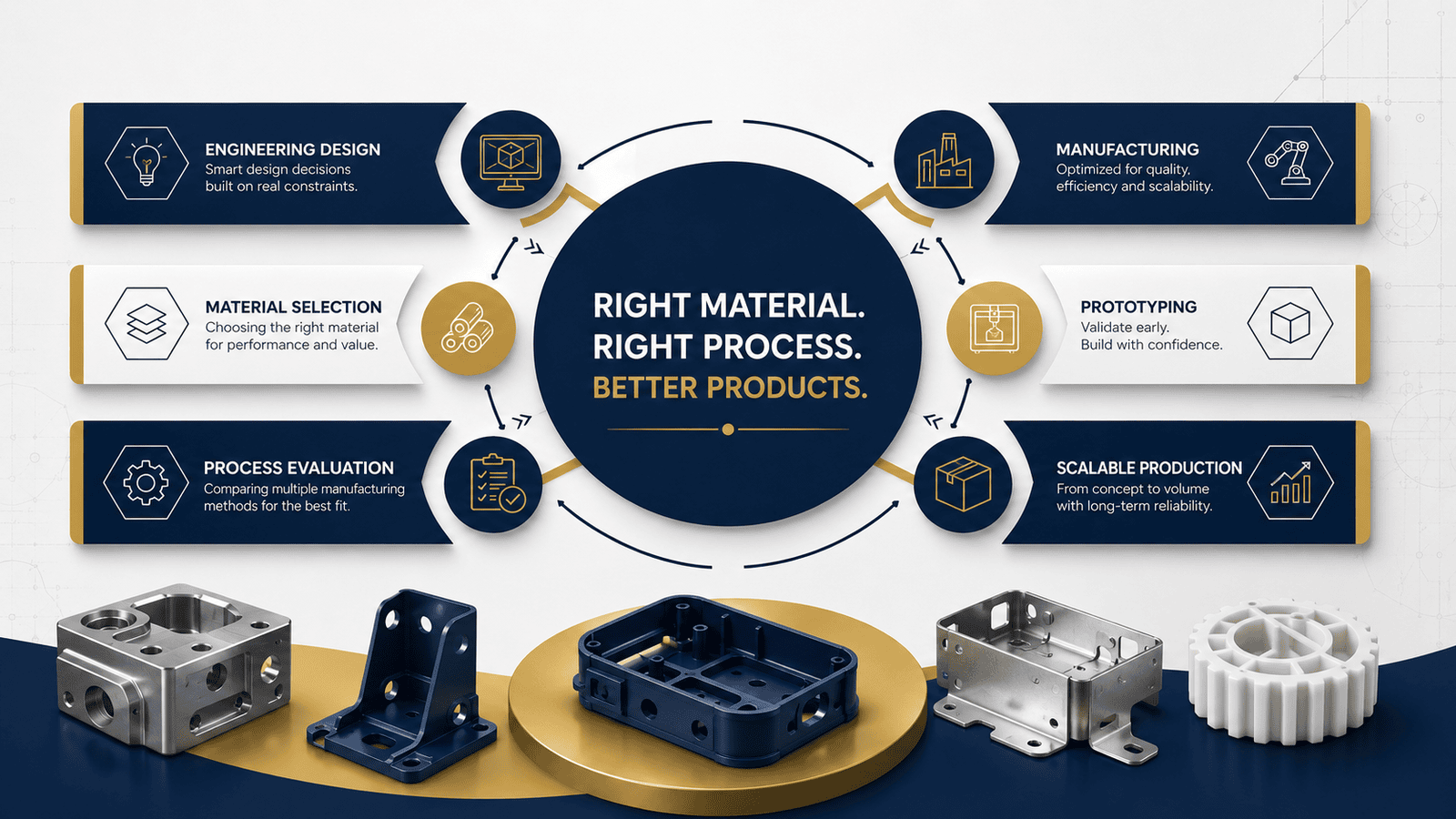
This is where material selection product design prototyping becomes a strategic advantage. The best design partners combine expertise in material selection, manufacturing processes, DFM, CNC machining, sheet metal, injection molding, prototyping, and engineering design to identify the most effective manufacturing strategy for every stage of product development. Instead of forcing designs into predefined manufacturing capabilities, they optimize products around the processes that best meet functional, commercial, and production requirements.
Introduction
This is where material selection product design prototyping becomes a strategic advantage. Every material behaves differently under real-world operating conditions, and every manufacturing process introduces its own design opportunities and constraints. Decisions made during the earliest stages of engineering design directly influence product performance, production cost, manufacturing lead times, and long-term scalability.
Whether a component is ultimately produced through CNC machining, sheet metal fabrication, injection molding, or another manufacturing process, selecting the right combination of material and process requires a broad understanding of Design for Manufacturability (DFM). Engineering teams that evaluate multiple production options early can optimize performance, simplify manufacturing, reduce development risks, and avoid costly redesigns later in the product lifecycle.
The best design partners do not recommend solutions based solely on the capabilities they already have. Instead, they evaluate the complete material and process universe to identify the manufacturing strategy that best aligns with functional requirements, commercial objectives, and future production needs. This broader engineering perspective creates greater manufacturing flexibility and enables companies to move from concept to production with higher confidence, lower risk, and better long-term outcomes.
Why Manufacturing Flexibility Has Become a Competitive Advantage
Manufacturing has evolved beyond simply selecting a material and sending a CAD model to production. Today's products require shorter development cycles, tighter quality requirements, improved supply chain resilience, and greater responsiveness to changing customer expectations. Engineering decisions that once focused only on functionality must now consider production scalability, cost optimization, supplier capability, and long-term adaptability.
Manufacturing flexibility enables companies to evaluate multiple production pathways before committing to a specific manufacturing strategy. Instead of designing exclusively for one process, engineering teams can compare alternative manufacturing methods, validate different material combinations, and optimize component geometry before production begins. This reduces costly redesigns, improves manufacturing efficiency, and creates products that remain adaptable as production requirements evolve.
Organizations that embrace manufacturing flexibility also strengthen collaboration between industrial designers, mechanical engineers, manufacturing specialists, and suppliers. Each decision is supported by broader technical knowledge rather than process limitations, allowing products to transition more smoothly from concept to scalable manufacturing.
- Flexibility Reduces Engineering Constraints
Every manufacturing process introduces its own design constraints. CNC machining requires practical cutter access, realistic internal radii, and stable workholding. Sheet metal fabrication depends on bend allowances, minimum flange dimensions, and springback compensation. Injection molding requires careful control of wall thickness, draft angles, material flow, and cooling behavior.
When engineering teams evaluate only one manufacturing process, designs often become constrained by those specific limitations. This frequently results in unnecessary geometry compromises, expensive design revisions, or production inefficiencies later in development.
By contrast, experienced design partners evaluate multiple production options before recommending a solution. If one manufacturing method creates unnecessary complexity, another may achieve the same functional objective more efficiently. This broader engineering perspective preserves product performance while improving manufacturability and reducing overall production risk.
- Adaptability Supports Long-Term Product Success
Products rarely remain unchanged throughout their lifecycle. Customer feedback, regulatory updates, supply chain disruptions, material availability, production volume increases, and cost-reduction initiatives often require engineering teams to revisit earlier design decisions.
Organizations that have already explored multiple manufacturing options are far better prepared for these changes. Instead of starting from scratch, they can leverage previously evaluated materials and manufacturing strategies to respond quickly without sacrificing quality or delaying production schedules.
This adaptability transforms manufacturing flexibility from a short-term engineering benefit into a long-term competitive advantage. Products remain easier to optimize, easier to scale, and more resilient against future business and manufacturing challenges.
Material Selection Is the Foundation of Manufacturing Flexibility
Every successful manufacturing strategy begins with selecting the right material. Material choice influences mechanical performance, weight, durability, corrosion resistance, thermal stability, manufacturability, production cost, finishing requirements, and overall product lifecycle. Choosing a material without considering how it interacts with different manufacturing processes often leads to unnecessary engineering challenges later in development.
Instead of focusing only on mechanical properties, experienced engineering teams evaluate materials within the context of production. The objective is to identify materials that not only satisfy functional requirements but also support efficient manufacturing, reliable quality, and scalable production.
Integrating material selection into early engineering discussions also improves collaboration across design, manufacturing, and supplier teams. This cross-functional approach allows products to move from concept through validation and into production with fewer engineering revisions and greater confidence.
- Matching Materials to Product Performance Requirements
Every engineering material offers unique advantages depending on the intended application. Aluminum alloys provide excellent strength-to-weight performance for lightweight structural components, while stainless steel offers superior corrosion resistance for demanding industrial environments. Engineering plastics reduce weight, simplify manufacturing, and improve cost efficiency in many consumer and electronic products, whereas composite materials may deliver specialized performance where traditional materials cannot.
Choosing the right material therefore requires more than comparing mechanical properties alone. Engineers must consider operating temperatures, fatigue life, chemical exposure, wear resistance, environmental conditions, assembly methods, and expected service life alongside manufacturing compatibility. Evaluating these factors together ensures that the selected material supports both functional requirements and efficient production throughout the product lifecycle.
- Designing Around Multiple Manufacturing Processes
The same product can often be manufactured using several different production methods, but each process interacts with materials differently. Materials that perform exceptionally well during CNC machining may not provide the same advantages during sheet metal fabrication or injection molding. Production volume, tooling investment, tolerance requirements, and surface finish expectations also influence which manufacturing process delivers the best overall value.
Experienced engineering teams evaluate materials alongside manufacturing processes rather than treating them as separate decisions. This integrated approach strengthens DFM by ensuring that material selection, geometry, production methods, and manufacturing capabilities remain aligned throughout development. As a result, companies gain greater manufacturing flexibility, reduce costly engineering changes, improve prototyping efficiency, and transition into full-scale production with significantly lower risk.
Multiple Manufacturing Processes Create Better Design Options
Products rarely have only one viable manufacturing route. A component that begins as a CNC-machined prototype may later transition to injection molding, sheet metal fabrication, die casting, or another high-volume manufacturing process as production requirements evolve. Evaluating multiple manufacturing processes early gives engineering teams the flexibility to optimize products for performance, cost, scalability, and production efficiency instead of committing to a single process too soon.
The most effective design partners understand how each manufacturing process influences geometry, tolerances, material behavior, surface finish, tooling investment, and production economics. Rather than recommending a familiar manufacturing method, they first evaluate the product's functional requirements and commercial objectives before identifying the most suitable production strategy. This process-first mindset minimizes engineering compromises while creating products that remain efficient to manufacture throughout their lifecycle.
- Choosing the Right Process Instead of Forcing One
Every manufacturing process offers distinct strengths and limitations that make it suitable for specific applications.
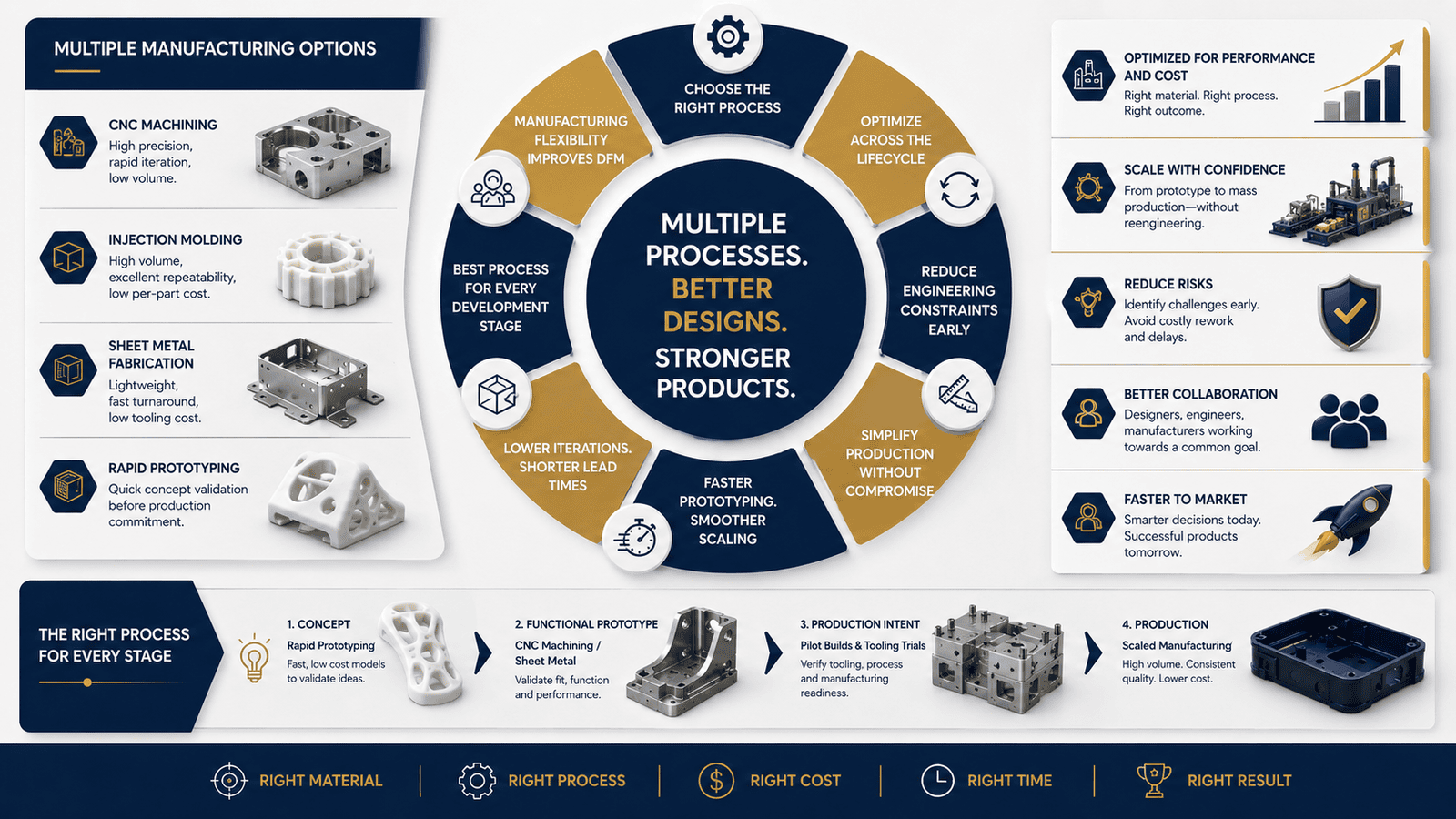
- CNC machining provides exceptional precision, rapid iteration, and flexibility for prototypes and low-volume production.
- Injection molding delivers excellent repeatability and low per-part costs once tooling investment is justified for higher production volumes.
- Sheet metal fabrication enables lightweight structural designs with fast turnaround times and relatively low tooling costs.
- Rapid prototyping technologies support quick concept validation before committing to production-grade manufacturing methods.
Selecting the wrong manufacturing process often increases production cost, extends lead times, and introduces unnecessary design constraints. Experienced engineering teams compare these alternatives before production begins, ensuring the selected process aligns with expected production volume, tolerance requirements, product complexity, and long-term business goals rather than existing manufacturing capabilities.
- Optimizing Designs Across the Product Lifecycle
Manufacturing requirements frequently evolve as products move from concept development to commercial production. During early development, rapid iterations may prioritize CNC machining or additive manufacturing because they allow fast design changes without tooling investment. Later production stages often require injection molding, progressive sheet metal tooling, or automated manufacturing processes to achieve lower unit costs and higher production volumes.
Engineering teams that anticipate these transitions early create products that evolve naturally from prototype to production without extensive redesign. By considering future manufacturing requirements during the initial design phase, they minimize geometry changes, preserve engineering intent, and reduce delays associated with tooling modifications or process changes.
This lifecycle-focused approach improves scalability, shortens development schedules, reduces engineering effort, and creates a more predictable path toward full-scale manufacturing.
Manufacturing Flexibility Improves Design for Manufacturability
Design for Manufacturability (DFM) becomes significantly more effective when engineering teams evaluate multiple manufacturing options instead of optimizing around a single production constraint. Products developed with this broader perspective achieve better manufacturing efficiency without sacrificing performance, quality, or innovation.
Manufacturing flexibility also strengthens collaboration between industrial designers, mechanical engineers, manufacturing specialists, quality teams, and suppliers. Each discipline contributes valuable insight into production feasibility, tooling requirements, assembly considerations, inspection accessibility, and material behavior. This collaborative approach enables engineering decisions that improve manufacturability while preserving the original product vision.
Rather than solving manufacturing problems after the design is complete, DFM encourages teams to prevent those problems during development, where changes are faster, simpler, and significantly less expensive.
- Reducing Engineering Constraints Early
Engineering constraints are far easier to resolve during concept development than after production tooling has been ordered or manufacturing has already begun. Features such as wall thickness, draft angles, internal radii, hole placement, material transitions, and assembly interfaces can often be optimized with minimal effort during the design phase.
Applying DFM principles across multiple manufacturing processes helps engineering teams identify potential production issues before they become costly manufacturing challenges. Instead of redesigning parts later, designers can refine geometry early while maintaining functionality and improving manufacturability.
This proactive engineering strategy minimizes production risks, protects tooling investments, and supports more predictable manufacturing outcomes.
- Simplifying Production Without Sacrificing Performance
Improving manufacturability does not mean reducing product capability or limiting engineering creativity. Instead, it focuses on eliminating unnecessary manufacturing complexity while preserving structural integrity, reliability, and customer expectations.
Small design improvements often create substantial manufacturing benefits. Examples include simplifying complex geometries, reducing unnecessary tight tolerances, standardizing component features, selecting materials with better process compatibility, and designing features that are easier to machine, inspect, or assemble.
These refinements reduce setup complexity, improve machining efficiency, shorten production cycles, and lower manufacturing costs while maintaining the same functional performance. The result is a product that balances engineering excellence with manufacturing practicality.
Faster Prototyping and Smoother Production Scaling
Prototyping is much more than building the first working model of a product. Its real purpose is to validate engineering assumptions, evaluate manufacturability, identify production risks, and confirm that a design can transition successfully into commercial manufacturing. Partners with expertise across multiple manufacturing technologies provide greater flexibility by selecting the most appropriate prototyping method for each stage of development rather than relying on a single process throughout the project.
Whether the objective is validating form, testing function, confirming mechanical performance, or preparing for production tooling, manufacturing flexibility allows engineering teams to choose the process that generates the most meaningful technical data while minimizing development time and cost.
This structured approach accelerates product development and reduces uncertainty before major production investments are made.
- Selecting the Best Process for Every Development Stage
Every phase of product development has different manufacturing requirements. Early concept models may prioritize speed and low cost, making rapid prototyping an effective solution. Functional prototypes often require CNC machining or sheet metal fabrication using production-grade materials to validate mechanical performance, dimensional accuracy, and assembly fit.
As products move closer to commercialization, pilot production and production-intent prototypes become increasingly important for verifying tooling strategies, manufacturing repeatability, quality control procedures, and supplier readiness.
Experienced design partners evaluate each development milestone independently instead of applying one manufacturing method throughout the entire project. This ensures that every prototype provides valuable engineering insight while avoiding unnecessary production costs or delays.
- Reducing Design Iterations and Manufacturing Lead Times
Repeated engineering revisions are often the result of discovering manufacturability issues too late in development. Evaluating multiple materials and manufacturing processes early allows engineering teams to identify production challenges before committing to tooling, fixtures, or supplier resources.
This early validation reduces engineering uncertainty, improves supplier communication, and enables more focused product optimization throughout development.
Manufacturing flexibility also shortens manufacturing lead times by reducing engineering rework, minimizing production bottlenecks, and improving collaboration between design and manufacturing teams. Because materials, production methods, and manufacturing strategies have already been evaluated across multiple scenarios, products enter production with greater confidence and significantly lower technical risk.
Ultimately, organizations achieve faster product launches, improved manufacturing efficiency, and a smoother transition from prototype validation to full-scale production.
Faster Prototyping and Smoother Production Scaling
A successful prototype should do more than prove that a concept works—it should also reduce uncertainty before production begins. Engineering teams that evaluate both materials and manufacturing processes early are better positioned to validate performance, identify production risks, and avoid expensive redesigns later. This is where prototype to production planning becomes a strategic advantage.
The strongest design partners select prototyping methods based on engineering objectives rather than convenience. Whether using CNC machining for functional validation, sheet metal fabrication for enclosure testing, or injection molding for production-like plastic parts, each stage contributes valuable insights that improve manufacturing readiness. By matching the right process to the right development milestone, companies accelerate validation while maintaining a smoother path toward scalable production.
- Selecting the Best Process for Every Development Stage
Different phases of product development demand different manufacturing approaches. Early concept validation may prioritize speed through rapid prototyping, while functional testing often requires CNC-machined components produced from production-grade materials. As products move closer to commercialization, pilot tooling and low-volume production runs help verify manufacturability, assembly processes, and quality consistency before full-scale production begins.
Rather than relying on a single manufacturing method throughout development, experienced engineering teams evaluate each milestone independently. This process-driven strategy ensures every prototype delivers meaningful engineering data while avoiding unnecessary tooling investments or production delays. The result is higher confidence before committing to mass production and fewer engineering surprises later in the product lifecycle.
- Reducing Design Iterations and Manufacturing Lead Times
Late-stage engineering changes are one of the biggest contributors to increased development cost and delayed product launches. Many of these revisions occur because manufacturing limitations are discovered only after designs have been finalized or tooling has already been ordered. Evaluating multiple manufacturing pathways early allows teams to identify these issues while design changes remain inexpensive and easy to implement.
Manufacturing flexibility also improves manufacturing lead times by reducing engineering rework, strengthening supplier communication, and minimizing production bottlenecks. When material selection, DFM analysis, and manufacturing process planning are validated together, products enter production with fewer unknowns and greater process stability. This integrated approach shortens development timelines while improving long-term manufacturing reliability.
- Why the Best Design Partners Build Flexible Manufacturing Strategies
The most valuable engineering partners contribute far more than manufacturing capacity. They provide strategic guidance that helps companies navigate changing technical requirements, production volumes, supply chain conditions, and commercial objectives. Rather than recommending familiar solutions, they evaluate the complete manufacturing landscape before determining the most appropriate path forward.
This broad perspective creates greater manufacturing flexibility throughout the product lifecycle. By combining expertise in material selection, engineering design, DFM, CNC machining, sheet metal fabrication, injection molding, and prototyping, experienced partners help companies reduce engineering risk while building products that remain adaptable as market conditions evolve.
- Supporting Better Decision-Making Across the Product Lifecycle
Every product development project involves balancing multiple priorities, including cost, performance, manufacturability, scalability, and time to market. Design partners with cross-process expertise help engineering teams evaluate these trade-offs using technical analysis instead of assumptions or process limitations.
Rather than asking whether a design can be manufactured, they determine which manufacturing route delivers the best overall business outcome. This broader evaluation enables companies to compare alternative materials, production methods, tooling investments, and cost scenarios before making significant commitments. As requirements evolve, products remain flexible enough to accommodate new suppliers, production volumes, or regulatory changes without requiring major redesigns.
- Creating Long-Term Manufacturing Resilience
Modern manufacturing environments are increasingly influenced by supply chain disruptions, fluctuating material availability, changing customer requirements, and continuous advances in production technology. Products designed around only one manufacturing process often become vulnerable when those external conditions change.
Experienced design partners build resilience into products from the earliest engineering stages by identifying alternative materials, secondary manufacturing routes, and scalable production strategies. This proactive approach enables organizations to respond more quickly to sourcing challenges, demand fluctuations, and evolving market opportunities while maintaining quality, production continuity, and customer satisfaction.
Conclusion
Successful product development is no longer defined by expertise in a single manufacturing process. It depends on the ability to evaluate multiple materials, manufacturing technologies, and engineering strategies before committing to production. The strongest products emerge when engineering decisions are guided by flexibility rather than manufacturing limitations.
A narrow-domain shop naturally optimizes designs around the capabilities it already possesses. The best design partners, however, evaluate the complete manufacturing ecosystem before making recommendations. By combining expertise in CNC machining, sheet metal fabrication, injection molding, prototyping, DFM, and engineering design, they identify solutions that balance technical performance with manufacturing efficiency and commercial objectives.
This broader engineering perspective reduces design compromises, minimizes development risk, strengthens supply chain resilience, and creates products that remain adaptable as production volumes and market demands evolve. Companies that embrace manufacturing flexibility gain a lasting competitive advantage through faster development cycles, lower production costs, improved product quality, and greater confidence throughout the journey from concept to scalable manufacturing.
Every product deserves more than a manufacturing partner with expertise in only one process. It deserves a team that can evaluate the full range of materials, manufacturing technologies, and engineering trade-offs before recommending the best path forward.
At Trustbridge, we help companies make smarter product development decisions through strategic material selection, engineering design, DFM, CNC machining, sheet metal fabrication, injection molding, prototyping, and end-to-end manufacturing support. Rather than limiting your options, we compare multiple manufacturing pathways to identify the solution that best aligns with your product requirements, production volumes, budget, and long-term growth objectives.
Whether you're validating an early concept, refining a functional prototype, or preparing for high-volume production, our engineering team helps reduce development risk, improve manufacturability, shorten manufacturing lead times, and build products that are ready for efficient, scalable production.
Ready to make better manufacturing decisions before production begins? Schedule a design and manufacturability consultation with Trustbridge to evaluate your product across multiple materials and manufacturing processes—and discover the strategy that delivers the greatest manufacturing flexibility for your next product.
Frequently Asked Questions
1. Why is manufacturing flexibility important in modern product development?
Manufacturing flexibility allows engineering teams to evaluate multiple materials and production processes before committing to a single manufacturing strategy. This approach helps reduce development risk, improve Design for Manufacturability (DFM), optimize production costs, and create products that can scale efficiently as business requirements evolve.
2. How do the best design partners choose the right manufacturing process?
Rather than recommending the processes they already specialize in, the best design partners evaluate the product's performance requirements, production volume, material properties, budget, and long-term manufacturing goals. They compare options such as CNC machining, sheet metal fabrication, injection molding, and rapid prototyping to identify the most effective manufacturing pathway.
3. Why should material selection and manufacturing process selection be evaluated together?
Material selection and manufacturing process selection are closely connected because the same material can behave differently depending on how it is manufactured. Evaluating both together helps engineering teams optimize product performance, manufacturability, production cost, and scalability while avoiding expensive redesigns later in the development cycle.
4. How does Design for Manufacturability (DFM) improve the transition from prototype to production?
DFM helps identify manufacturing challenges early by optimizing product geometry, material selection, and production methods before tooling or full-scale manufacturing begins. Combined with expertise across multiple manufacturing processes, DFM reduces engineering revisions, shortens development timelines, improves production efficiency, and creates a smoother path from prototype to scalable manufacturing.