
How the Best Smart Home & Consumer Hardware Engineers Design Products That Scale to Production
Introduction
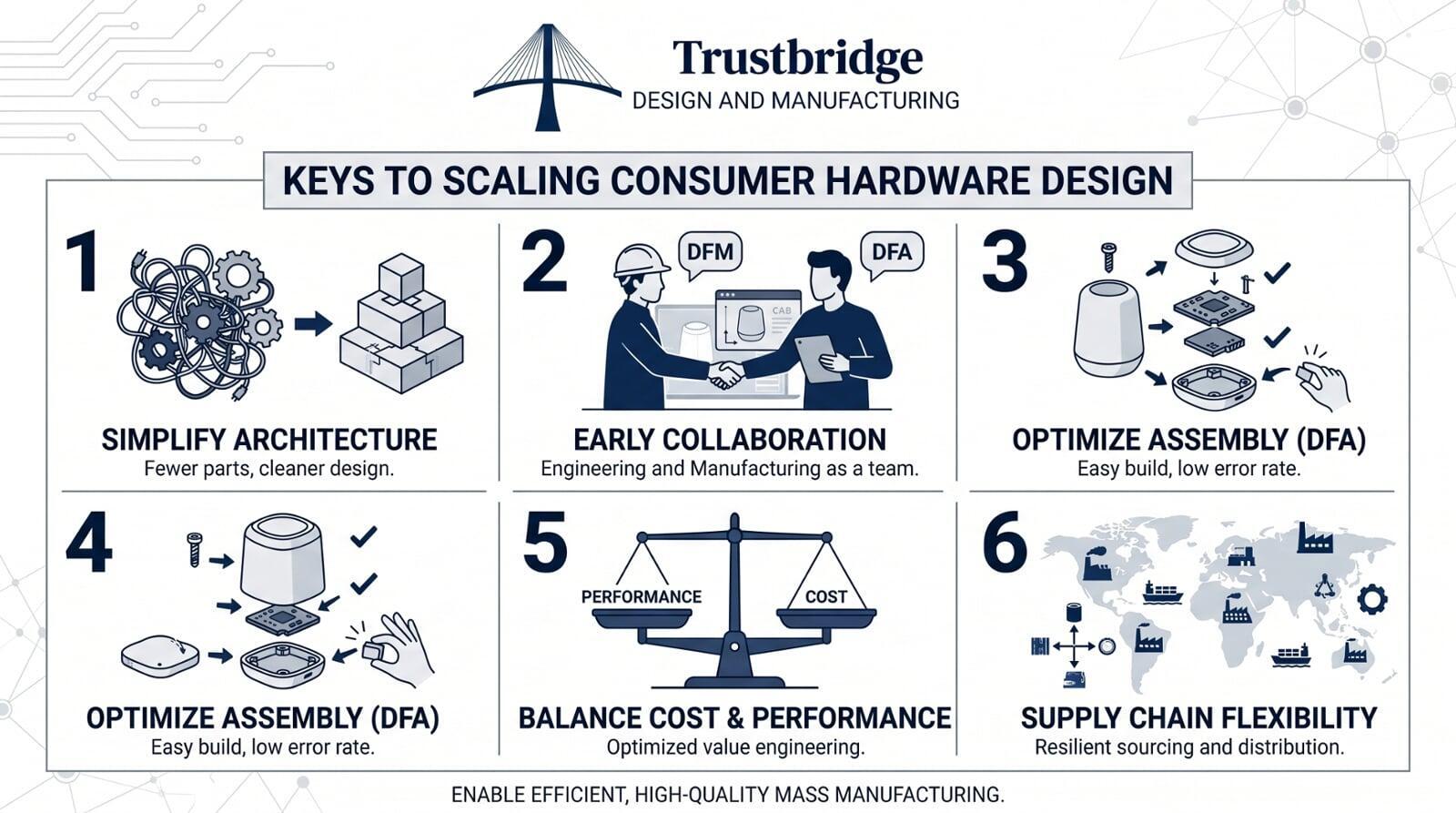
Designing a smart home or consumer hardware (CH) hardware product is only the beginning of the journey. The real challenge lies in translating that design into something that can be manufactured efficiently, consistently, and at scale—without compromising quality or performance.
Many hardware products fail to scale not because of weak innovation, but because scalability was not considered early enough. Decisions made during initial development—such as material selection, component choices, and product architecture—have long-term consequences on manufacturability, cost, and production timelines, especially during New Product Introduction (NPI) phases.
The best engineers take a different approach. They design with production in mind from day one, applying Design for Manufacturability (DFM) principles early to reduce friction, minimize iterations, and create a smoother path from prototype to mass production.
Please read on to understand how leading teams consistently design products that scale.
The Role of Simplicity in Scalable Hardware Design
Reducing Part Count and Complexity
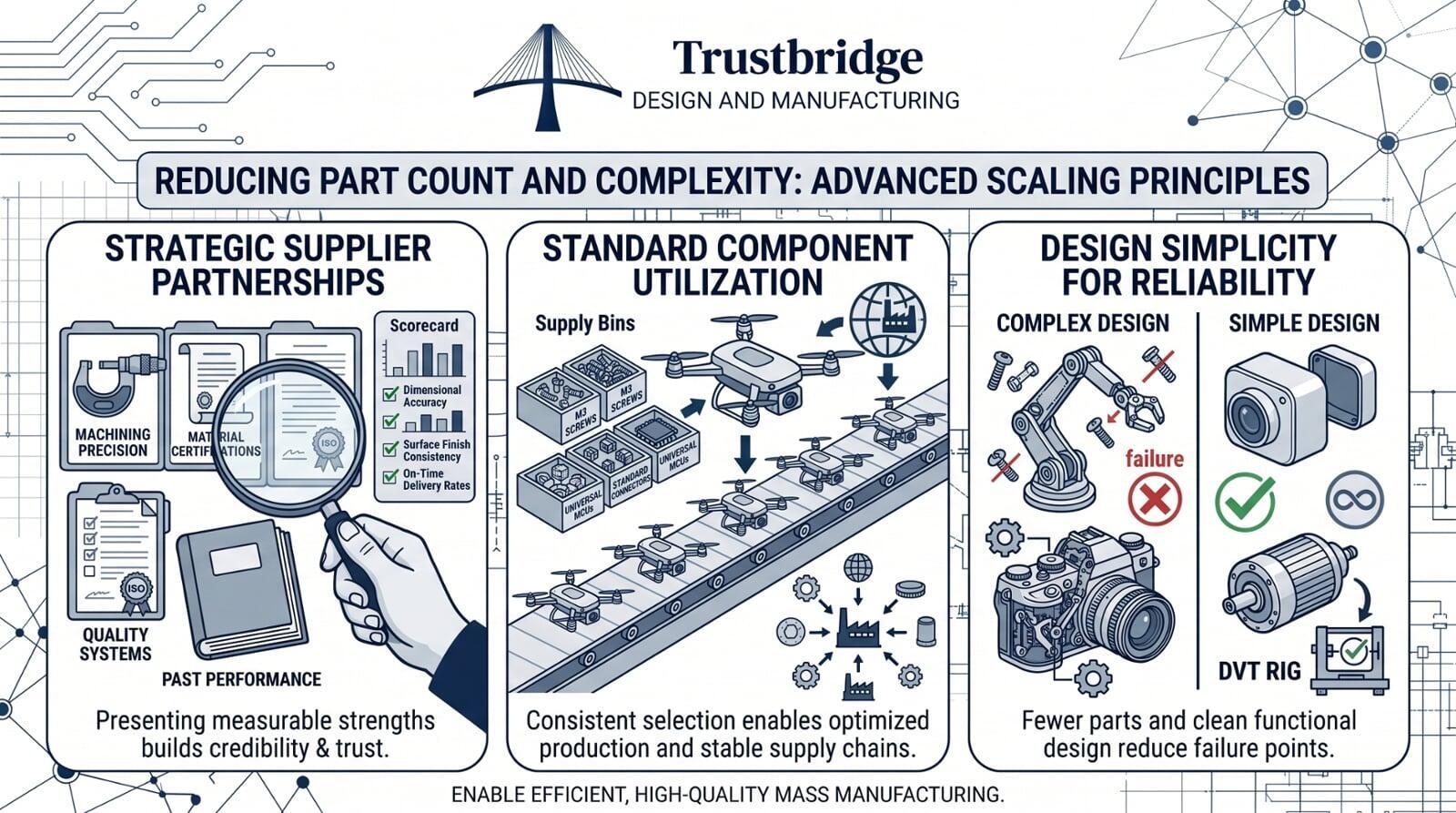
OEMs compare suppliers across defined criteria such as machining precision, material certifications, quality systems, and past performance with similar applications. Manufacturers that clearly present measurable strengths make evaluation easier and more favorable.
Sharing metrics like dimensional accuracy, surface finish consistency, and on-time delivery rates builds credibility and improves the likelihood of progressing through the RFP process.
Standardizing Components for Consistency
Standardized components make it easier to scale production across different manufacturing environments. Widely available parts improve supply chain stability and reduce reliance on specialized suppliers.
Consistency in component selection also allows manufacturers to optimize processes and maintain uniform quality across production batches—critical for consumer hardware (CH) products operating at scale.
Improving Reliability Through Simplicity
Simpler designs naturally reduce potential failure points. Complex geometries and intricate assemblies are more prone to defects, misalignment, and long-term wear.
By focusing on clean, functional design, engineers improve durability and ensure consistent performance across large production volumes, especially when validated through Design Validation Testing (DVT).
Early Collaboration with Manufacturing Teams
Early collaboration between engineering and manufacturing teams is a defining factor in successful product scaling. Waiting until designs are finalized often leads to costly redesigns, delays, and inefficiencies.
Leading teams integrate manufacturing insights during the design phase itself, aligning decisions with DFM (Design for Manufacturability) and DFA (Design for Assembly) principles. This ensures that product decisions reflect real-world production capabilities from the outset.
Identifying Production Constraints Early
Manufacturing partners provide critical insights into tooling limitations, material behavior, and process constraints. Identifying these early helps avoid designs that are difficult or expensive to produce.
This proactive approach significantly reduces late-stage surprises during Engineering Validation Testing (EVT) and pre-production builds that can derail timelines and budgets.
Incorporating Feedback into Design Decisions
Feedback from manufacturing teams helps refine tolerances, select appropriate fabrication methods, and optimize assembly strategies.
This collaboration ensures that designs are not only innovative but also practical and production-ready—aligned with NPI (New Product Introduction) requirements.
Reducing Iterations and Time-to-Market
Addressing manufacturing considerations early reduces the need for multiple design revisions later. This accelerates development cycles and helps products reach the market faster.
Fewer iterations also mean lower development costs and a more predictable production ramp, particularly when transitioning from EVT to DVT stages.
Designing for Efficient Assembly
Assembly efficiency plays a critical role in scaling production. Even well-designed products can struggle if they are difficult or time-consuming to assemble.
Engineers must design with the full assembly process in mind—whether manual, semi-automated, or fully automated—leveraging DFA (Design for Assembly) principles to ensure efficiency at scale.
For Example : Key DFA principles include minimizing part count, designing parts for easy handling (symmetrical or self-locating geometry), using single-direction assembly (top-down assembly), reducing the need for fasteners, and eliminating adjustments. For example, replacing screws with snap-fit features or using self-aligning geometries can significantly reduce assembly time and error rates. Standardizing tools and minimizing reorientation during assembly also improve throughput and consistency.
Simplifying Assembly Processes
Simplified assembly reduces build time and effort per unit. This includes minimizing steps, reducing handling requirements, and ensuring intuitive component fit.
Clear assembly logic also lowers training requirements and improves overall production speed, particularly in lean manufacturing environments.
Enabling Automation and Modular Design
As production scales, automation becomes increasingly important. Designing modular sub-assemblies and standardized interfaces makes automation easier to implement.
Modular designs also enable parallel assembly, where different sections are built simultaneously, improving throughput and aligning with cellular manufacturing systems.
A modular assembly is a design approach where a product is divided into independent, self-contained units (modules) that can be developed, tested, and assembled separately. Each module performs a specific function and connects to the overall system through well-defined interfaces.
A design is considered modular when it has:
- Clear functional separation between components
- Standardized mechanical and electrical interfaces
- Interchangeable or replaceable sub-assemblies
- Minimal interdependency between modules
For example, in a smart home device, the power module, connectivity board, and sensor unit can be designed as separate modules. This allows parallel manufacturing, easier testing, faster troubleshooting, and simplified upgrades or replacements—making the product more scalable and automation-friendly.
Reducing Labor Costs and Errors
Features like snap fits, self-aligning components, and guided insertion points reduce the need for manual adjustments.
These design choices lower labor costs and minimize human error, leading to more consistent product quality, especially in high-mix, high-volume (HMHV) production environments.
Optimizing Cost and Performance Trade-offs
Balancing cost and performance is essential when designing for scale. High-performance components can enhance functionality but may also increase production costs.
Engineers must carefully evaluate trade-offs to meet both performance expectations and cost targets, often guided by Value Engineering (VE) methodologies.
VALUE ENGINEERING EXPLANATION
Value Engineering (VE) is a systematic approach to improving the value of a product by either enhancing its function or reducing its cost without compromising performance, quality, or reliability. It focuses on analyzing each component and process to determine whether it contributes optimally to the product’s function.
In practice, VE involves:
- Identifying high-cost components and evaluating alternatives
- Eliminating unnecessary features that do not add user value
- Optimizing materials, manufacturing processes, and design complexity
- Comparing cost vs. function to ensure every element justifies its expense
For example, replacing a machined metal part with an injection-molded plastic part—while maintaining required strength—can significantly reduce cost at scale without impacting performance.
Balancing Performance with Manufacturability
A high-performing design that is difficult to manufacture will struggle at scale. Engineers must ensure that performance improvements do not introduce unnecessary complexity.
Achieving this balance requires a strong understanding of both product requirements and manufacturing capabilities, particularly under DFM (Design for Manufacturability) constraints.
Selecting Cost-Effective Materials and Components
Material selection significantly impacts production costs. Choosing durable yet cost-effective materials helps maintain quality while controlling expenses.
Similarly, selecting readily available components supports scalable and reliable production, especially within global Bill of Materials (BOM) optimization strategies.
Aligning Design with Target Price Points
Every product is built for a specific market and price range. Engineers must ensure that design decisions align with these expectations.
Continuous evaluation of cost drivers—such as tooling, materials, and assembly—helps avoid exceeding budget constraints while maintaining competitiveness in the consumer hardware (CH) market.
Planning for Supply Chain Flexibility
A scalable consumer hardware (CH) product must account for real-world supply chain challenges. Disruptions, shortages, and lead time variability can significantly impact production if not addressed early.
Designing with flexibility ensures continuity as production scales, particularly within global sourcing environments.
Avoiding Single-Source Dependencies
Relying on a single supplier creates vulnerability. If that supplier faces issues, production can stop entirely.
Designing for multiple sourcing options improves resilience and reduces risk, aligning with dual sourcing strategies.
Designing for multiple sourcing means ensuring that critical components can be procured from more than one supplier without requiring redesign. This reduces supply chain risk and improves flexibility during scale.
Engineers can enable this by:
- Using industry-standard components instead of custom or proprietary parts
- Defining clear and widely achievable specifications and tolerances
- Avoiding over-constrained designs that depend on a specific supplier’s process
- Qualifying multiple vendors during the NPI phase
- Designing parts that can be manufactured using different processes (e.g., casting vs. machining)
For example, selecting a standard connector or microcontroller with multiple approved vendors ensures continuity even if one supplier faces shortages. This approach is critical for maintaining production stability in global supply chains.
Using Widely Available Components
Commonly available components reduce lead times and simplify procurement. They are easier to source in large quantities and across regions.
This also allows for easier supplier switching without major design changes, improving overall supply chain agility.
Designing for Supply Chain Resilience
Flexible designs that allow for substitutions—whether components or materials—help mitigate supply chain risks.
This adaptability is critical in global manufacturing environments where disruptions are often unpredictable, especially during NPI (New Product Introduction) scaling phases.
Conclusion
Designing products that scale production requires more than technical expertise. It demands a deep understanding of manufacturing, assembly, and supply chain dynamics.
Engineers who prioritize simplicity, collaborate early with manufacturing partners, and design for efficiency are far better positioned to succeed. By embedding DFM (Design for Manufacturability) and DFA (Design for Assembly) principles throughout the development process, they reduce risk, control costs, and enable seamless scaling from prototype to mass production.
Scaling a hardware product starts with the right design decisions.
Teams that integrate manufacturing thinking early, simplify product architecture, and plan for real-world production challenges consistently outperform those that treat scalability as an afterthought.
Vulcury works with engineering and product teams to apply DFM (Design for Manufacturability), DFA (Design for Assembly), and NPI (New Product Introduction) best practices—helping turn innovative concepts into production-ready, scalable products.
Explore how you can accelerate your path from prototype to mass production with the right engineering and manufacturing strategy.
Frequently Asked Questions (FAQs)
1. What does it mean to design hardware products for scalability from the start?
Designing for scalability means building hardware with manufacturing, assembly, and supply chain realities in mind from day one. This includes simplifying product architecture, selecting production-ready components, and applying DFM (Design for Manufacturability) principles early to ensure a smooth transition from prototype to mass production.
2. Why do many smart home and consumer electronics products fail during scaling?
Many products fail to scale because they are designed for functionality rather than manufacturability. Common issues include complex designs, lack of manufacturing input, poor component selection, and supply chain constraints—leading to delays, cost overruns, and production challenges during NPI (New Product Introduction).
3. How do DFM and DFA improve hardware production at scale?
DFM (Design for Manufacturability) ensures products are easy and cost-effective to produce, while DFA (Design for Assembly) focuses on simplifying the assembly process. Together, they reduce production errors, lower costs, improve efficiency, and enable faster scaling in high-volume manufacturing environments.
4. Why is early collaboration with manufacturing teams critical in hardware design?
Early collaboration helps engineers align designs with real-world production capabilities. Manufacturing teams provide insights into tooling, materials, and process constraints—reducing redesigns, accelerating development cycles, and ensuring a smoother path through EVT, DVT, and mass production.