
7 Ways Die Cast Metal Suppliers Reduce Risk and Improve Production Stability
Introduction
Die cast metal production plays a critical role in automotive, aerospace, industrial equipment, and consumer product manufacturing. As OEMs push for lighter-weight EV battery housings, structural castings, and high-strength enclosure components, geometric tolerances are tightening and wall thicknesses are shrinking below 2.5 mm in many applications. The margin for production error continues to narrow.
Buyers are no longer evaluating suppliers solely on price and lead time. They are assessing process capability indices, launch readiness, and long-term operational control. A shift of just ±0.05 mm on critical bores or mounting surfaces can trigger downstream assembly misalignment.
Modern production environments demand consistency across high-volume runs, multi-cavity tooling, and complex nonferrous metals such as aluminum, magnesium, and zinc alloys. When scrap rates rise from 3 percent to 8 percent, Overall Equipment Effectiveness (OEE) can drop below 70 percent, directly eroding margin and delivery performance. Instability in tooling, melt control, or inspection discipline quickly translates into rework, expedited freight, and missed customer schedules. Top suppliers build risk containment into their operating model before problems appear.
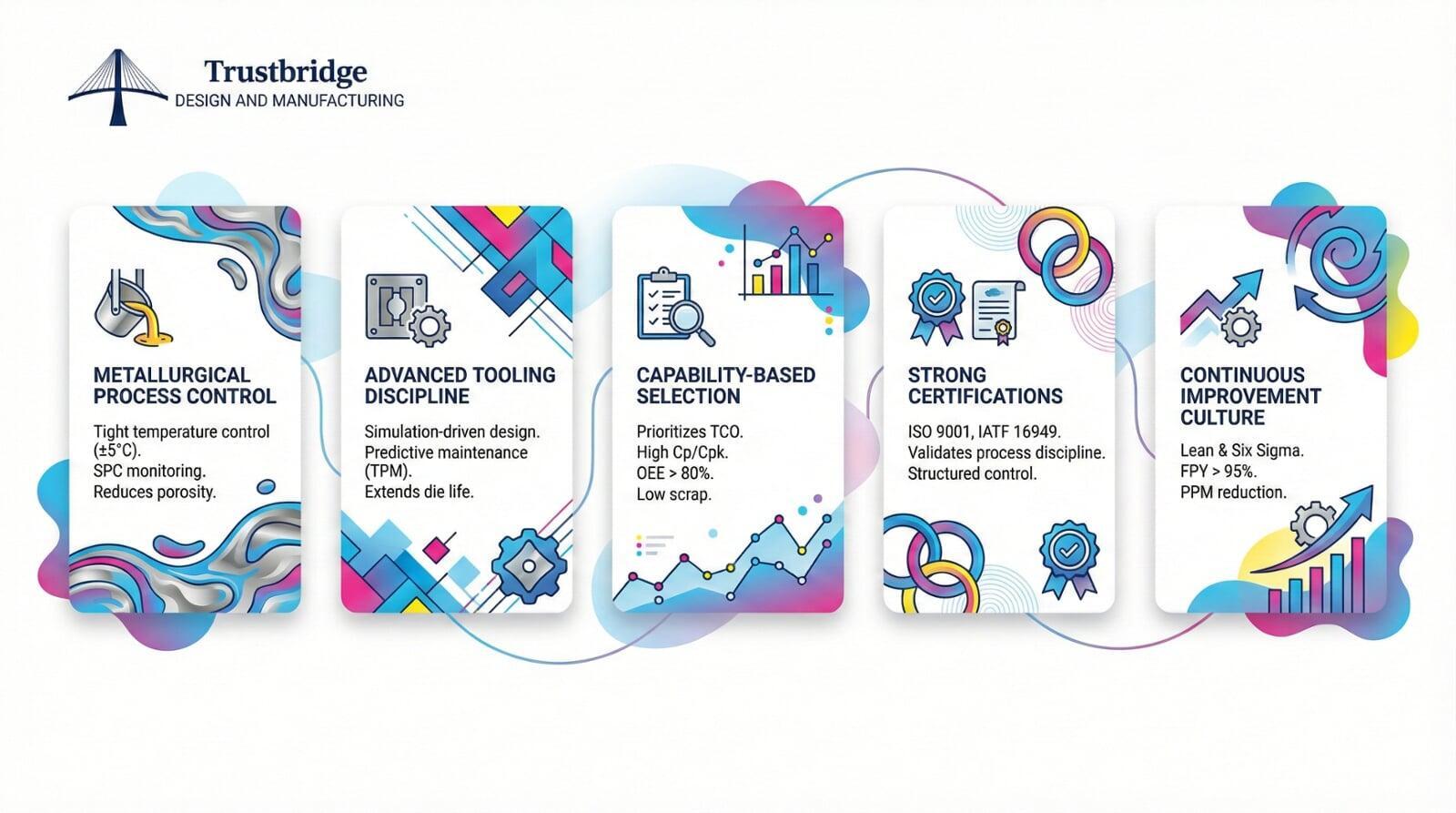
1. Process Control Built Around Nonferrous Metals Expertise
Die casting depends heavily on controlling the behavior of nonferrous metals under high pressure and temperature. Aluminum and magnesium alloys require specialized furnaces, degassing systems, and thermal handling protocols to maintain metallurgical integrity. These materials are far more sensitive to temperature variation and contamination than ferrous processes.
Leading suppliers operate dedicated melting systems with temperature variation tightly controlled within ±5°C. Statistical Process Control (SPC) dashboards monitor shot speed, fill time, cavity pressure curves, and cooling rates in real time. Each casting batch is traceable through lot coding and digital production logs, strengthening accountability and recall containment if required.
This level of metallurgical control reduces porosity rates by 25 to 35 percent in high-pressure die casting environments. With traceability tied to every casting batch, suppliers create manufacturing repeatability that protects buyers from field failures and warranty exposure.
2. Advanced Tooling Design and Maintenance Discipline
Tooling is the backbone of die cast metal production stability. Die steel selection, thermal fatigue resistance, and cavity hardness directly influence longevity and dimensional integrity over long production runs. Leading suppliers frame tooling as a lifecycle asset, engineered for durability across hundreds of thousands of cycles.
- Simulation Driven Tool Design
Top suppliers apply mold flow analysis, computational fluid dynamics, and thermal simulation during die design. Engineering teams model gating systems, venting geometry, solidification rates, and pressure distribution before cutting steel.
By validating fill balance and thermal gradients digitally, suppliers reduce launch scrap from double-digit percentages to below 5 percent during early ramp-up. This engineering-first approach improves cavity balance, minimizes hot tearing, and protects against premature fatigue cracking.
The economic outcome is clear. Fewer launch iterations, faster time to production approval, and predictable long-term output across multi-cavity tools.
- Preventive Maintenance Programs
Leading die cast metal suppliers implement TPM (Total Productive Maintenance) frameworks supported by predictive cycle tracking. Cavity inspections, dimensional verification, and wear component replacement occur at defined intervals based on data rather than reaction.
Predictive maintenance programs reduce unplanned downtime by 30 to 40 percent while protecting tolerances within ±0.05 mm during extended production runs. Avoiding unexpected die failure prevents line stoppage costs that can exceed tens of thousands of dollars per hour in automotive environments.
For executive leadership, the benefit is straightforward. Fewer disruptions, controlled output, and stabilized delivery performance.
3. Clear Supplier Selection Criteria Based on Capability Not Price
Effective risk reduction begins during sourcing. Buyers applying disciplined supplier selection criteria evaluate Total Cost of Ownership (TCO) rather than piece price alone. Poor sourcing decisions often lead to elevated scrap, engineering change volatility, and long-term program lifecycle cost exposure.
High-performing suppliers demonstrate measurable capability. Critical features show Cp ≥ 1.33 as a baseline and Cpk ≥ 1.67 for safety or performance-sensitive characteristics. OEE performance above 80 percent and documented scrap thresholds below 3 percent signal operational robustness.
Transparency includes real-time performance dashboards, traceability systems, and engineering support documentation. Mature suppliers often align with a supplier capability maturity model, proving launch readiness and ramp-up stability before contracts are finalized.
When supplier selection criteria prioritize measurable capability, quality escapes decline and launch volatility is reduced significantly.
4. Strong Supplier Certifications That Demonstrate Process Discipline
Supplier certifications validate system integrity through third-party audits and documented control frameworks. Leading die cast metal suppliers maintain certifications such as ISO 9001, IATF 16949 for automotive applications, and in some sectors AS9100 for aerospace programs.
These certifications require structured documentation control, corrective action tracking, and risk-based thinking embedded into operational workflows. External audit validation reinforces accountability and reduces compliance exposure.
- Quality Management System Alignment
A robust quality management system includes documented control plans, FMEA (Failure Mode and Effects Analysis), and MSA (Measurement System Analysis). Internal audit cadence and layered process audits verify adherence to established standards.
This infrastructure reduces undocumented process changes and strengthens dimensional repeatability. For buyers, certified suppliers signal disciplined execution, audit readiness, and reduced risk across the program lifecycle.
- Continuous Improvement Culture
Recognized suppliers embed Lean Manufacturing principles, Six Sigma using the DMAIC framework, and structured Kaizen events into daily operations. Corrective action closure times are tracked rigorously, often under 30 days for systemic issues.
Measured improvements include PPM reduction trends below 500 for mature programs, First Pass Yield (FPY) exceeding 95 percent, and sustained downward scrap trajectories. This culture drives measurable performance gains rather than reactive containment.
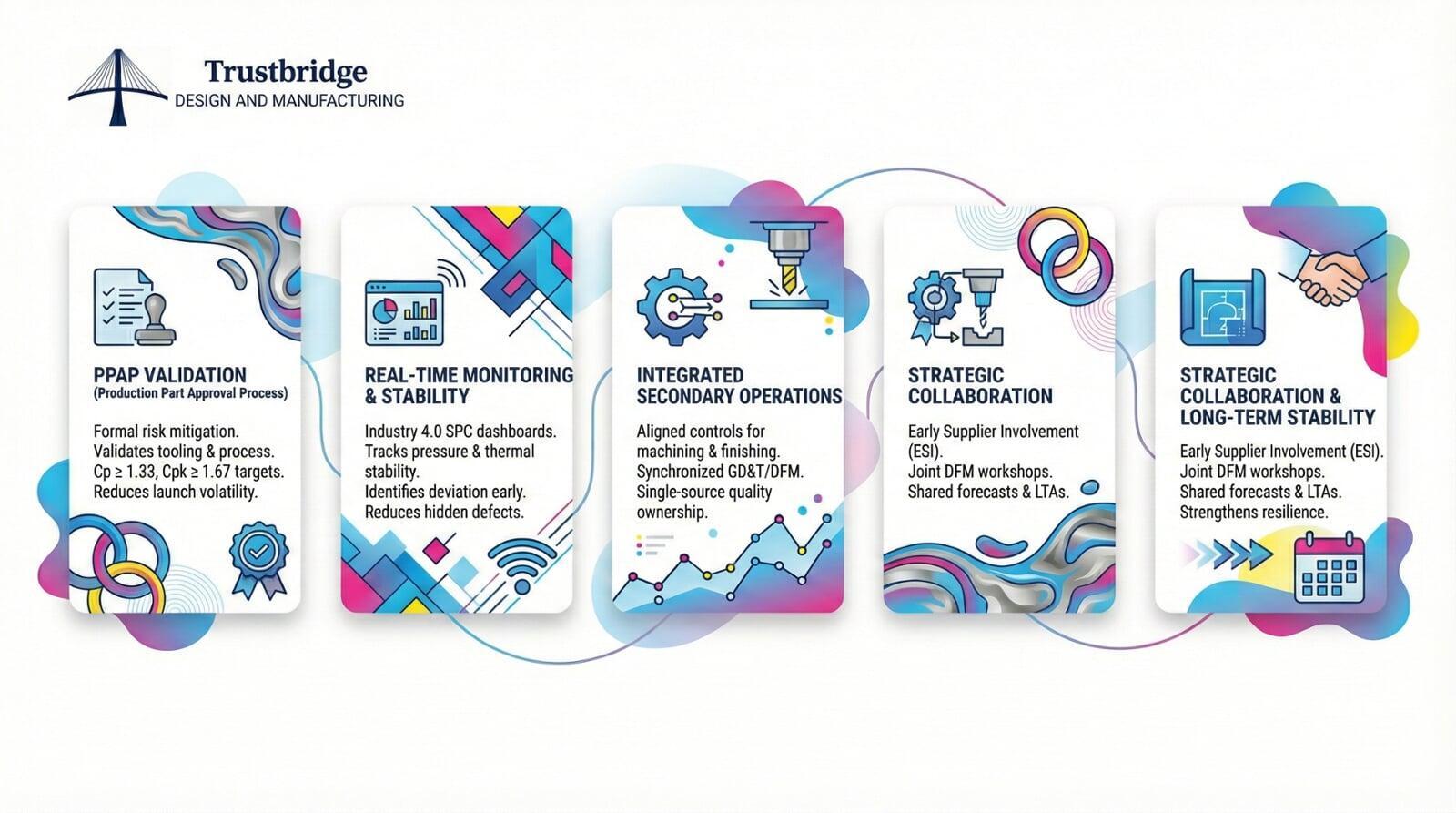
5. Structured Validation Through PPAP Production Part Approval Process
The PPAP Production Part Approval Process is a formal risk mitigation system in die casting programs. It validates that tooling, materials, machines, and inspection systems operate within defined control limits before production release.
A disciplined PPAP submission includes First Article Inspection reports, Control Plans, PFMEA documentation, MSA studies, material certifications, and capability results. Standard expectations include Cp ≥ 1.33 for general characteristics and Cpk ≥ 1.67 for critical features.
When executed rigorously, PPAP reduces ramp-up volatility and strengthens engineering change management. Buyers gain documented proof that scaled production will match approved samples under controlled conditions.
6. Real Time Monitoring and Data Driven Stability
High-pressure die casting parameters are highly sensitive to temperature fluctuation, injection pressure variation, and cycle inconsistency. Industry 4.0 systems now allow suppliers to monitor these variables continuously.
Real-time SPC dashboards track statistical control limits, cavity pressure signatures, and thermal stability curves. Trend analysis identifies deviation before it exceeds tolerance thresholds. Monitoring porosity indicators and cooling balance reduces hidden defect formation.
This approach replaces assumptions with quantifiable process capability data. Buyers gain measurable performance visibility and stronger confidence in production consistency.
7. Integrated Secondary Operations and Machining Control
Many die cast metal components require CNC machining, thread tapping, trimming, powder coating, or anodizing. Fragmented secondary operations introduce dimensional drift and communication gaps.
Leading suppliers integrate machining and finishing under aligned process controls. Casting shrink factors are synchronized with machining offsets using GD&T alignment and DFM (Design for Manufacturability) validation.
Integrated accountability reduces rework rates and eliminates multiple supplier handoffs. Buyers benefit from single-source quality ownership and fewer process disconnects.
Strategic Collaboration with Buyers for Long Term Stability
Production stability improves significantly when suppliers engage in Early Supplier Involvement (ESI). Joint DFM workshops and value engineering sessions address manufacturability risks before tooling investment.
Shared production forecasts, rolling 12-month demand planning, and safety stock strategies support stable capacity utilization tracking. Contingency planning prepares both parties for surge demand.
Long-term agreements (LTAs) and structured Quarterly Business Reviews (QBRs) reinforce transparency and performance accountability. Strategic alignment at this level strengthens resilience during market volatility and protects launch timelines.
Conclusion: Stability Is the Result of Structured Supplier Discipline
Reducing risk in die cast metal production requires measurable control. Process capability indices, controlled scrap thresholds below 3 percent, OEE above 80 percent, and validated PPAP systems form the backbone of manufacturing repeatability.
Suppliers that embed operational control across tooling, nonferrous metallurgy, certifications, and digital monitoring deliver reduced Total Cost of Ownership, lower warranty exposure, and improved program launch confidence.
Production stability is engineered, not assumed.
If your next program depends on tighter tolerances, lighter-weight structural castings, or high-volume aluminum die casting, now is the time to evaluate supplier capability before instability impacts your margins.
Request a formal process capability review, tooling lifecycle assessment, and PPAP readiness evaluation before your next launch window closes.
Choose a die cast metal supplier that proves Cp and Cpk performance, controls scrap thresholds, and delivers traceable, audit-ready production systems.
Protect your launch timeline. Protect your margins. Partner with a supplier built for measurable production stability.
Frequently Asked Questions
1. Why is supplier selection criteria so important in die cast metal sourcing?
Strong supplier selection criteria ensure that a die cast metal partner has the technical capability, process controls, and quality systems required for stable production. Evaluating tooling expertise, process validation methods, supplier certifications, and nonferrous metals experience reduces the risk of late-stage defects and supply disruptions.
2. How does the PPAP production part approval process reduce risk in die casting?
The PPAP production part approval process validates that a die cast metal supplier can consistently produce parts that meet dimensional, material, and performance requirements. It confirms tooling readiness, process capability, and control documentation before full-scale production begins, preventing costly surprises after launch.
3. What supplier certifications matter most in die cast metal manufacturing?
Certifications such as ISO 9001 and IATF 16949 demonstrate that a supplier follows structured quality management systems. For buyers sourcing complex nonferrous metals components, supplier certifications signal disciplined documentation, traceability, and continuous improvement practices that protect production stability.
4. Why are nonferrous metals expertise and process control critical in die casting?
Die casting involves precise thermal management, alloy control, and pressure regulation. Suppliers with deep experience in nonferrous metals such as aluminum, zinc, and magnesium understand porosity control, shrinkage behavior, and mechanical performance requirements, which directly impact long-term product reliability.