
6 Ways Aerospace Machining Suppliers Ensure Production Integrity
Aerospace machining demands a level of precision, traceability, and control that few industries can tolerate without compromise. Components such as turbine blades, actuator housings, structural brackets, landing gear fittings, and engine mounts operate under extreme thermal and mechanical stress. A single deviation in these parts can result in audit findings, delayed aircraft delivery, costly rework, or in worst cases, flight safety risks.
Production integrity in aerospace machining means far more than meeting dimensional tolerances. It includes verified material certification, proven process capability, validated inspection systems, documented traceability, and sustained statistical control over time. Aerospace machining suppliers operate in an environment where Cp and Cpk performance, material documentation accuracy, and inspection rigor are directly tied to program approval and long-term contracts.
For suppliers delivering aerospace machining services, ensuring production integrity begins long before a component is released for flight. It starts with compliance frameworks such as AS9100 and, where applicable, Nadcap accreditation for special processes. It includes rigorous inspection systems such as coordinate measuring machines, non-destructive testing methods, and SPC-based dimensional tracking. First Article Inspection conducted per AS9102 requirements validates dimensions, materials, and processes before production release. From initial FAI approval to sustained multi-year program execution, integrity must be engineered into every layer of the operation.
The six categories below represent the structural pillars that align aerospace machining suppliers with aerospace quality systems. Together, they support long-term program stability defined by multi-year contracts, revision discipline, ongoing audits, and sustained capability performance.
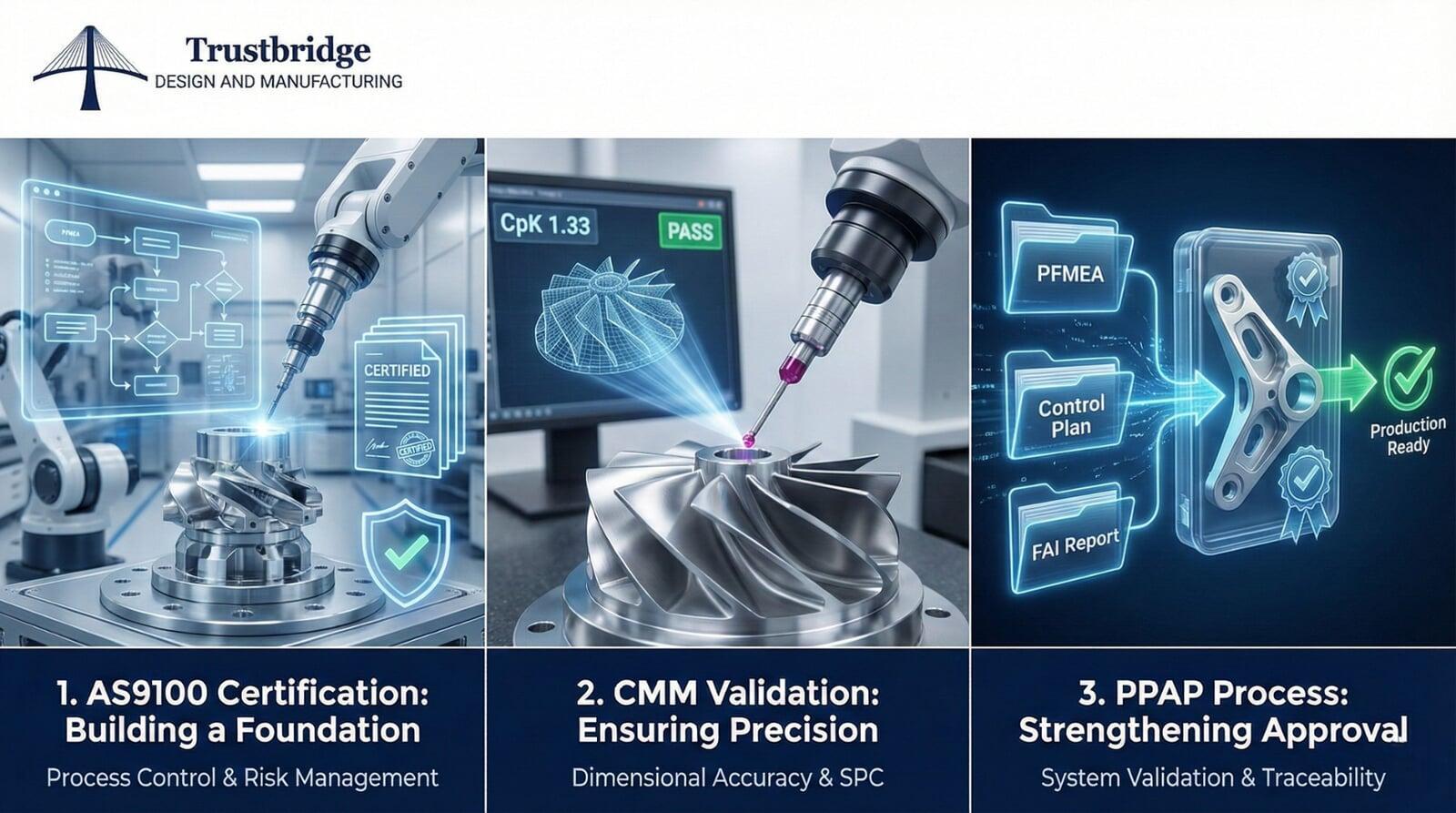
1. Building a Foundation With AS9100 Certification
Production integrity in aerospace machining is inseparable from AS9100 certification. While ISO 9001 establishes general quality management principles, AS9100 expands those requirements to address aerospace-specific risks such as configuration management, product safety, counterfeit parts prevention, and enhanced traceability controls.
AS9100 certification establishes structured documentation control, formal risk assessment, corrective action systems, and continuous improvement processes. It ensures that process changes, operator training updates, tooling adjustments, and inspection plan modifications are documented, reviewed, approved, and consistently followed. Cross-functional accountability is enforced through engineering change boards, multidisciplinary FAI reviews, and controlled workflow approvals. Formal review procedures include documented sign-offs, controlled revisions, and system-level traceability to prevent undocumented variation.
- System-Level Process Control
AS9100 requires defined workflows such as controlled travelers, documented routing sequences, setup verification checklists, and version-controlled CNC programs. Machine calibration schedules, tool-life management systems, and preventive maintenance routines reinforce repeatability across shifts and machines. This level of control becomes critical in multi-axis aerospace machining where tight GD&T requirements and complex geometries demand consistent execution.
- Risk-Based Thinking and Continuous Improvement
Risk evaluation tools such as PFMEA, control plans, SPC dashboards, and trend charts allow suppliers to identify early warning signs. Tool wear patterns, recurring minor deviations, and operator feedback are monitored before they escalate. Management reviews evaluate KPIs such as scrap rate, Cp/Cpk trends, and on-time delivery performance to guide long-term improvements and protect program stability.
2. Validating Dimensional Accuracy With Coordinate Measuring Machines
Aerospace machining tolerances often fall within ±0.001 inch or ±0.025 mm, requiring inspection precision beyond manual measurement tools. A coordinate measuring machine eliminates human variability and ensures objective validation of tight dimensional and geometric requirements.
Bridge, gantry, touch-probe, and scanning CMM systems are selected based on component size and complexity. These systems provide repeatable verification of positional tolerances, surface profiles, and complex geometries that are common in aerospace machining services.
Advanced inspection strategies integrate CMM validation directly into AS9102 First Article Inspection workflows. Dimensional results are documented and linked to engineering drawings to ensure traceable validation.
- First Article Validation Through Structured Inspection
Under AS9102 requirements, FAI validation confirms dimensions, materials, and process compliance. CMM programs are locked and version-controlled to ensure consistency between first article approval and production runs. This prevents variation between prototype validation and sustained output.
- Sustained Dimensional Control
Beyond FAI, CMM data supports ongoing capability monitoring. Aerospace programs typically require Cp and Cpk values of 1.33 or higher for standard features and higher thresholds for critical characteristics. Continuous SPC analysis identifies drift before tolerance limits are exceeded.
TrustBridge Tip:
Ensuring production integrity in aerospace machining isn’t just about meeting tolerances—it’s about eliminating hidden waste. When processes are validated, documented, and statistically controlled, efficiency improves across setups, inspection loops, and rework cycles. This reduces scrap, shortens lead times, and protects program margins. For a deeper dive into strategies that improve operational efficiency and profitability across the shop floor, check out our ebook: Maximizing Production Efficiency.
3. Strengthening Approval With the PPAP Process
Although traditionally associated with automotive programs, the PPAPprocessaligns closely with aerospace machining validation. Key PPAP elements such as process flow diagrams, PFMEA, control plans, and capability studies mirror aerospace expectations.
Many aerospace programs use hybrid validation models that combine AS9102 FAI documentation with PPAP-style system validation. This ensures that both the product and the manufacturing system are verified.
- Process Validation Before Volume Release
System validation includes machine stability confirmation, operator qualification records, gage R&R studies, and material certifications. Production trials may include pilot lots, machining simulations, and multi-part capability runs. Capturing cycle time consistency, tool wear trends, and stability metrics strengthens validation before ramp-up.
- Documentation and Traceability Alignment
PPAP deliverables such as PFMEA, control plans, and process flow diagrams directly support traceability requirements. When aligned with AS9100 document control and AS9102 inspection standards, these tools create lifecycle traceability for long-running aerospace programs.
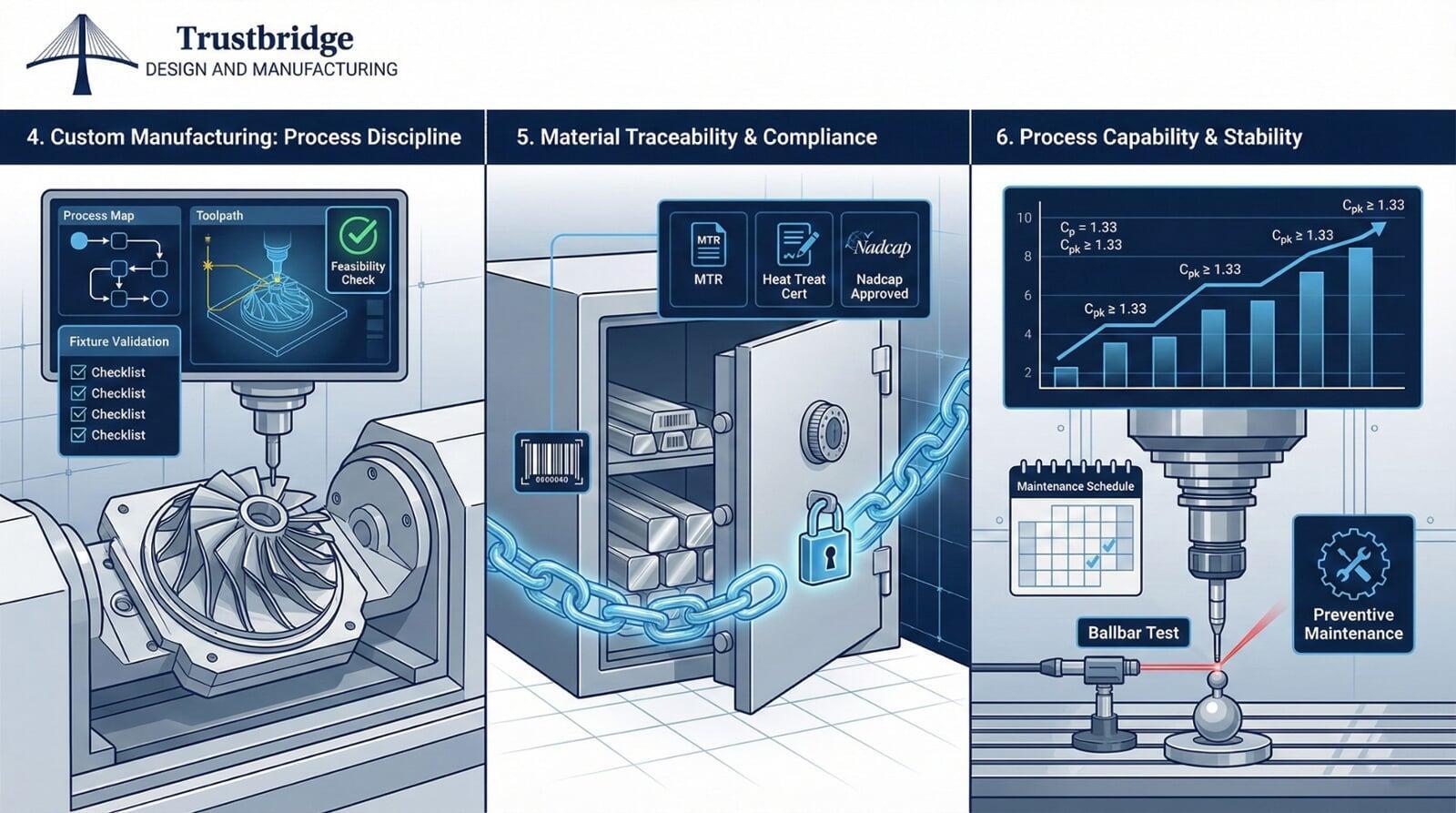
4. Managing Custom Manufacturing Without Losing Control
Aerospace machining often involves thin-wall structures, deep pockets, multi-axis features, and tight tolerance stack-ups. Advanced alloys such as Inconel, titanium, and aluminum-lithium introduce additional complexity. Production integrity becomes vulnerable when customization lacks engineering discipline.
Custom manufacturing requires documented process mapping outputs including setup instructions, CNC programming reviews, routing diagrams, and fixture validation reports. Fixture validation may include stress analysis, repeatability checks, and clamping force verification.
- Engineering Feasibility and Process Mapping
Manufacturability reviews evaluate tool reach, part accessibility, hold requirements, tolerance stack-up risk, and thermal distortion potential. Early CAM programming reviews help identify chatter risks or tool deflection before production begins.
- Scaling Custom Processes Safely
Spindle speeds, feed rates, tooling configurations, and inspection frequencies are locked through setup sheets and revision-controlled CNC programs. Tooling logs and operator training eliminate tribal knowledge and ensure repeatability across production cycles.
5. Ensuring Material Traceability and Compliance
Material integrity is as critical as dimensional precision. Aerospace machining suppliers must manage mill test reports, heat treatment certifications, and Nadcap-approved special process documentation. AS9100 and AS9102 requirements reinforce traceability and audit preparedness.
Structured systems such as ERP or MES platforms, barcode tracking, and controlled material vaults prevent mix-ups. Segregation may be organized by alloy family, heat lot, or customer program.
- Controlled Documentation Systems
Material certifications are stored in digital logs with revision control and approval workflows. Dual verification gates may be used for critical material lots to prevent release without confirmation.
- Preventing Material Variability
Dedicated racks, color-coded bins, and locked material cages prevent cross-contamination. Cutting tools and coolants may also be segregated when machining dissimilar alloys to avoid contamination risks.
6. Monitoring Process Capability for Long-Term Stability
Long-term aerospace machining programs require sustained capability monitoring. Cp and Cpk tracking, SPC dashboards, tool wear trend charts, and in-process probe feedback provide early warnings of variation.
Aerospace contracts may require periodic re-validation, including re-FAI after major process changes or extended downtime.
- Statistical Process Control in Aerospace Machining
SPC tools such as X-bar and R charts, individual-moving range charts, and capability histograms monitor variation. Most aerospace programs require Cp/Cpk ≥ 1.33 for general features and higher for safety-critical dimensions.
- Preventive Maintenance and Equipment Stability
Calibration methods such as laser interferometry, ballbar testing, and probe qualification routines maintain machine accuracy. Preventive maintenance includes spindle health monitoring, lubrication checks, axis alignment verification, and coolant quality control.
Conclusion
Production integrity in aerospace machining requires multi-layered controls because aerospace programs operate under strict regulatory oversight, flight safety requirements, and multi-year reliability expectations. AS9100 systems reduce traceability gaps. CMM validation prevents tolerance drift. PPAP-style documentation strengthens lifecycle traceability. Material control systems eliminate alloy inconsistencies.
Suppliers that invest in structured systems reduce scrap, prevent SCARs, stabilize cycle times, and protect margins. Integrity lowers the cost of poor quality while increasing predictability.
Long-term aerospace success belongs to suppliers who continuously monitor capability, maintain documentation discipline, and treat production integrity as an ongoing operational responsibility.
Aerospace machining requires more than having advanced CNC machines. It requires controlled processes, documented validation, traceable materials, and sustained statistical oversight. Capability without documentation or traceability is insufficient in aerospace.
Evaluate your AS9100 systems, review your CMM programs, analyze capability data, confirm fixture repeatability, and audit tool-life monitoring strategies. Conduct a structured readiness review aligned with AS9102 and PPAP validation principles before your next program launch or audit.
Production integrity is not proven by equipment alone. It is proven by disciplined systems that perform consistently from first article to flight-ready delivery.
Frequently Asked Questions (FAQs)
1. What ensures production integrity in aerospace machining programs?
Production integrity is ensured through structured quality systems such as AS9100, validated First Article Inspection (AS9102), statistical process control, certified material traceability, and disciplined documentation control. These systems work together to maintain dimensional accuracy, repeatability, and audit readiness throughout the program lifecycle.
2. Why is First Article Inspection critical before full production?
First Article Inspection validates that the manufacturing process can consistently produce parts that meet engineering specifications. It confirms dimensional accuracy, material compliance, and process stability before long-term production commitments are made, reducing the risk of scrap, rework, and program delays.
3. How do aerospace machining suppliers maintain long-term capability?
Suppliers monitor Cp and Cpk performance, track tool wear trends, conduct periodic re-validations, and maintain calibrated inspection systems such as CMMs. Continuous statistical monitoring ensures early detection of variation before it impacts tolerance limits or contract performance.
4. What risks increase when aerospace machining lacks structured quality systems?
Without structured systems like AS9100 and documented process controls, suppliers face higher scrap rates, SCARs, delayed deliveries, audit findings, and reduced contract opportunities. In aerospace, uncontrolled variation can compromise safety, margins, and long-term customer relationships.