
5 Strategic Ways Sheet Metal Stamping Suppliers Strengthen Quality, Lead Time, and Margin Control
In today’s competitive manufacturing environment, sheet metal stamping is no longer just a fabrication process. It is a strategic function that directly impacts product quality, delivery performance, working capital efficiency, and overall profitability. Studies across high-volume manufacturing environments show that even a 2–3% scrap rate increase can reduce program margins by up to 8–12%, while unplanned press downtime can potentially cost thousands of dollars per hour when fully accounting for downstream assembly dependencies.
For Procurement Leaders, Supply Chain Executives, Engineering Heads, and Operations Directors, stamping instability directly affects EBITDA through scrap write-offs, expediting costs, premium freight, and lost production capacity. Inconsistent output lowers OEE (Overall Equipment Effectiveness), increases working capital tied up in safety stock, and creates unpredictable launch risk.
Strategic sheet metal stamping suppliers operate differently. They build structured systems around tooling precision, process validation, supplier certifications, digital monitoring, and continuous improvement. They understand that production stability is engineered long before parts reach the press.
Below are five strategic ways high-performing sheet metal stamping suppliers strengthen quality, reduce lead time variability, and protect margins across the supply chain.
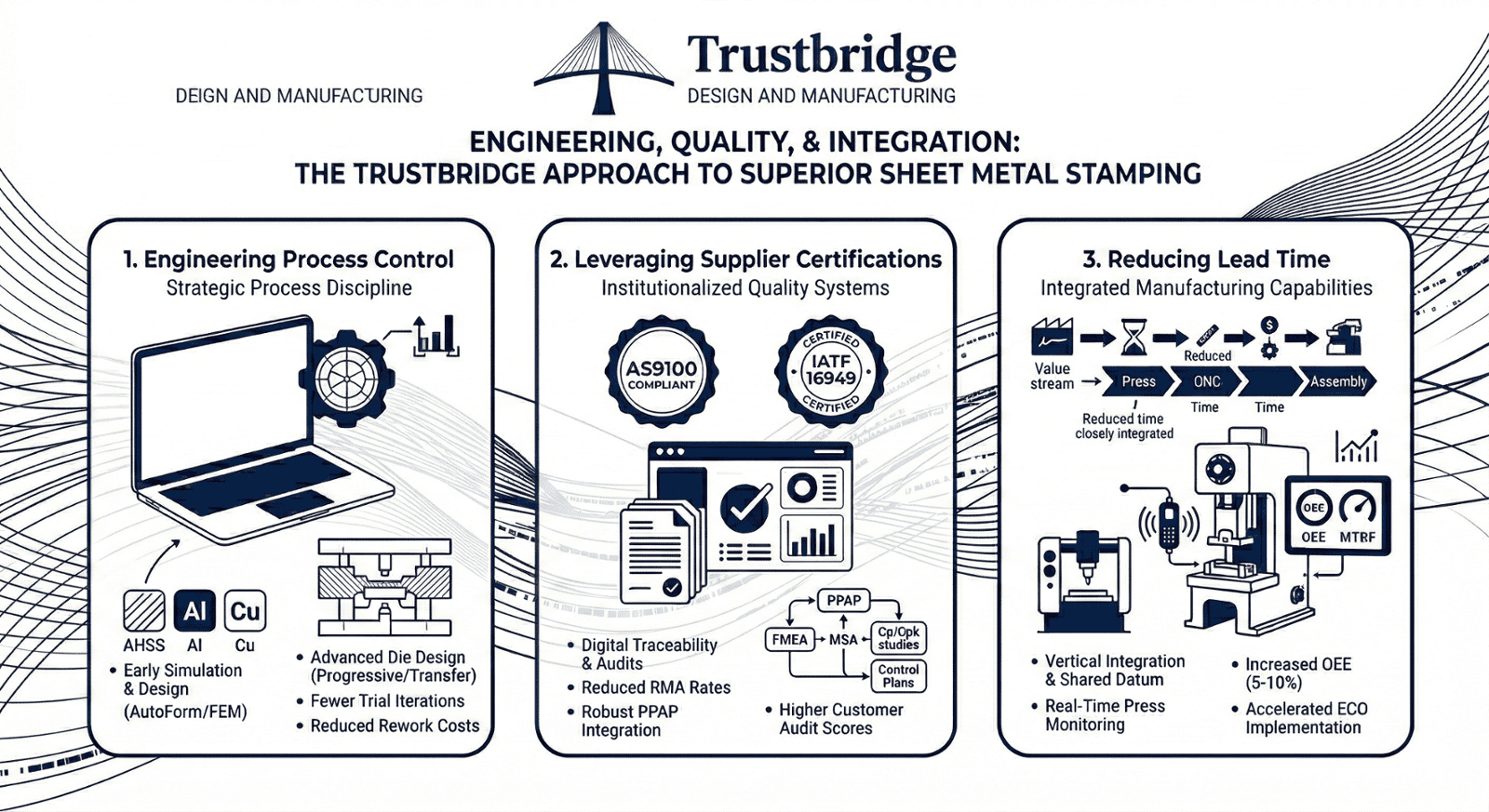
1. Engineering Process Control Into Sheet Metal Stamping From Day One
Production stability in sheet metal stamping begins with engineering discipline. Strategic suppliers invest in advanced die design, material analysis, AutoForm simulation, finite element modeling (FEM), and die flow analysis before full-scale production begins. This early investment directly protects long-term margins by reducing rework, scrap, and tooling redesign costs.
In many programs, simulation has reduced die tryout iterations from six to two, accelerating launch timelines by several weeks and cutting engineering rework costs significantly.
Rather than relying on reactive adjustments, these suppliers build control into the process from the start. They analyze forming stresses, press tonnage, springback behavior, and material thinning to eliminate variation before it becomes costly.
- Advanced Tooling and Die Optimization
High-performing suppliers recognize that a die is the foundation of repeatability. Progressive and transfer dies are engineered with burr control, springback compensation, and material flow optimization embedded into their design.
Preventive maintenance systems and tool life monitoring programs ensure dies operate within validated performance windows. Real-time press monitoring with integrated sensors tracks tonnage signatures, vibration patterns, and die protection systems to prevent catastrophic failure.
Optimized die design and predictive maintenance can increase OEE by 5–10%, reducing downtime while extending die life.
- Material Selection and Nonferrous Metals Expertise
Whether working with stainless steel, aluminum, copper alloys, or advanced high-strength steel (AHSS), strategic suppliers account for tensile strength, elongation, coating adhesion, and grain direction. AHSS materials in particular present cracking and springback challenges that require simulation-backed validation.
Strong supplier relationships with mills enable material traceability and consistent lot performance. Digital traceability systems ensure each coil can be linked to production batches, supporting compliance and recall mitigation.
Cost control is further strengthened through nesting optimization, yield improvement strategies, and coil width optimization. Even a 1% improvement in material yield on a high-volume automotive program can generate hundreds of thousands of dollars in annual savings.
2. Leveraging Supplier Certifications to Institutionalize Quality
Supplier certifications are not marketing tools. They are structured systems that reduce risk, increase audit readiness, and institutionalize process discipline.
Certified suppliers embed digital documentation systems, layered process audits, and real-time traceability into daily operations. This operational rigor reduces RMA rates, lowers warranty exposure, and strengthens customer confidence during audits.
Measured outcomes frequently include:
Reduced defect escape rates
Lower warranty reserves
Improved customer audit scores
Faster corrective action closure
- AS9100 and IATF 16949 Compliance
For aerospace programs, AS9100 requires control plans, First Article Inspection (FAI), documented risk-based thinking, and rigorous configuration management.
For automotive programs, IATF 16949 mandates defect prevention, statistical process control, and traceability discipline across production environments.
Compliance requires structured control plans, formalized FMEA workflows, documented corrective actions, and disciplined inspection processes. These systems reduce operational risk and increase resilience under customer scrutiny.
- PPAP Production Part Approval Process Integration
Disciplined suppliers integrate PPAP into launch workflows. Beyond dimensional layouts, they deploy:
PSW (Part Submission Warrant)
FMEA (Failure Mode and Effects Analysis)
MSA (Measurement System Analysis)
Capability studies (Cp, Cpk)
Control plans tied to real-time data
PPAP reduces financial and operational risk by validating repeatability before volume production begins. It prevents launch delays, premium freight, and costly containment actions that erode margins.
3. Reducing Lead Time Through Integrated Manufacturing Capabilities
Lead time variability is rarely caused by press speed alone. Inter-facility transport, vendor handoffs, and inspection bottlenecks can add 3–5 days per transaction cycle.
Strategic suppliers use value stream mapping to eliminate non-value-added steps and integrate complementary capabilities under one operational structure.
Vertical integration stabilizes scheduling volatility and reduces cost-of-delay exposure. A single late stamping batch can halt downstream assembly lines costing tens of thousands per hour.
- CNC Machining and Secondary Operations Alignment
When machining operations are integrated with stamping, tolerance stack-up management improves significantly. Shared datum referencing, fixture alignment consistency, and cross-process engineering coordination eliminate dimensional drift.
Internal alignment also accelerates engineering change orders (ECOs). Instead of waiting weeks for external coordination, changes can be implemented within days, protecting program timelines.
- Digital Transformation in Manufacturing
Leading suppliers deploy real-time press monitoring, predictive maintenance systems, and ERP-integrated dashboards.
These dashboards track:
Scrap rate by die set
Mean time between failure (MTBF)
OEE by press line
Downtime by root cause
Immediate visibility reduces decision latency. Faster response to deviation minimizes downtime cost per hour and protects production throughput.
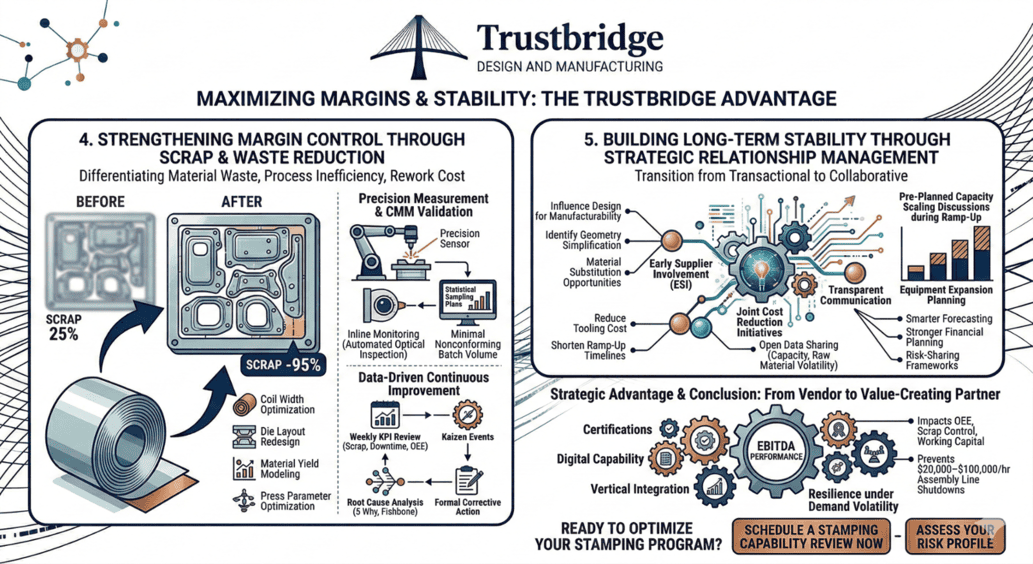
4. Strengthening Margin Control Through Scrap and Waste Reduction
Margins in sheet metal stamping are frequently lost in scrap, inefficient die layouts, and excessive rework.
Strategic scrap reduction tactics include:
Coil width optimization
Die layout redesign
Material yield modeling
Press parameter optimization
Even a 1% scrap reduction can significantly increase contribution margin in high-volume programs.
Waste reduction also supports ESG reporting requirements. Reduced material waste lowers carbon intensity and improves sustainability metrics for OEM customers.
It is important to differentiate:
Material waste (scrap metal)
Process inefficiency (downtime, slow cycle time)
Rework cost (labor and inspection expense)
Each directly impacts EBITDA.
- Precision Measurement and Coordinate Verification
Coordinate Measuring Machines (CMM) are used for offline validation, while automated optical inspection systems enable inline monitoring.
Strategic suppliers implement statistical sampling plans tied to process capability thresholds. Inspection data feeds directly back into die adjustment workflows, minimizing nonconforming batch volume.
- Data-Driven Continuous Improvement
High-performing suppliers conduct daily tier meetings and weekly KPI reviews focused on scrap, downtime, and OEE performance.
Structured methodologies include:
Kaizen events
Root cause analysis (5 Why, Fishbone)
Formal corrective action systems
Supplier scorecards and transparent customer reporting shift conversations from blame to performance optimization.
5. Building Long-Term Stability Through Strategic Supplier Relationship Management
Production excellence is built through collaboration, not transactional sourcing.
Early Supplier Involvement (ESI) allows stamping partners to influence design for manufacturability before tooling investment. Joint cost reduction initiatives identify geometry simplification, material substitution, and process optimization opportunities.
In volatile material markets, strategic partnerships allow risk-sharing frameworks rather than adversarial price renegotiation cycles.
Suppliers engaged in capacity scaling discussions during ramp-up can pre-plan equipment expansion, avoiding launch instability.
- Collaborative Design for Manufacturability
Early review identifies undercuts, unnecessary tight tolerances, and inefficient geometries. This reduces tooling cost and shortens ramp-up timelines.
- Transparent Communication and Risk Sharing
Open data sharing around capacity planning, engineering change responsiveness, and raw material volatility enables smarter forecasting and stronger financial planning.
Strategic dual-sourcing strategies may protect risk, but deep partnerships often outperform fragmented supplier models in complex programs.
The Strategic Advantage of the Right Sheet Metal Stamping Partner
Choosing the right supplier directly impacts EBITDA performance.
Assembly line shutdowns can cost $20,000–$100,000 per hour depending on product complexity. Scrap overruns reduce contribution margins and inflate working capital through excess inventory.
Supplier selection criteria must evaluate certifications, tooling expertise, digital capability, vertical integration depth, and resilience under demand volatility.
A high-performing supplier operates as an extension of engineering and operations teams. They reduce risk before disruption occurs. They stabilize output during ramp-up. They protect profitability during demand swings.
Conclusion: From Vendor to Value-Creating Partner
Sheet metal stamping is a strategic lever influencing cost structure, operational stability, and competitive positioning.
OEMs that align with disciplined, data-driven suppliers gain measurable advantages in OEE, scrap control, working capital efficiency, and launch predictability.
By engineering process control, institutionalizing certifications, integrating manufacturing capabilities, reducing waste, and building collaborative partnerships, strategic stamping suppliers strengthen quality, lead time, and margin control simultaneously.
In markets defined by volatility and margin pressure, the right stamping partner becomes a competitive differentiator.
If your stamping program carries hidden scrap exposure, lead time volatility, or tooling risk, now is the time to act.
Assess your program risk profile.
In an environment of inflation, supply chain volatility, and rising customer expectations, proactive supplier alignment is not optional. It is a competitive necessity.
Trustbridge Design and Manufacturing supports the growth of the global manufacturing ecosystem. By providing in-house design for manufacturability services and directly connecting those clients - and their buyers - with a global network of qualified manufacturers, Trustbridge strives to accelerate innovation and empower the world's best manufacturers.
Frequently Asked Questions (FAQs)
1. Why does sheet metal stamping have such a large impact on profitability?
Stamping directly affects material usage, scrap rates, downtime exposure, and lead time stability. Even a small increase in scrap or press downtime can significantly reduce contribution margins in high-volume programs. Strategic suppliers protect profitability by engineering repeatability into tooling, materials, and process controls from the beginning.
2. How can a stamping supplier reduce lead time variability?
Lead time variability often comes from tooling delays, vendor handoffs, and poor scheduling coordination. Suppliers with integrated machining, finishing, and assembly capabilities eliminate unnecessary transfers and stabilize production flow. Digital monitoring systems also help identify bottlenecks early, preventing delays before they impact delivery commitments.
3. What certifications actually matter when evaluating stamping suppliers?
Certifications like IATF 16949 (automotive) and AS9100 (aerospace) demonstrate structured quality systems. These standards require formal control plans, FMEA risk assessments, traceability systems, and disciplined documentation — all of which reduce operational and financial risk for OEMs.
4. What should procurement teams look beyond price when selecting a stamping supplier?
Price alone does not reflect long-term value. Procurement teams should evaluate tooling expertise, digital monitoring capability, scrap reduction performance, preventive maintenance systems, certification maturity, and the supplier’s ability to respond quickly to engineering changes. These factors determine production stability and long-term margin protection.