
Trustbridge Independent Sales Rep & Lead Generation Services for Manufacturers Supporting Consumer Hardware Companies
Introduction
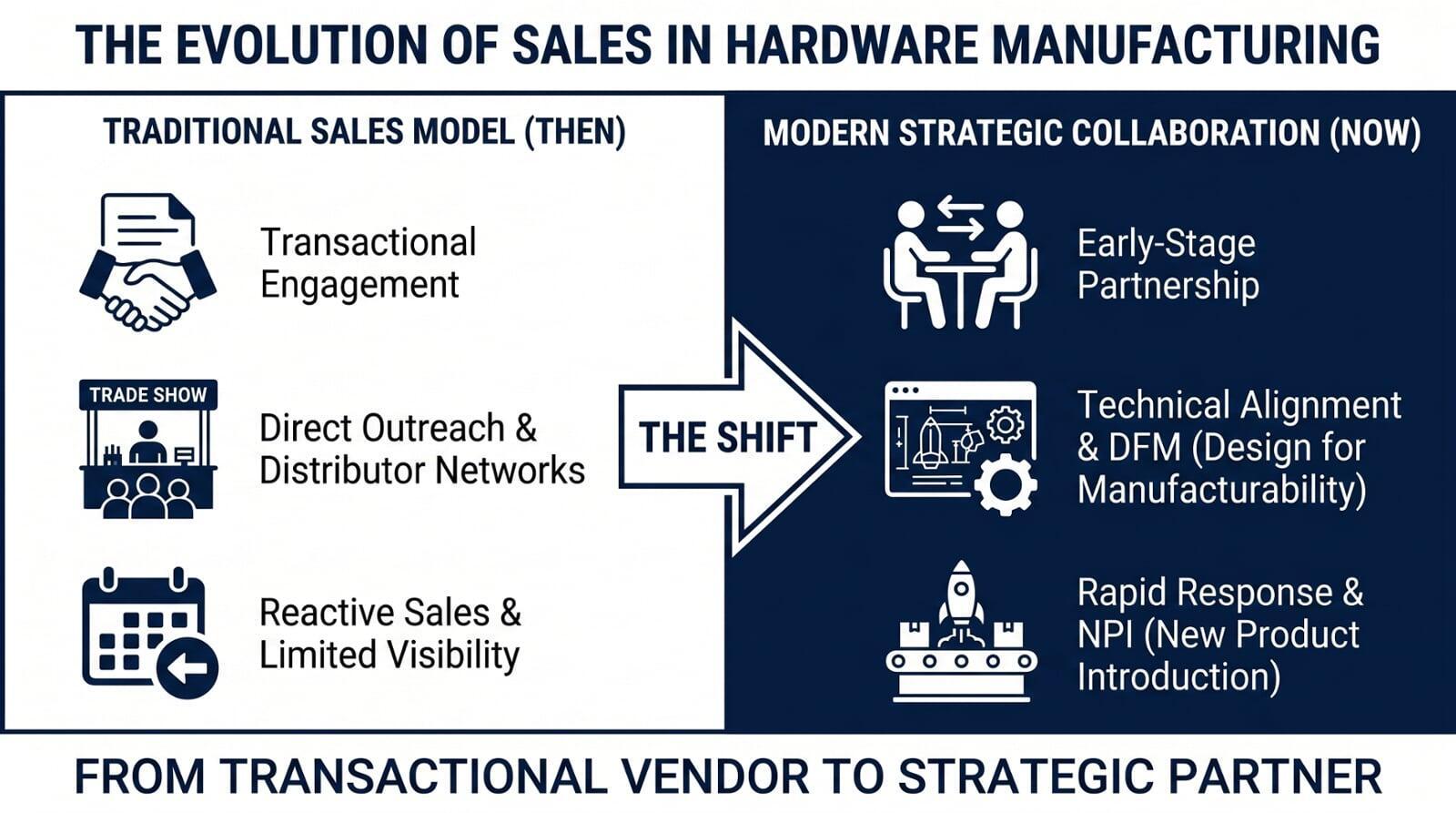
The Evolution of Sales in Hardware Manufacturing
Understanding the Trustbridge Model
The Trustbridge-inspired model operates on the principle of aligning manufacturers with high-intent opportunities through independent, technically informed representation. Rather than relying on volume-based outreach, this approach focuses on precision—connecting the right supplier with the right opportunity at the right time.
In this model, the intermediary plays a critical role in understanding both sides of the equation. On one side are OEMs with specific product requirements, timelines, and constraints—often tied to EVT (Engineering Validation Testing), DVT (Design Validation Testing), and pilot production phases. On the other are manufacturers with defined capabilities, capacities, and specialization areas.
By pre-qualifying opportunities and matching them with suitable suppliers, the model reduces inefficiencies, minimizes misalignment, and increases the probability of successful engagement.
Independent Sales Representation: A Strategic Lever
Deep Market Access
Technical Alignment
Performance-Driven Engagement
Lead Generation as a System, Not a Campaign
A key differentiator of the Trustbridge-style approach is the treatment of lead generation as a continuous, structured system rather than a series of isolated campaigns.
A key differentiator of the Trustbridge-style approach is the treatment of lead generation as a continuous, structured system rather than a series of isolated campaigns.
Intent-Based Targeting
Instead of broad outreach, lead generation efforts focus on identifying companies that are actively developing new consumer hardware (CH) products, moving through NPI (New Product Introduction) stages, scaling production, or seeking alternative suppliers. This intent-driven approach significantly improves conversion rates. y
Data Enrichment and Qualification
Advanced lead generation systems leverage data to refine targeting and prioritize accounts. By analyzing company profiles, product pipelines, and engagement signals, these systems ensure that only relevant opportunities are pursued.
Appointment Setting with Context
Meetings are not scheduled blindly. Each interaction is informed by prior qualification, ensuring that both the manufacturer and the OEM enter discussions with a clear understanding of fit, technical feasibility, and DFM (Design for Manufacturability) considerations. This reduces wasted effort and accelerates decision-making.
Bridging Design and Manufacturing with Sales
In consumer hardware (CH) hardware, the boundary between design and manufacturing is inherently fluid. Decisions made during product development—especially during EVT and DVT phases—have direct implications for cost, scalability, and time to market.
A Trustbridge-aligned approach integrates sales with technical positioning, presenting manufacturers as partners who can contribute across the product lifecycle. This includes supporting prototyping, advising on Design for Manufacturability (DFM), and optimizing production strategies for smoother transition into mass production.
By positioning manufacturers as collaborators rather than vendors, this model strengthens relationships and increases long-term engagement potential.
Benefits for Manufacturers
Manufacturers adopting this approach gain access to a more predictable and higher-quality pipeline of opportunities. Pre-qualified leads—aligned with NPI (New Product Introduction) timelines—reduce the inefficiencies associated with traditional prospecting, allowing teams to focus on opportunities with a higher likelihood of conversion.
Sales cycles become shorter due to better upfront alignment, while resource allocation improves as engineering and sales teams spend less time on unqualified inquiries. Over time, this creates a scalable growth model that does not rely on proportional increases in internal headcount.
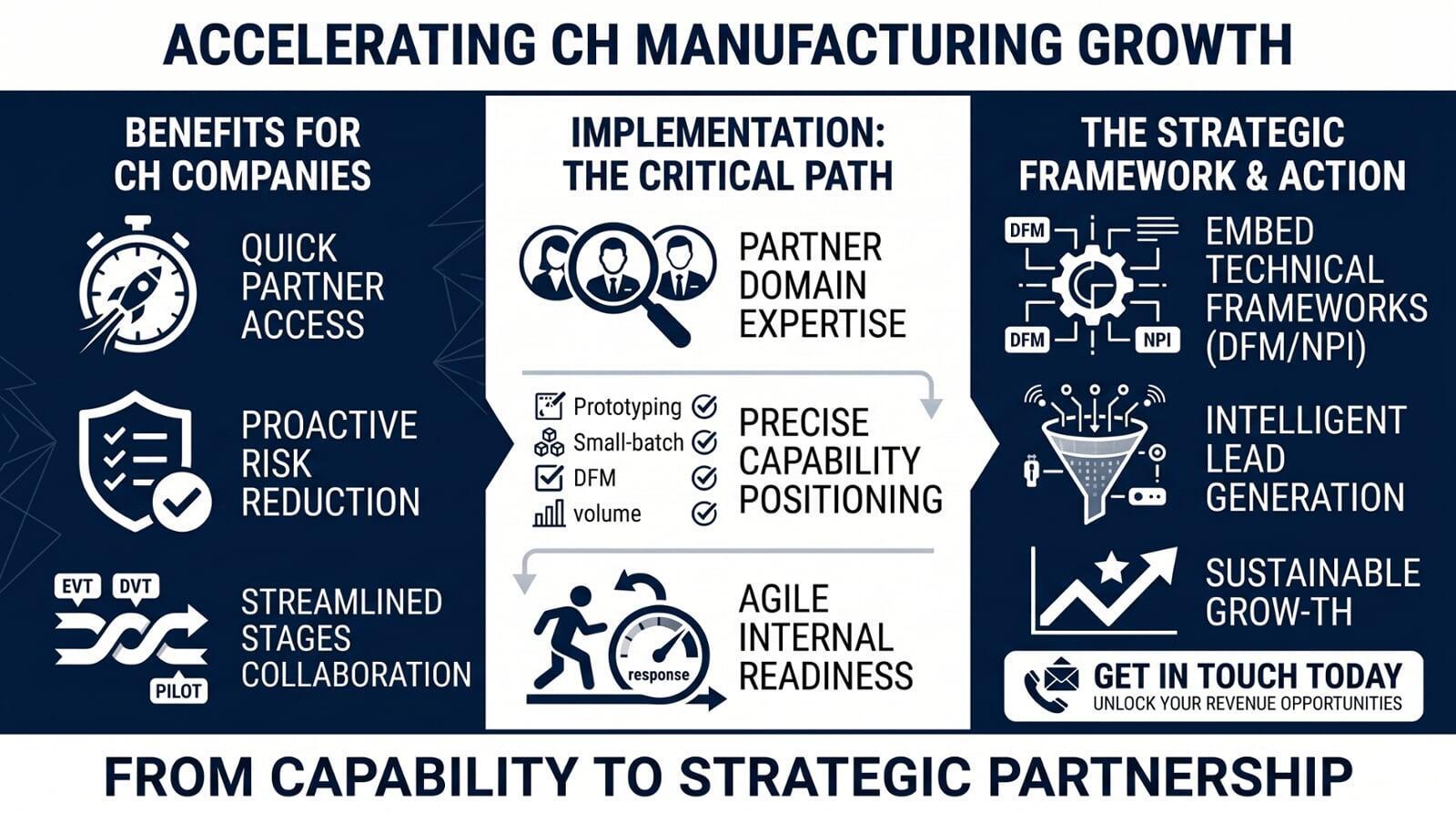
Benefits for Consumer Hardware Companies
Consumer hardware (CH) companies benefit from faster access to capable and reliable manufacturing partners. The pre-qualification process reduces the risk of misalignment, while improved communication ensures smoother collaboration across EVT, DVT, and pilot production stages.
By engaging with manufacturers who are already aligned with their requirements, OEMs can accelerate product development timelines and reduce operational friction.
Implementation Considerations
Adopting a Trustbridge-style model requires a deliberate and structured approach.
Partner Selection
Choosing the right sales and lead generation partner is critical. Manufacturers must ensure that their partners possess both domain expertise and a deep understanding of the consumer hardware (CH) landscape and DFM principles (Design for Manufacturability).
Capability Positioning
Clear and precise articulation of manufacturing capabilities is essential for effective matchmaking. This includes defining strengths in areas such as prototyping, small-batch production, DFM optimization, or high-volume manufacturing.
Internal Readiness
Operational readiness plays a crucial role in success. Manufacturers must be equipped to respond quickly to opportunities, provide accurate quotations, and engage in technical discussions tied to NPI (New Product Introduction) cycles without delay.
The Future of Manufacturer–OEM Engagement
Models that combine independent sales representation with intelligent lead generation—while embedding technical frameworks like DFM (Design for Manufacturability) and NPI (New Product Introduction)—are well-positioned to meet these needs. By prioritizing precision, transparency, and value creation, they offer a scalable framework for modern manufacturing growth.
Conclusion
The challenge for manufacturers is no longer limited to building capability—it lies in consistently connecting those capabilities with the right opportunities. A Trustbridge-inspired approach addresses this challenge by transforming sales into a structured, strategic function.
Through the integration of independent sales representation and data-driven lead generation, manufacturers can achieve higher win rates, faster sales cycles, and stronger partnerships with consumer hardware (CH) companies.
In an increasingly competitive and fast-paced industry, this approach is not merely an advantage—it is becoming a necessity for sustainable growth.
Looking to turn your manufacturing capabilities into consistent, high-quality revenue opportunities?
Trustbridge helps manufacturers connect with the right OEMs at the right stage—whether it's early NPI (New Product Introduction), EVT/DVT validation, or full-scale production.
Get in touch today to explore how a structured, data-driven sales approach can unlock your next phase of growth.
Frequently Asked Questions (FAQs)
1. Why do capable manufacturers still struggle to win consistent OEM business in consumer hardware?
Even with strong CNC machining, injection molding, and Design for Manufacturability (DFM) capabilities, many manufacturers lack structured access to high-intent OEM opportunities. The challenge is commercial, not technical—without targeted lead generation and early engagement during NPI, EVT, or DVT stages, pipelines remain inconsistent.
2. How does a Trustbridge-style model improve OEM opportunity quality?
A Trustbridge-inspired approach prioritizes pre-qualified, intent-driven opportunities over broad outreach. By aligning manufacturer capabilities with OEM needs—especially during NPI and DFM-driven development phases—it reduces misalignment, improves conversion rates, and ensures higher-quality engagements.
3. How does intent-based lead generation impact sales cycles in manufacturing?
Intent-based lead generation targets OEMs actively developing products or scaling production. Engaging during key stages like EVT, DVT, and NPI ensures better timing and context, leading to shorter sales cycles, more relevant discussions, and higher win rates.
4. Why is early-stage engagement (EVT/DVT) critical for manufacturers?
Engaging during EVT (Engineering Validation Testing) and DVT (Design Validation Testing) allows manufacturers to contribute DFM insights early. This improves product manufacturability, reduces costly iterations, and positions the manufacturer as a strategic partner rather than just a supplier.