
6 Ways Buyers Evaluate Gear Hobbing for Tolerances Materials and Supplier Selection
Introduction
Gear hobbing remains one of the most widely deployed precision gear manufacturing processes across automotive, aerospace, industrial automation, and heavy equipment sectors. For procurement leaders and sourcing managers, gear hobbing is not simply a machining method. It is a critical production variable that directly influences drivetrain efficiency, torque transmission accuracy, vibration levels, acoustic performance, service life, and total lifecycle cost.
The sourcing risk extends beyond dimensional deviation. Poorly controlled hobbing processes can result in elevated warranty claims, line stoppages, field failures, expedited freight costs, and reputational damage. Latent defects often surface during production ramp-up when load cycles increase and stress accumulates under real operating conditions. Weak documentation further delays root cause investigation, increasing recall exposure and cost escalation.
In OEM manufacturing environments, poorly controlled gear tolerances lead to premature fatigue failure, energy losses from inefficiency, excess NVH (noise vibration harshness), and downstream inspection cost increases. Buyers therefore require more than unit price analysis. They need measurable supplier risk management frameworks, validated process capability studies, documented compliance systems, and audit-ready governance before awarding production volume.
This guide explains how buyers evaluate gear hobbing suppliers through tolerance validation, material performance assessment, distortion control, PPAP governance, traceability discipline, and structured supplier qualification frameworks that reduce operational and financial risk.
Understanding Gear Hobbing in OEM Manufacturing
Gear hobbing is a generating process in which a rotating multi-tooth cutting tool called a hob synchronizes precisely with the rotation of the gear blank. This synchronized kinematic relationship between hob and workpiece ensures continuous generation of involute tooth geometry. Modern multi-axis CNC hobbing centers coordinate rotational axes, feed motion, and tool engagement with high precision, improving repeatability and production throughput.
Unlike single-tooth milling, hobbing generates continuous tooth profiles in a highly efficient cycle, making it suitable for scaled OEM production. The synchronization advantage reduces pitch variation and improves consistency when machines are properly calibrated.
In OEM manufacturing, hobbing produces spur gears for parallel shaft systems, helical gears for angled load distribution and smoother torque transfer, splines for power transmission interfaces, and worm gears for high reduction ratio systems. Scalability is achieved through automated loading systems, tool life monitoring, and CNC repeatability across large production batches.
However, production success depends on machine calibration integrity, hob wear control, synchronization accuracy between blank and cutter, clamping rigidity, cutting parameters, material consistency, and post processing operations such as heat treatment and gear grinding. Small deviations accumulate across tooth count, creating cumulative tolerance stack-up that alters backlash, contact ratio, and load distribution, ultimately increasing fatigue stress and premature failure risk.
Tolerance Requirements Buyers Must Validate Before Awarding Production
Gear performance is governed by precision geometry. Deviations in involute profile, base pitch error, radial runout, lead deviation, or total composite variation can create uneven tooth contact and localized stress concentration.
Buyers should define tolerance classifications using recognized standards such as ISO 1328 for cylindrical gears or AGMA quality levels. Misalignment between specified tolerance grade and supplier capability increases downstream inspection cost and corrective action frequency.
Suppliers must provide documented process study reports rather than theoretical compliance statements.
- Dimensional Accuracy and Statistical Capability
Buyers should request Cp and Cpk studies for critical characteristics. Cp measures process spread relative to tolerance limits, while Cpk accounts for both spread and centering. A Cp of 1.33 without proper centering may still produce defects if Cpk is inadequate.
Inspection reports should include involute profile deviation charts, pitch variation data, helix angle measurements, and radial runout verification. Analytical inspection methods such as coordinate measuring machines, gear analyzers, and double flank composite testing provide quantifiable validation.
Batch consistency is more important than first article success, particularly for drivetrain assemblies.
- Heat Treatment and Distortion Control
Many gears undergo carburizing, nitriding, or induction hardening to achieve surface hardness while retaining core toughness. The balance between case depth and core hardness determines durability.
Heat treatment introduces distortion risk that alters tooth geometry. Buyers should require documented distortion studies, case depth certification, hardness profiles, and post heat treatment dimensional validation. Suppliers must demonstrate distortion compensation strategies such as controlled quenching or secondary grinding.
Without documented distortion control, tolerance achieved during hobbing may not survive final processing.
Material Selection and Performance Risk
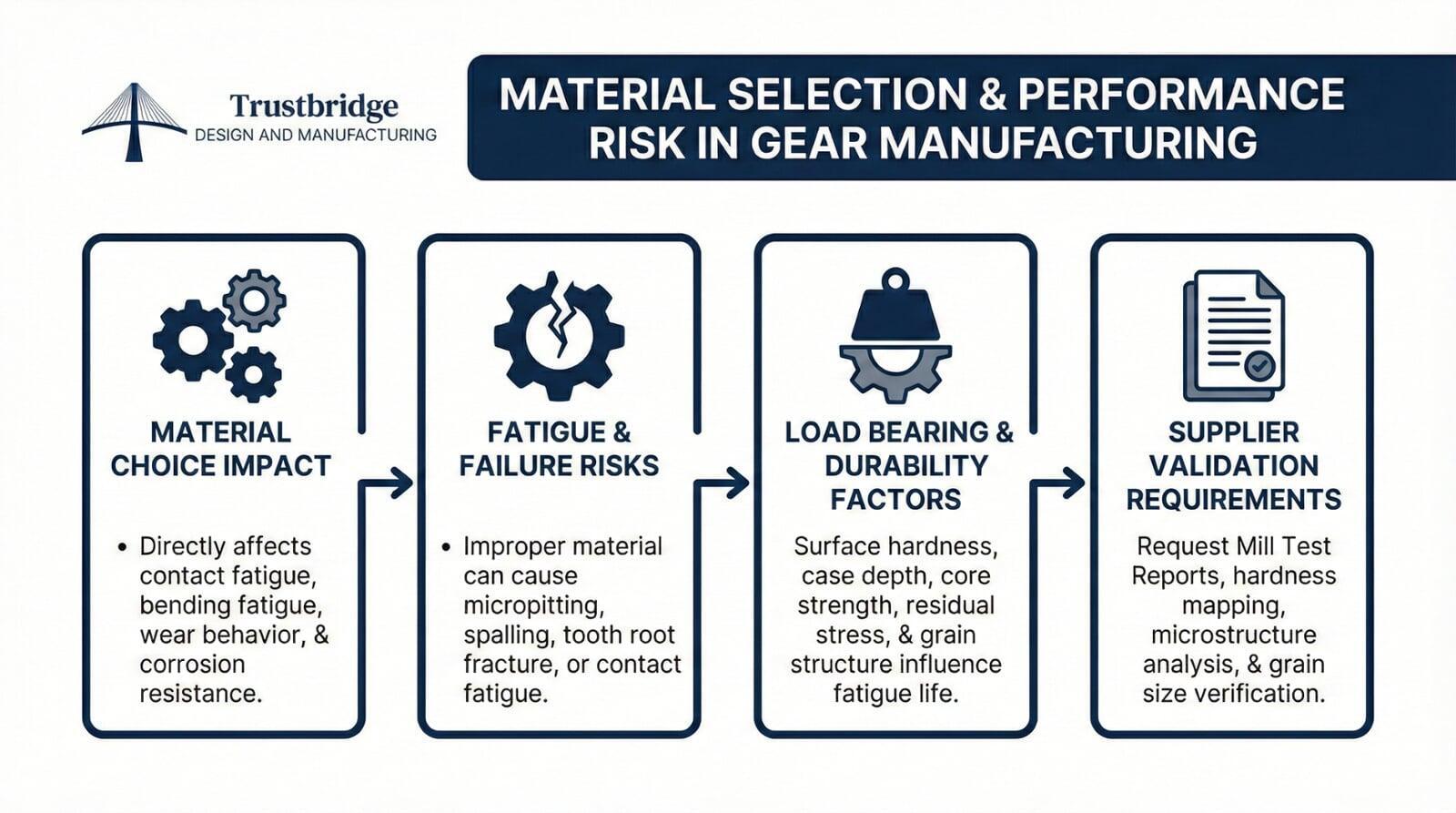
Material selection directly affects contact fatigue resistance, bending fatigue life, wear behavior, and corrosion resistance. Common gear steels such as AISI 4140, AISI 8620, or DIN 20MnCr5 should align with internationally recognized metallurgical standards.
Improper material choice can result in micropitting, spalling, contact fatigue failure, or tooth root fracture under compressive stress conditions.
- Load Bearing and Fatigue Considerations
Gears operate under cyclic Hertzian contact stress and bending fatigue at the tooth root. Surface hardness alone does not guarantee fatigue life. Residual stress distribution, core strength, grain structure, and case depth significantly influence durability.
Suppliers should provide Mill Test Reports, hardness mapping, microstructure analysis, and grain size verification to validate metallurgical integrity.
- Corrosion and Environmental Exposure
Industrial environments expose gears to moisture, chemicals, temperature cycling, and potential galvanic corrosion. Salt spray resistance testing and environmental validation may be necessary depending on application.
Material selection decisions should incorporate lifecycle performance modeling, maintenance interval impact, and total ownership cost rather than focusing solely on short term procurement metrics.
Aligning Gear Hobbing with Production Part Approval Process PPAP
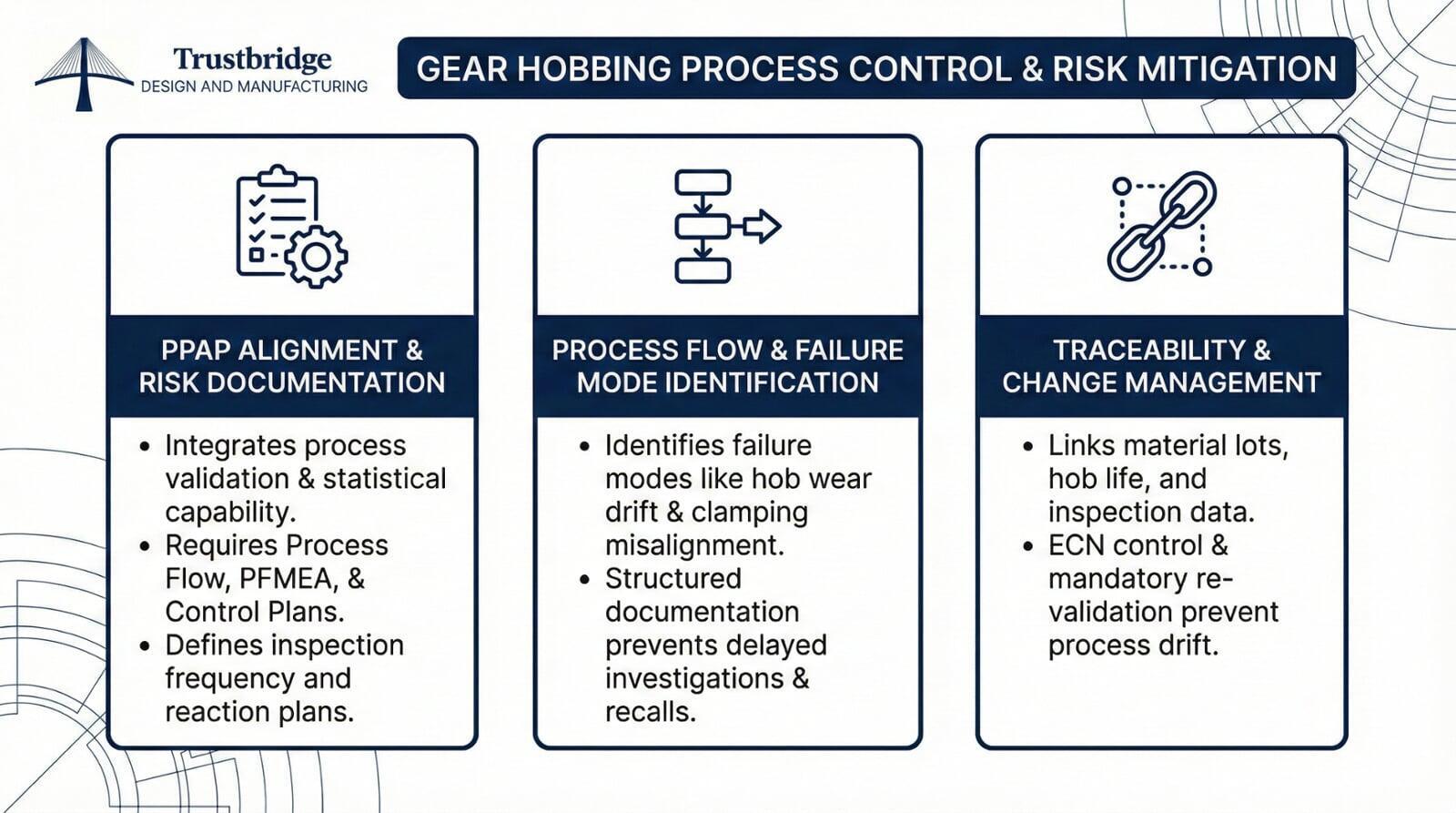
In automotive and aerospace programs, gear manufacturing must align with formal PPAP governance frameworks. PPAP integrates process validation, risk documentation, statistical capability studies, and special characteristic control.
Buyers should request process flow diagrams, PFMEA documentation, control plans, dimensional layouts, Initial Process Studies, and Measurement System Analysis reports.
- Process Flow and Risk Documentation
PFMEA should identify failure modes such as hob wear drift affecting profile accuracy, improper synchronization between hob and blank, clamping misalignment, or burr formation. Control plans must define inspection frequency and reaction plans.
Without structured documentation, variability increases, root cause investigations are delayed, and recall exposure escalates.
- Traceability and Change Management
Traceability systems must link raw material lots, hob tool life tracking, heat treatment batches, inspection data, and serialized production records. ERP integration and tool life management software improve transparency.
Engineering Change Notice control and mandatory re validation after tooling updates prevent uncontrolled process drift. Uncontrolled changes are a common root cause of quality escapes.
Vendor Vetting and Supplier Risk Management for Gear Hobbing
Selecting a gear hobbing supplier requires structured evaluation beyond price and lead time. Vendor vetting should include financial solvency analysis, audit history review, scalability assessment, and risk adjusted supplier scoring models.
Dual sourcing strategies and geographic diversification mitigate global sourcing risks and supply chain disruption.
- Equipment and Technical Capability
Buyers should verify CNC hobbing axis capability, maximum module capacity, part diameter limits, automation level, and integrated in process measurement systems.
Tool life tracking by cut count, wear offset compensation systems, predictive maintenance alerts, and documented calibration intervals indicate process maturity.
H3: Supplier Compliance and Certification
Compliance with ISO 9001, ISO 13485, or AS9100 under accredited certification bodies demonstrates governance discipline. Buyers should assess internal audit cadence, time to containment metrics, and corrective action closure cycle times.
Certification must translate into measurable operational performance.
- Scalability and Lead Time Stability
Evaluation criteria should include machine utilization percentage, Overall Equipment Effectiveness baseline, redundant CNC capacity, and historical lead time variance.
Capacity constraints can trigger expedited freight, assembly line stoppages, SLA breaches, and contractual penalties.
Building a Supplier Selection Framework for Gear Hobbing
Best supplier selection requires structured pillars including technical capability validation, statistical performance verification, compliance governance, and financial resilience.
Supplier scorecards should track PPM defect rate, On Time Delivery performance, lead time variance, responsiveness, and corrective action effectiveness.
Digital procurement tools enable supplier performance dashboards, ERP integrated traceability, automated risk flagging, and centralized supplier data management for continuous oversight.
Conclusion
Gear hobbing directly determines drivetrain reliability, efficiency, and lifecycle cost. Buyers must evaluate tolerance capability, metallurgical integrity, heat treatment distortion control, documentation governance, and supplier process maturity before awarding production volume.
Production risk rarely originates from machining technology alone. It emerges from weak supplier discipline, incomplete statistical validation, inadequate traceability, and uncontrolled process variation. Latent risk often surfaces during ramp-up phases when production stress increases.
Disciplined supplier risk management, rigorous vendor vetting, and formal Production Part Approval Process alignment convert gear hobbing from a potential sourcing vulnerability into a structured competitive advantage.
If you are sourcing gears for OEM manufacturing, move beyond unit price analysis.
Audit Cp and Cpk capability studies, request Measurement System Analysis reports, review PFMEA documentation with defined RPN thresholds, verify heat treatment case depth certification, and assess traceability systems before awarding production.
Apply structured vendor vetting, evaluate compliance governance, and implement supplier scorecards to safeguard long term cost, quality, and delivery performance.
The right gear hobbing partner will deliver measurable repeatability, scalable capacity, documented compliance, and risk controlled production that protects your operational stability and brand reputation.
Frequently Asked Questions (FAQs)
1. What tolerances should buyers expect from a qualified gear hobbing supplier?
Tolerance capability depends on gear type, module, material, and application requirements. However, buyers should expect documented process capability data, gear inspection reports, and compliance with standards such as ISO 2768 where applicable. The key is not just theoretical tolerance but consistent repeatability in production.
2. How does PPAP apply to gear hobbing projects in OEM manufacturing?
The production part approval process PPAP ensures that a gear hobbing supplier can consistently meet engineering, material, and dimensional specifications at scale. It validates tooling, process flow, inspection methods, traceability, and corrective action systems before full production release.
3. What materials are most commonly used in gear hobbing and how do they affect performance?
Common materials include alloy steels, case hardening steels, and corrosion resistant grades depending on torque, wear, and environmental requirements. Material selection directly impacts fatigue resistance, load capacity, distortion during heat treatment, and long term durability of machined parts.
4. How can buyers reduce supplier risk when sourcing gear hobbing?
Buyers reduce risk by conducting structured vendor vetting, reviewing supplier compliance systems, evaluating supplier scorecards, verifying machining and heat treatment capability, and aligning procurement KPIs with quality and delivery performance metrics. Strong supplier risk management prevents costly production delays and field failures.