
Techniques Buyers Use Reduce Production Risk with ABS Plastic 3D Printing
ABS Plastic 3D Printing has evolved from a prototyping tool into a viable production strategy for many OEM manufacturing environments. Industries such as automotive interiors, electrical enclosures, consumer appliance housings, and industrial equipment panels increasingly rely on ABS for functional strength and impact resistance. Buyers are using it for bridge production, tooling aids, housings, and select end-use components where moderate heat resistance and durability are required.
However, reducing production risk requires more than selecting the right material. Common risks in ABS Plastic 3D Printing include warpage from poor thermal control, shrinkage variance between builds, repeatability drift across batches, and material inconsistency due to improper storage or moisture absorption. Production success depends less on the ABS itself and more on supplier discipline, environmental control, and documented process management.
For procurement leaders, reducing risk means ensuring dimensional stability, repeatability across runs, regulatory alignment, and predictable lead times. Without structured supplier risk management, additive manufacturing can introduce variability that undermines cost savings. With the right controls, however, ABS Plastic 3D Printing can reduce tooling investment, accelerate validation cycles, and increase production agility without sacrificing quality.
Understanding the Role of ABS Plastic 3D Printing in OEM Manufacturing
In OEM manufacturing, risk often emerges during the transition from prototype validation to scaled production. A single successful build does not guarantee performance across hundreds or thousands of parts. Scale-up risks include dimensional drift, layer adhesion inconsistency, thermal distortion in larger builds, and variation caused by machine-to-machine differences.
Structured risk mitigation tools such as Design Failure Mode and Effects Analysis (DFMEA), ProcessFailure Mode and Effects Analysis (PFMEA), capability studies, and statistical process control should be integrated before scaling. ABS Plastic 3D Printing must operate within these structured frameworks rather than as an isolated prototyping method.
Unlike injection molding, additive manufacturing depends heavily on digital file accuracy, machine calibration, chamber temperature stability, humidity control, and operator consistency. Vendor vetting must therefore include evaluation of these operational variables before awarding production volume.
- Functional Prototypes Versus End-Use Production Parts
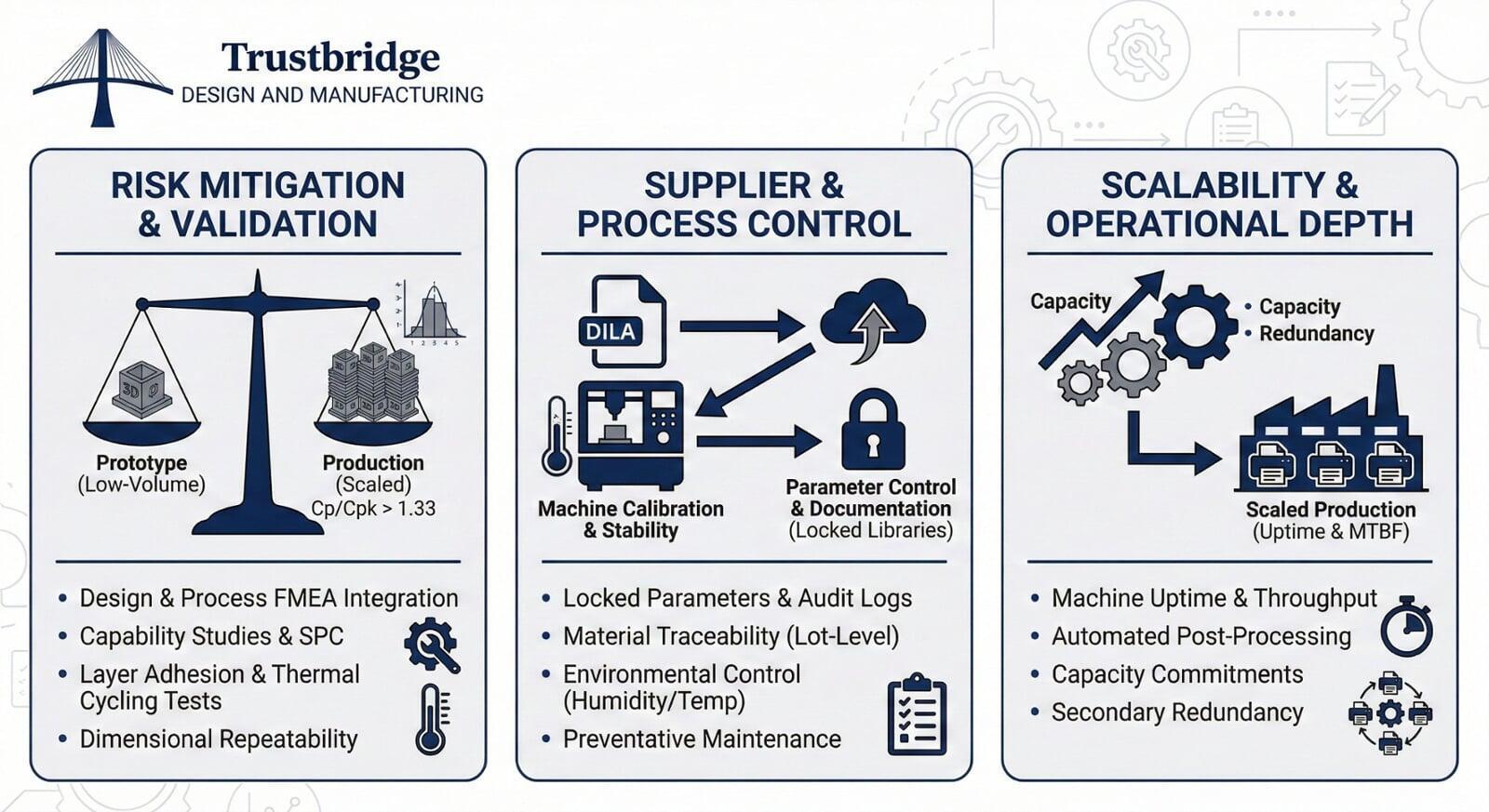
ABS performs well in early-stage validation because of its favorable strength-to-weight ratio and machinability. However, a part that passes low-volume testing may not hold tolerance at scale. Buyers should request quantifiable validation criteria such as Cp/Cpk values above 1.33 for critical dimensions, tensile strength consistency across multiple builds, and documented thermal cycling performance.
Layer adhesion strength, raster orientation, chamber temperature stability, and cooling rates directly affect dimensional repeatability. Without statistical validation across multiple batches, prototype approval offers limited assurance for production.
Repeatability, not first-piece success, determines OEM manufacturing reliability.
- Bridge Production and Market Acceleration
ABS Plastic 3D Printing is often used while injection molds are being manufactured. While this accelerates product launch, it also shifts production dependency to the additive supplier.
Buyers should negotiate contractual safeguards such as defined capacity commitments, secondary machine redundancy, resin dual sourcing, and agreed lead-time buffers. Balanced strategies may include staged transition planning from additive to molding once volume thresholds are reached. Without these controls, bridge production can become a bottleneck instead of a competitive advantage.
Applying Supplier Risk Management to ABS Plastic 3D Printing
Supplier risk management must address technical variability specific to additive processes. ABS performance can shift due to nozzle temperature variation, inconsistent layer height, unstable chamber temperatures, poor filament drying, or altered build orientation.
Buyers should verify operational controls such as locked parameter libraries, machine calibration routines, documented maintenance schedules, and controlled environmental conditions. Formal risk frameworks, including PFMEA and control plans, should identify potential failure modes such as warping, anisotropic strength variation, or dimensional shrinkage.
Strong supplier risk management links these controls directly to business outcomes, including reduced scrap, stable delivery performance, and fewer corrective actions.
- Process Documentation and Parameter Control
Reliable suppliers lock critical parameters including layer height, nozzle temperature, chamber temperature, print speed, infill density, raster orientation, and cooling profiles. Software access controls and audit logs should prevent unauthorized changes.
Buyers should confirm the use of structured systems such as PLM platforms, QMS software, or version-controlled repositories for digital file management. Poor revision control can lead to outdated geometry, incorrect wall thickness, or unintended orientation changes affecting mechanical performance.
Material traceability should include lot-level resin certifications and moisture content verification to prevent performance degradation.
- Evaluating Scalability and Operational Depth
Scalability requires more than additional printers. Buyers should assess machine uptime percentages, mean time between failures (MTBF), throughput modeling, and redundancy planning. Automated post-processing systems and inspection capacity must also scale with volume.
Operational metrics such as cycle time per build, capacity utilization, and preventive maintenance compliance provide insight into scalability readiness. Production interruptions in OEM environments can halt assembly lines, making scalability evaluation a core supplier risk management function.
Aligning ABS Plastic 3D Printing with the Production Part Approval Process PPAP
In automotive, aerospace, and regulated industrial sectors, additive manufacturing must integrate into Advanced Product Quality Planning (APQP) and the production part approval process PPAP. ABS Plastic 3D Printing cannot operate outside these structured quality systems.
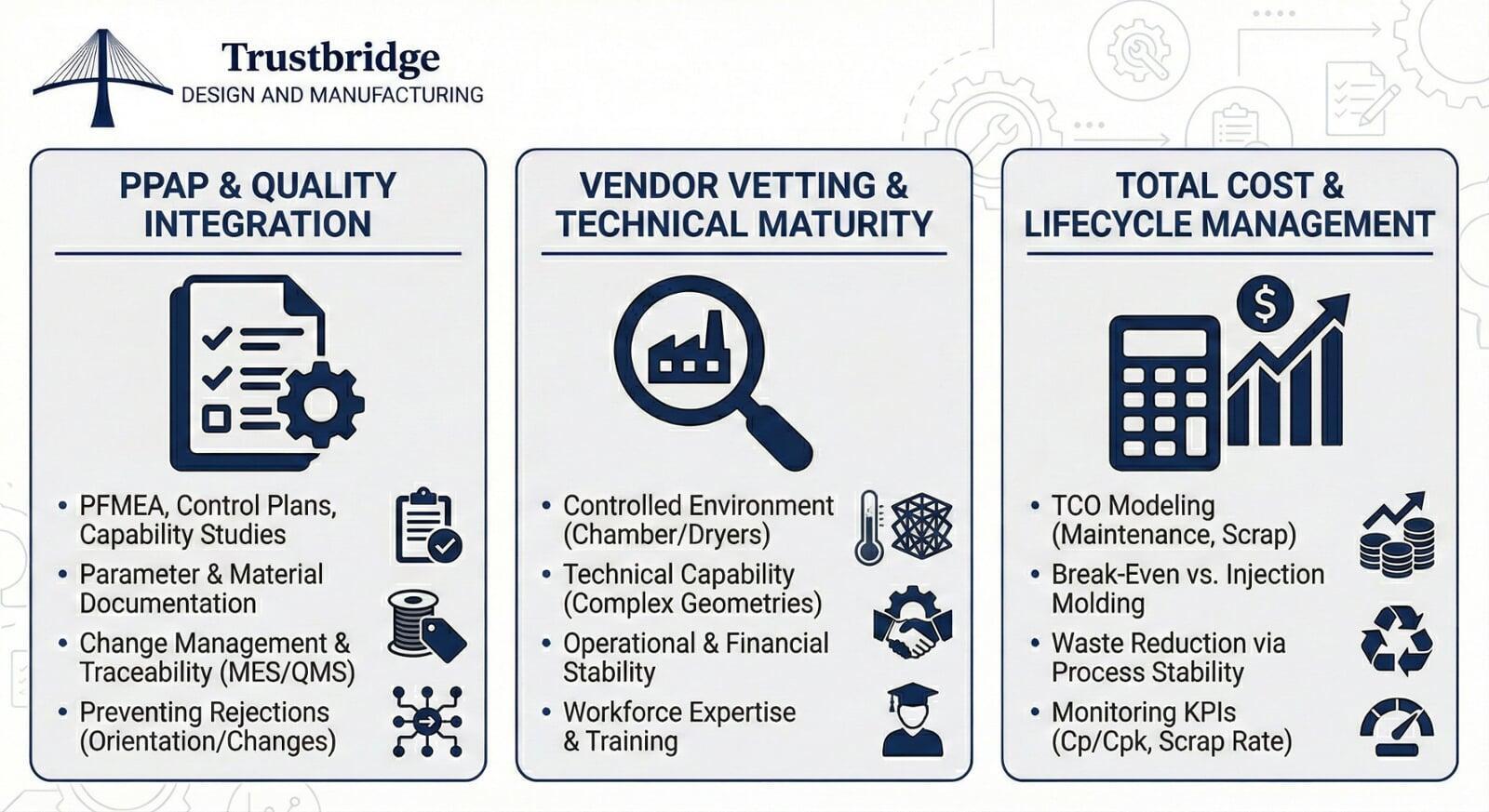
PPAP deliverables for additive manufacturing include PFMEA, process flow diagrams, control plans, capability studies, dimensional layouts, performance testing, and lot-level material certifications. Buyers should request the supplier’s additive manufacturing quality manual and QMS certifications to verify integration into these frameworks.
- Documentation and Process Validation Requirements
Critical parameters that must be documented include raster orientation, extrusion temperature, chamber temperature, cooling rates, print speed, and infill density. Suppliers should provide lot-level resin certifications, moisture verification records, and dimensional inspection reports.
Capability studies for critical features help demonstrate repeatability. Without formal validation, PPAP approval carries elevated risk.
- Preventing Rejections and Resubmissions
PPAP resubmissions are often triggered by orientation changes, machine swaps, altered infill patterns, new resin batches, or calibration updates. Orientation shifts are especially critical because they influence anisotropic mechanical properties and dimensional stability.
Strong governance includes workflow-based change approvals, controlled access permissions, automated change tracking, daily calibration checks, operator training logs, and real-time build monitoring. Buyers should request audit records rather than relying solely on certification claims.
- Traceability and Change Management
Traceability systems such as MES platforms, QMS software, or serialized build ID tracking should link machine logs, environmental conditions, operator IDs, and inspection data to each production batch.
Formal Engineering Change Request and Engineering Change Notice workflows ensure that updates to drying temperatures, orientation, or calibration settings undergo documented review. Without this structure, outdated builds may enter production unnoticed.
- Audit Readiness and Documentation Transparency
Customer audits, internal audits, and regulatory audits require access to maintenance logs, calibration certificates, operator training records, and revision histories. Transparent documentation includes accessible revision logs, real-time dashboards, and documented approval workflows.
Operational enforcement must be visible, not theoretical.
Vendor Vetting for ABS Plastic 3D Printing Suppliers
ABS performance depends heavily on heated chamber stability, humidity control, extrusion consistency, and material drying protocols. Vendor vetting should include on-site assessments or controlled sample builds under production conditions.
Structured evaluation criteria should include process audits, machine redundancy reviews, Cp/Cpk data for critical dimensions, environmental monitoring systems, and PPAP readiness verification for regulated industries.
- Technical Capability Assessment
Industrial FDM platforms with enclosed heated chambers provide better thermal stability than open-frame systems. Proper filament drying systems and controlled storage prevent moisture-related defects.
Suppliers should demonstrate ability to manage complex geometries such as internal channels, snap-fit features, thin-wall sections, and overhangs. ABS-specific challenges including warping, shrinkage, and anisotropic strength require experienced parameter tuning.
- Operational Maturity and Long-Term Fit
Financial stability supports equipment maintenance, technology upgrades, and redundancy investment. Workforce expertise can be evaluated through training certifications, documented operator qualification programs, and turnover rates.
OEM production demands often evolve to include tighter tolerances, higher volumes, and expanded documentation requirements. Vendor vetting should confirm readiness for these future demands.
Managing Total Cost of Ownership with ABS Plastic 3D Printing
While ABS Plastic 3D Printing eliminates mold tooling costs, total cost of ownership includes maintenance charges, post-processing labor, scrap, dimensional inspection, and material waste.
Break-even thresholds depend on part size, annual volume, and material usage. For moderate-sized housings, additive manufacturing may remain competitive up to mid-volume ranges before injection molding becomes economically favorable. Buyers must model lifecycle costs rather than comparing per-unit pricing alone.
- Cost Predictability and Volume Thresholds
As volumes increase, cost per unit may approach molded alternatives. Break-even modeling helps prevent margin erosion and ensures strategic transition timing.
- Reducing Waste Through Process Stability
Controlled chamber temperatures, calibrated machines, and standardized print orientations reduce failed builds, dimensional rejects, and excessive support material waste.
Monitoring KPIs such as Cp/Cpk, machine uptime, scrap rate, and rework frequency helps control variability-driven costs. Process stability directly improves batch-to-batch consistency and reduces cumulative waste.
Conclusion
ABS Plastic 3D Printing delivers agility and tooling savings during prototyping and bridge production, but scaling introduces thermal, dimensional, and repeatability risks. Consistent ABS performance depends on controlled chamber temperatures, disciplined material handling, documented revision control, validated work instructions, and statistical dimensional validation.
Repeatability relies on both machine capability and operator discipline. Strong documentation maturity includes traceability systems, version control, audit-ready logs, and structured change management. Buyers who prioritize these elements reduce production disruption and protect long-term performance.
If you are considering ABS Plastic 3D Printing for production or bridge manufacturing, move beyond sample validation by conducting process audits, reviewing capability studies, and running controlled pilot production builds.
Request supplier quality manuals, audit records, PPAP templates, locked parameter documentation, build logs, and evidence of backup machines or dual material sourcing strategies. Evaluate risk mitigation systems before awarding contracts.
The suppliers who can demonstrate disciplined process control, documented traceability, scalability readiness, and additive-specific risk mitigation strategies will best protect your quality, cost, and delivery performance.
Frequently Asked Questions (FAQs)
1. Why does production risk increase when scaling ABS Plastic 3D Printing from prototype to production?
Production risk increases because repeatability becomes more important at higher volumes. Factors such as chamber temperature control, material moisture levels, raster orientation, and machine calibration can cause dimensional changes between builds. A single successful prototype does not guarantee consistent performance across hundreds or thousands of parts.
2. How can buyers use supplier risk management to control ABS 3D printing variability?
Buyers should evaluate whether suppliers have locked print parameters, documented maintenance routines, material traceability, and environmental controls. Structured supplier risk management reduces scrap, prevents unexpected delays, and improves part consistency. Reviewing process documentation is just as important as reviewing sample parts.
3. Can ABS Plastic 3D Printing meet production part approval process PPAP requirements?
Yes, but only if the supplier integrates additive manufacturing into formal quality systems. Buyers should request PFMEA documentation, control plans, dimensional reports, material certifications, and capability studies. ABS production parts must meet the same validation standards as traditionally manufactured OEM components.
4. When should buyers transition from ABS 3D printing to injection molding?
The transition depends on annual volume, tooling investment, and cost per unit. ABS Plastic 3D Printing is ideal for bridge production and moderate volumes. As demand increases, injection molding may offer lower long-term unit costs. Buyers should evaluate total cost of ownership before making the shift.