8 Ways Buyers Reduce Risk in Custom Plastic Fabrication Through Smarter Supplier Selection
Introduction
Custom plastic fabrication plays a critical role in OEM manufacturing across industries ranging from medical devices and aerospace components to industrial equipment and consumer products. While plastics offer flexibility, weight reduction, and cost advantages, procurement teams frequently encounter hidden risks tied to material performance, tooling reliability, compliance documentation, and supplier capability.
These risks are not theoretical. In manufacturing programs, tooling rework, material substitution errors, or dimensional drift can lead to production delays, field failures, regulatory penalties, and product recalls that cost millions of dollars. For OEM procurement managers, sourcing leaders, and supply chain directors, reducing these risks is a core responsibility.
For buyers, reducing exposure is not about selecting the lowest quote. It requires a structured evaluation process that aligns supplier capability with quality discipline, regulatory compliance, and long-term production stability. Leading sourcing teams implement a series of structured controls during supplier evaluation to prevent quality escapes and supply disruptions.
Below are eight proven ways buyers reduce exposure when sourcing custom plastic fabrication.
1. Define Technical Requirements Beyond Basic Drawings
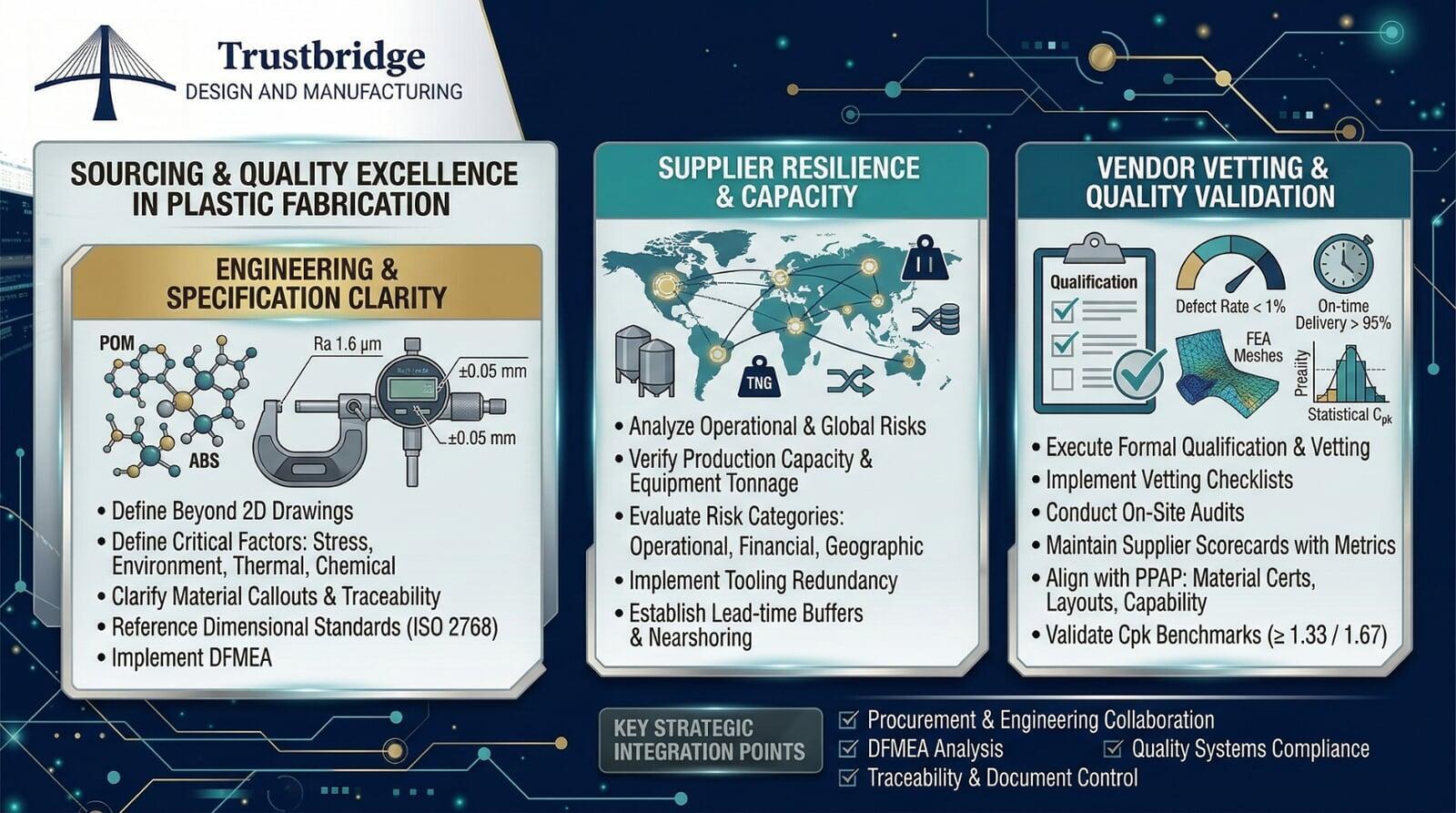
Many fabrication failures begin with incomplete technical definitions. Buyers who rely solely on 2D drawings often miss critical performance factors such as stress exposure, environmental resistance, chemical compatibility, thermal loads, or regulatory requirements.
This issue is particularly common in processes such as injection molding, CNC plastic machining, and thermoforming. When specifications lack clarity, fabricated components may crack under load, warp during temperature cycling, or fail due to chemical incompatibility in real-world operating environments.
Strong procurement teams collaborate closely with engineering to clarify tolerances, resin grades, surface finishes, secondary operations, and performance testing expectations before supplier engagement. For example, dimensional tolerance bands such as ±0.05 mm or surface finish requirements like Ra 1.6 µm may need to be defined before supplier quotation.
Early design reviews, including Design Failure Mode and Effects Analysis (DFMEA), help identify performance risks before fabrication begins. This ensures alignment between design intent and supplier capability.
- Material Specification Clarity
Not all plastics behave the same under mechanical or environmental stress. Engineering plastics material such as POM plastic material is widely used for wear resistance and dimensional stability in moving components, while thermosetting plastic materials offer superior heat resistance and structural rigidity. ABS variants are commonly selected for impact resistance and cosmetic surfaces.
Clear material callouts prevent unauthorized substitutions that may compromise durability. Buyers should also require resin traceability and Approved Vendor Lists (AVL) tied to verified resin manufacturers.
- Tolerance and Inspection Standards
Referencing dimensional standards such as ISO 2768 ensures tolerance expectations are measurable and consistent across suppliers.
In addition, buyers should request First Article Inspection (FAI) reports during early production validation. When applicable, Production Part Approval Process PPAP documentation should also confirm dimensional accuracy, inspection procedures, and process stability before full production begins.
2. Strengthen Supplier Risk Management Frameworks
Supplier risk management is foundational in custom plastic fabrication sourcing. Delays in tooling delivery, resin shortages, equipment downtime, or inconsistent quality performance can disrupt production schedules and damage customer relationships.
Effective sourcing strategies evaluate suppliers across multiple structured risk categories including operational risk, financial stability, geographic exposure, and historical performance.
Buyers should request specific data such as annual production capacity, machine tonnage range for injection molding operations, and historical delivery performance metrics before onboarding suppliers.
- Capacity and Scalability Verification
A supplier capable of low volume injection molding or prototyping may not be prepared to support scaled production. Buyers must distinguish between prototyping shops, mid-volume manufacturers, and full-scale production facilities.
Evaluation should include equipment availability, tooling redundancy, workforce capability, mold storage procedures, and documented mold maintenance programs. Buyers should also confirm tool life expectancy expectations and refurbishment planning.
- Geographic and Global Sourcing Risks
Global sourcing introduces risks related to logistics disruptions, customs delays, trade policy shifts, and regional regulatory differences.
Buyers should establish lead-time buffers, align on Incoterms to clarify shipping responsibilities, and assess supplier geographic diversification strategies. In some cases, nearshoring production can reduce transportation volatility while improving supply chain resilience.
3. Implement Structured Vendor Vetting
Effective vendor vetting requires moving beyond sales decks and marketing certifications. Buyers must verify real manufacturing capability and operational discipline.
On-site audits, sample production reviews, and customer reference validation provide deeper insight into process control, equipment maintenance, and quality culture.
Structured evaluation tools such as on-site audit checklists help standardize supplier assessments across procurement teams.
- Vendor Qualification Checklist
A formal vendor qualification checklist functions as a risk-control mechanism rather than a simple evaluation form.
Buyers should verify documentation control systems, traceability processes, inspection equipment calibration schedules, and corrective action procedures. Alignment with recognized Quality Management Systems such as International Organization for Standardization frameworks ensures suppliers maintain disciplined operational controls.
- Supplier Scorecard Review
Supplier scorecards provide objective performance visibility across multiple operational metrics.
Buyers typically evaluate defect rates below 1 percent, on-time delivery performance above 95 percent, and corrective action response speed. Reviewing scorecard trends over six to twelve months provides a clearer performance picture than a single short-term snapshot.
4. Align with Production Part Approval Process PPAP
The Production Part Approval Process PPAP originated in the automotive industry but is now widely adopted across many OEM manufacturing sectors. Its core purpose is validating that suppliers can consistently manufacture parts according to engineering specifications before mass production begins.
Using PPAP ensures custom plastic fabrication suppliers demonstrate repeatable capability under real production conditions, reducing the likelihood of launch delays and post-launch quality escapes.
Typical validation elements include material certifications, dimensional layout reports, and process documentation that confirm manufacturing readiness.
- Process Capability Validation
PPAP approval confirms that tooling, molding parameters, and inspection procedures are capable of delivering consistent output.
Buyers often require statistical capability benchmarks such as Cpk ≥ 1.33 for standard production features and Cpk ≥ 1.67 for critical dimensions. These metrics are validated using Statistical Process Control SPC under full production conditions rather than pilot runs.
- Documentation and Traceability
PPAP documentation supports supplier compliance while protecting buyers during audits, warranty investigations, or product recall scenarios.
Required records typically include lot traceability systems, resin batch certificates, dimensional inspection reports, and material certifications. Increasingly, digital traceability platforms improve audit readiness and accelerate root-cause investigations.
5. Verify Supplier Compliance and Certifications
Supplier compliance reduces regulatory exposure and product liability risk.
Certification requirements vary by industry. Medical manufacturing programs typically require ISO 13485 compliance, aerospace programs often require AS9100 certification, and many industrial suppliers maintain ISO 9001 as a foundational quality system.
These certifications demonstrate disciplined process control, structured documentation systems, and regular external audits.
- Regulatory Alignment
Different industries impose different documentation and quality expectations.
Medical manufacturing environments may require cleanroom validation and Device History Records (DHR), while industrial products may require compliance with material flammability or safety standards. Buyers must ensure suppliers maintain quality systems aligned with these sector-specific expectations.
- Change Management Control
Robust compliance systems include formal Engineering Change Notification ECN procedures.
Suppliers should not implement material substitutions, tooling changes, or process adjustments without buyer approval. Formal change management protects product integrity and prevents unauthorized modifications that could compromise product performance.
6. Evaluate Tooling Strategy and Lifecycle Planning
Tooling often represents 20 to 40 percent of total program investment in custom plastic fabrication projects. Poorly designed molds can introduce dimensional drift, flash defects, cosmetic inconsistencies, and excessive scrap rates.
Buyers must evaluate tooling design standards, lifecycle expectations, and ownership agreements before awarding production.
Clear ownership definitions are also critical, particularly when distinguishing between supplier-owned tooling and customer-owned molds.
- Mold Flow and Design Validation
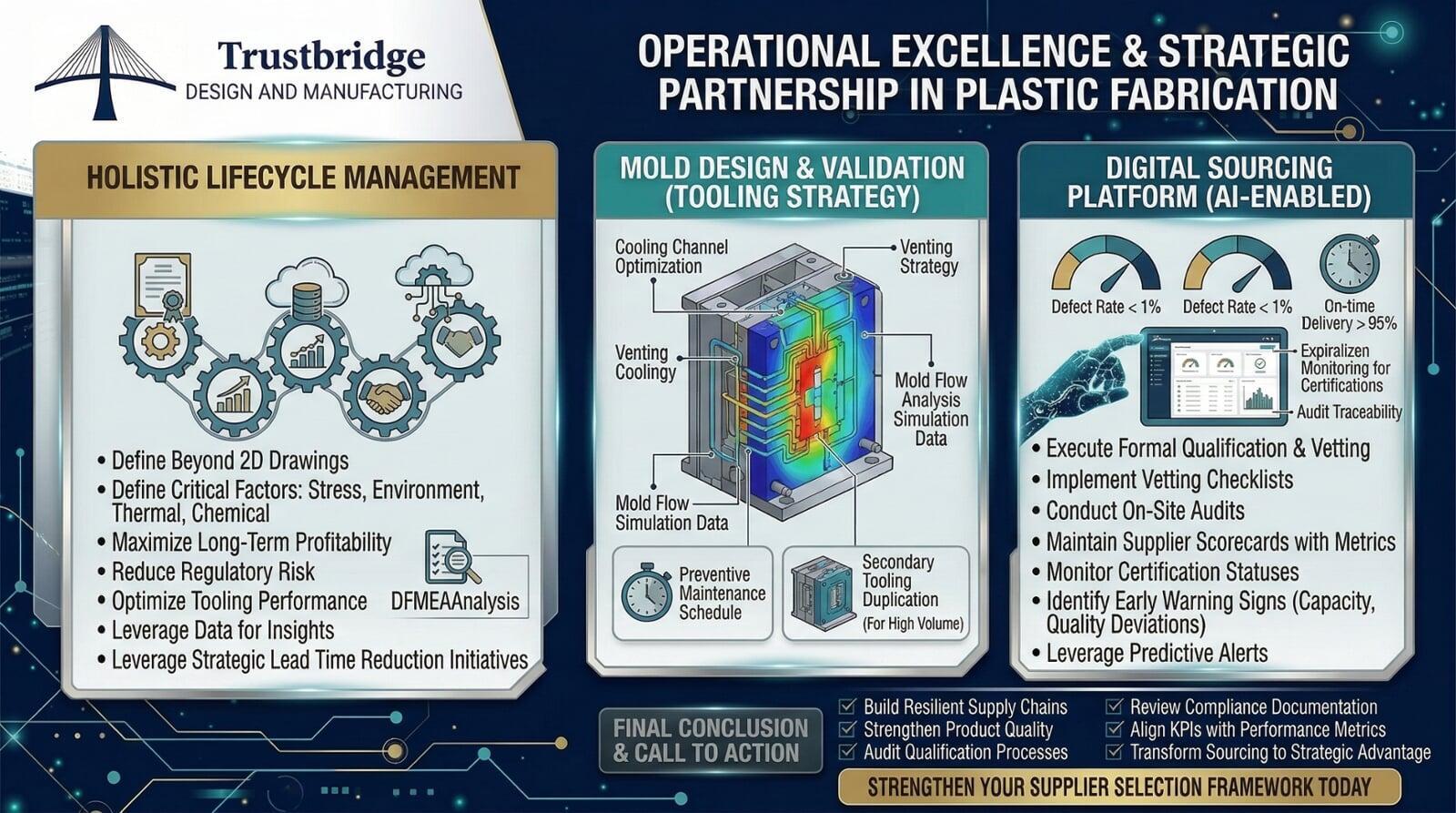
Suppliers should demonstrate mold flow analysis, cooling channel optimization, and venting strategy to ensure stable molding performance.
Simulation-based validation reduces tooling rework and improves first-pass production yield, lowering both development time and program risk.
- Maintenance and Spare Tooling
Preventive mold maintenance programs reduce downtime and maintain dimensional stability over long production runs.
For high-volume programs, buyers may consider secondary tooling duplication strategies to maintain production continuity if a primary mold requires maintenance.
7. Use Digital Procurement Tools and Data Visibility
Digital procurement tools significantly improve sourcing transparency and reduce communication gaps between buyers and suppliers.
Organizations that centralize supplier data often reduce sourcing cycle time and eliminate manual documentation errors.
Data-driven evaluation also supports smarter supplier consolidation decisions and improves procurement KPIs.
- Supplier Data Management
Centralized supplier documentation repositories allow buyers to manage certifications, inspection reports, audit records, and performance metrics in one controlled system.
Effective systems include expiration monitoring for certifications and controlled-access digital archives to ensure audit traceability.
- AI in Procurement
AI-driven procurement platforms can identify early warning signs such as delivery instability, capacity constraints, or recurring quality deviations.
Predictive alerts allow sourcing teams to address emerging supplier risks before disruptions occur. Importantly, AI enhances strategic decision making rather than replacing procurement expertise.
8. Focus on Long Term OEM Manufacturing Partnerships
Custom plastic fabrication programs typically span multiple product lifecycle phases including prototyping, validation, production ramp-up, and sustained manufacturing.
Buyers who focus on long-term supplier partnerships gain advantages such as demand forecasting alignment, capacity reservation agreements, and stable production planning.
Strategic supplier relationships also support supplier lead time reduction and operational improvement initiatives.
- Collaborative Cost Engineering
Early engineering collaboration enables Design for Manufacturability DFM improvements.
Examples include resin downgrades that reduce cost without sacrificing performance, or cooling system redesigns that shorten cycle times. These improvements directly support margin expansion and program profitability.
- Continuous Improvement Culture
Suppliers that invest in workforce training, automation, and process optimization support sustainable sourcing strategies.
Continuous improvement programs also reduce long-term cost volatility and improve manufacturing efficiency over the product lifecycle.
Conclusion
Custom plastic fabrication offers major advantages in product design flexibility and manufacturing efficiency, but it also introduces sourcing risks that must be actively managed.
The eight structured controls discussed in this guide — including technical specification clarity, supplier risk management frameworks, vendor qualification rigor, PPAP validation, compliance verification, tooling lifecycle planning, digital procurement visibility, and strategic supplier partnerships — help buyers build resilient supply chains.
Proactive supplier evaluation allows organizations to prevent production disruptions rather than react to them.
Smarter supplier selection ultimately strengthens product quality, protects lead times, and improves long-term manufacturing profitability.
Organizations that treat supplier selection as a strategic capability consistently outperform those that rely on reactive sourcing decisions.
If you are evaluating custom plastic fabrication suppliers for an upcoming program, now is the time to strengthen your supplier selection framework through cross-functional collaboration between engineering, procurement, and quality teams.
Audit vendor qualification processes, validate PPAP readiness, review compliance documentation, and align procurement KPIs with production performance metrics.
Companies that institutionalize disciplined supplier evaluation transform sourcing from a transactional activity into a strategic manufacturing advantage.
Frequently Asked Questions (FAQs)
1. Why is supplier selection critical in custom plastic fabrication?
Supplier selection directly affects product quality, lead times, and production stability. A supplier lacking proper tooling capability, material control, or process discipline can cause dimensional defects, production delays, and costly rework. Buyers reduce these risks by implementing structured vendor vetting and supplier scorecard evaluations before awarding production.
2. How does the Production Part Approval Process help buyers reduce fabrication risk?
The Production Part Approval Process validates that a supplier can consistently manufacture parts according to engineering specifications before full production begins. PPAP documentation confirms tooling capability, material certification, inspection procedures, and process stability, helping buyers prevent launch delays and post-production quality failures.
3. What should buyers evaluate when vetting custom plastic fabrication suppliers?
Buyers should evaluate several factors including manufacturing capacity, equipment capability, quality management systems, compliance certifications, tooling design standards, and historical delivery performance. Conducting site audits and reviewing supplier scorecard metrics also provides valuable insight into real production capability.
4. How do digital procurement tools improve supplier risk management?
Digital procurement tools centralize supplier data such as certifications, inspection records, performance metrics, and compliance documentation. This visibility helps procurement teams track supplier performance, identify risk patterns, and make more informed sourcing decisions while improving procurement KPIs.