
Deep Pockets, Thin Walls & Undercuts: How to Redesign Problem Features Before They Reach the Machine
Preamble
Some of the most expensive CNC machining problems originate from design features that appear harmless inside CAD but become unstable during production. Deep cavities, thin unsupported walls, restricted internal profiles, and undercuts often create machining challenges related to tool access, cutter rigidity, chip evacuation, and inspection difficulty. By identifying and redesigning these high-risk features early through strong manufacturing DFM practices, engineering teams can improve machining stability, reduce tooling wear, lower production cost, and create a far more manufacturable design before the part ever reaches the machine.
Introduction
Modern CNC systems are capable of machining extremely advanced geometries, especially with today’s high-performance multi-axis machining technologies. However, many production problems still begin long before the machine starts cutting material.
Designers frequently prioritize part function, compact packaging, or cosmetic appearance without fully evaluating how the cutting tool will physically access the feature during machining.
Inside CAD, a deep cavity looks no different from a shallow one, and an undercut may appear like a small geometric detail. But the machine does not interpret geometry visually. It only responds to what the cutting tool can physically reach with enough rigidity and clearance to maintain stable cutting conditions.
A thin wall may appear structurally acceptable. But once machining begins, these same features can create vibration, unstable cutting conditions, poor chip evacuation, excessive tool wear, and inconsistent dimensional accuracy.
Studies and shop-floor manufacturing reviews consistently show that a significant portion of avoidable machining cost originates during the design phase rather than inside the machine room itself. Geometry decisions made early often determine whether machining becomes efficient and repeatable or slow and unstable.
This is where strong manufacturing DFM becomes essential. Small geometry changes made before production can dramatically improve machining efficiency, reduce setup complexity, stabilize cutting behavior, and lower overall machining cost.
Deep pockets, thin walls, and undercuts are not automatically poor design choices. They become expensive when geometry ignores how real CNC tools behave during machining. Understanding how to redesign these features early helps improve manufacturability, production stability, and long-term machining efficiency.
Why Undercuts Create CNC Machining Challenges
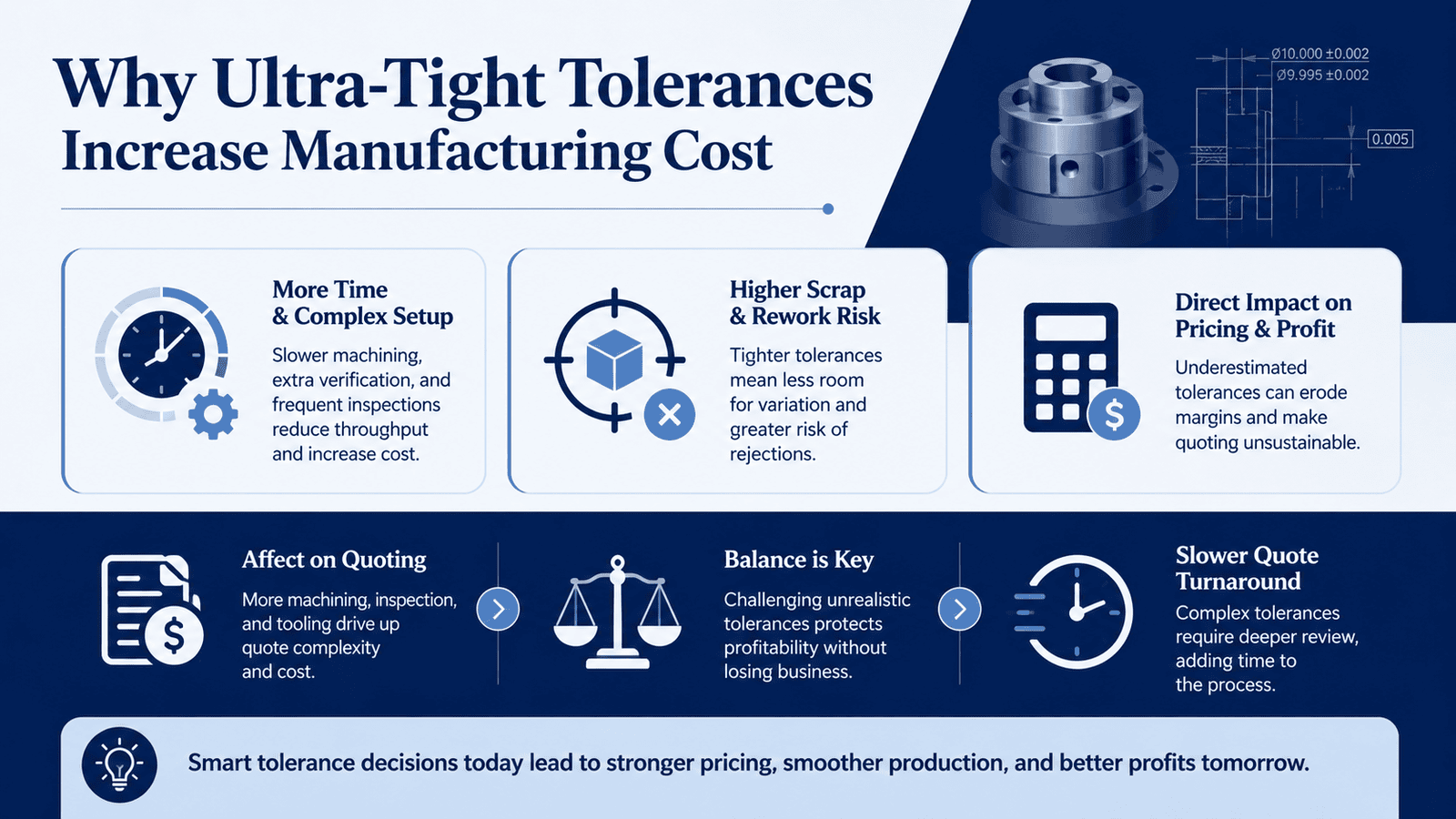
Undercut features are difficult to machine because traditional cutting tools cannot easily access the geometry using standard tool movement. Unlike open surfaces, undercuts often require specialized entry angles, reduced-clearance tooling, or extended cutter reach.
In many cases, generating the toolpath is not the real issue. The challenge is maintaining stable machining conditions while physically reaching the feature.
As cutter projection length increases, tool rigidity decreases. Long tools naturally deflect more under cutting loads, which affects dimensional accuracy, surface finish quality, and overall machining consistency.
Restricted geometry also limits chip evacuation. Chips trapped inside deep or enclosed areas increase heat buildup and accelerate cutting-edge wear, eventually creating unstable machining behavior.
Undercuts also introduce measurable production cost penalties. Compared with a standard same-depth pocket, undercut features commonly increase machining cost by approximately thirty to fifty percent due to specialty tooling requirements, reduced feed rates, secondary setups, and longer cycle times.
Without early redesign, undercut features frequently require specialty cnc tooling, secondary operations, or custom fixturing that were never anticipated during the initial design phase.
Hidden Costs of Complex Internal Geometry
Complex internal profiles increase more than machining time alone. They also increase setup verification requirements, inspection difficulty, and programming complexity.
Features that are difficult to access are typically harder to manufacture consistently across production batches. This creates additional quality-control challenges and higher long-term production costs.
Why Tool Reach Matters More Than CAD Appearance
A geometry may appear fully machinable inside the CAD model while remaining physically inaccessible for stable cutting.
If the spindle, holder, or cutting tool cannot safely enter the feature without collision risk or excessive tool extension, machining stability decreases immediately.
Designing around real cutter movement rather than only digital geometry is one of the most important principles of manufacturable CNC design.
Improving Manufacturability Through Better CNC Design Decisions
Strong machining performance begins during design, not during programming. Good manufacturable design reduces unnecessary machining difficulty before the part ever reaches production.
The goal is not to oversimplify the component. The goal is to remove geometry decisions that create instability, slow machining, or excessive tooling demand without adding meaningful functional value.
Designers should evaluate every deep feature, internal corner, restricted profile, and hidden surface by asking a simple question:
Can this feature be machined efficiently and inspected consistently?
If the answer is uncertain, redesign is usually far less expensive than compensating during production.
Optimizing Thread Features for CNC Production
Thread depth is one of the most commonly overdesigned features in CNC machining. Excessively deep threads increase cycle time and tooling wear while often adding very little functional improvement. In many applications, thread engagement beyond approximately 1.5 times the fastener diameter provides minimal additional holding strength.
Blind threaded holes also create chip evacuation problems, increasing the risk of tap breakage and inconsistent thread quality.
Standardized thread sizes and practical thread depths improve programming efficiency, simplify inspection, and reduce tooling changes.
Designing Internal Features Around Standard Tooling
Features designed around common tooling dimensions are significantly easier and cheaper to machine.
Large internal radii allow stronger, more rigid tools to enter the feature efficiently, while extremely tight corners force the use of fragile small-diameter cutters that remove material slowly.
A strong corner radius rule is to design internal radii larger than the cutting tool radius whenever possible. This allows smoother toolpath transitions, reduces abrupt cutter engagement, improves chip evacuation, and minimizes vibration inside deep pockets.
Even small adjustments to internal geometry can dramatically improve machining speed and tooling stability.
Thin Walls and Unsupported Features Reduce Machining Stability
Thin walls remain one of the most common causes of instability in modern CNC machining. As wall thickness decreases, rigidity decreases as well, making the part more sensitive to cutting pressure and vibration.
Even highly accurate machines struggle when the workpiece itself begins moving during machining operations.
Material behavior also plays a major role. Thin aluminum walls may vibrate under aggressive cutting conditions, while harder materials such as stainless steel or titanium experience even greater cutting forces and heat concentration.
Wall height further amplifies the problem. Tall unsupported walls become increasingly unstable as aspect ratio increases. In many standard CNC operations, walls exceeding approximately fifteen times their thickness become highly impractical because chatter and deflection make dimensional consistency unreliable.
Design Strategies for Thin Wall Machining
Temporary support ribs connecting thin walls to the workpiece body can stabilize thin sections during roughing operations before being removed during finishing passes.
Combined with climb milling at reduced radial engagement, this approach helps keep cutting forces within manageable limits while minimizing wall deflection.
Reducing depth of cut and maintaining light radial engagement also lowers cutting pressure and minimizes wall movement during machining.
Climb milling strategies combined with high spindle speed and reduced engagement often improve stability by directing cutting forces into the material instead of pulling walls outward.
When Thin Walls Become Impractical
Walls with extremely high height-to-thickness ratios often become impractical for conventional CNC processes.
At a certain point, sheet metal fabrication, welded assemblies, or alternative manufacturing methods may provide a more stable and cost-effective solution than machining thin unsupported geometry from solid stock.
Deep Pockets and Cavities Increase Machining Risk
Deep pockets create serious machining challenges because tool rigidity decreases rapidly as cavity depth increases.
A cavity that appears simple in the CAD model becomes significantly more difficult once the cutting tool extends deep into the material.
Longer tool reach increases vibration, heat concentration, poor chip evacuation, and unstable cutting conditions. As cavity depth increases relative to width, maintaining dimensional consistency becomes far more difficult.
Designers who ignore depth-to-width relationships often force programmers into highly conservative machining strategies that dramatically increase cycle time.
Tool Access and Pocket Geometry
Even advanced 5 axis CNC machining systems cannot eliminate the physical limitations of cutter reach and spindle clearance.
If the holder or tool cannot safely access the cavity without collision risk, machining becomes unstable regardless of programming quality.
Designing larger corner radii and improving internal clearance often allows stronger, more rigid tools to machine the feature efficiently.
Practical Pocket Depth Guidelines
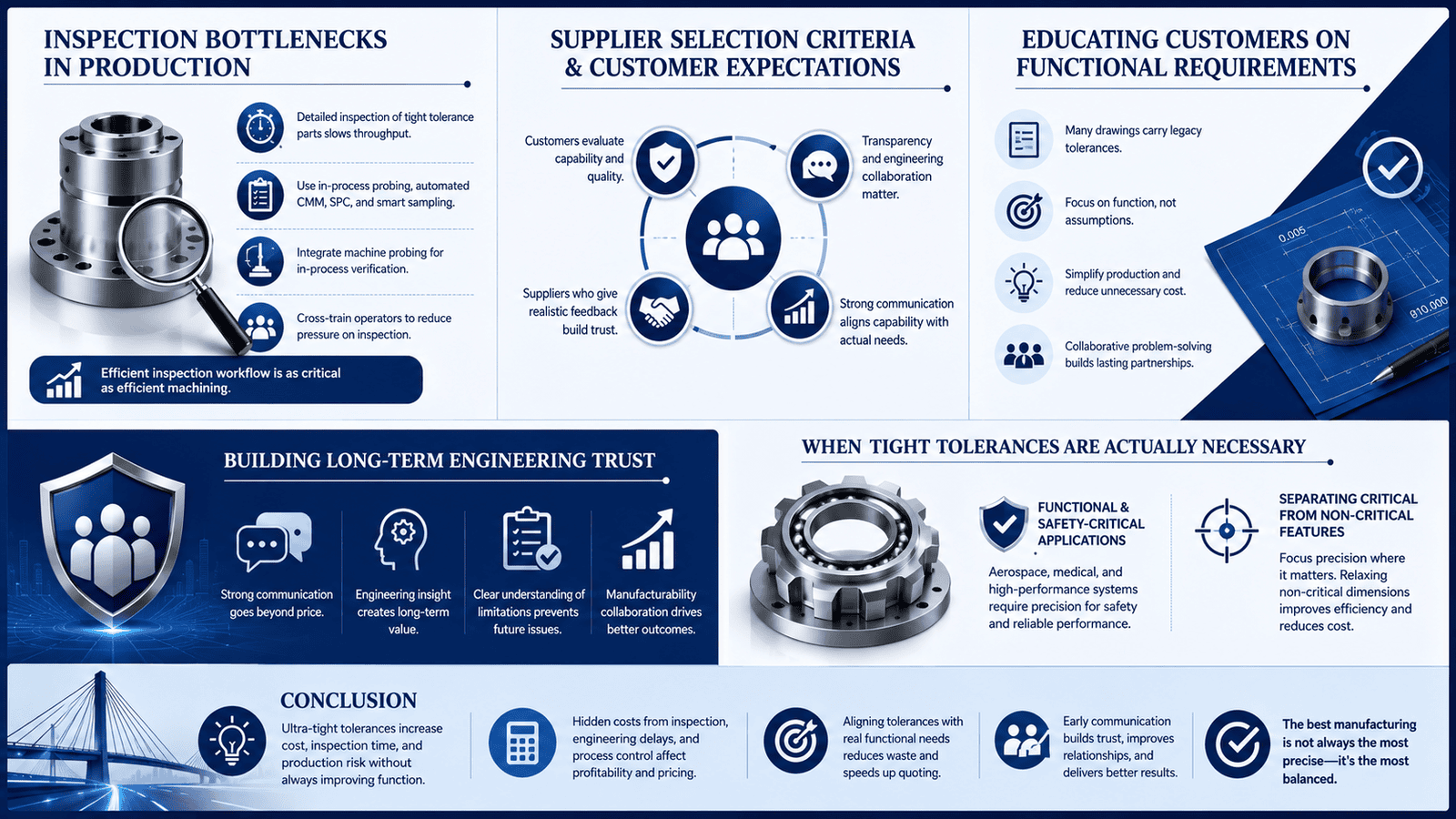
As a general manufacturing guideline, pocket depth should ideally remain below four times the cutting tool diameter whenever possible.
Beyond this range, cutting stability decreases significantly and may require specialty tooling, lower feed rates, additional roughing passes, or secondary operations.
Deep cavities should also include proper chip evacuation paths to prevent chip recutting and heat buildup.
Inspection Challenges Often Begin During Design
Features that are difficult to machine are usually difficult to inspect as well. Deep internal geometry, undercuts, and restricted profiles frequently create major inspection challenges during production.
Standard probes and measurement equipment may not physically reach deep internal features without specialized extensions or additional setups.
This increases inspection cycle time, measurement uncertainty, and quality-control complexity.
Why Inspection Accessibility Matters
Inspection should never be treated as a downstream issue separate from design.
Features that cannot be measured reliably are difficult to manufacture consistently across production batches. Strong DFM processes consider inspection accessibility as part of the original geometry decision.
Reducing Verification Complexity Through Better Geometry
Simplified internal profiles, improved probe access, and practical datum placement all reduce inspection difficulty.
When parts are easier to verify, production consistency improves and quality-control costs decrease significantly.
Early Manufacturing DFM Prevents Expensive Redesigns
The most cost-effective redesign is the one completed before machining begins.
Strong manufacturing DFM processes allow engineers, machinists, and programmers to evaluate feature accessibility, tooling strategy, and machining stability during the design stage rather than during production.
Collaboration between design and manufacturing teams often reveals simpler geometry alternatives that preserve functionality while dramatically improving machinability.
In many cases, small design adjustments reduce machining cost more effectively than machine upgrades or programming optimization alone.
Why Early Collaboration Improves CNC Outcomes
Machinists understand tooling limitations, fixturing constraints, chip evacuation behavior, and real-world cutting stability in ways that CAD systems alone cannot predict.
When manufacturing teams participate early, production risks are identified before programming begins.
Manufacturable Design Creates Long Term Production Stability
Good manufacturable design is not about limiting engineering creativity. It is about creating geometry that performs reliably inside real manufacturing environments.
Parts designed with machining stability in mind consistently reduce tooling wear, improve repeatability, shorten cycle times, and simplify long-term production scaling.
Conclusion
Deep pockets, thin walls, and undercuts are not inherently poor design features. The real problem begins when geometry ignores how cutting tools behave inside actual machining conditions.
Features that appear simple in CAD can quickly become expensive once tool reach, vibration, cutter rigidity, chip evacuation, and inspection access are considered.
The most successful CNC components are not only functional. They are designed around machining stability, tooling efficiency, inspection accessibility, and long-term manufacturability from the beginning.
By improving manufacturing DFM, optimizing cnc tooling access, applying smarter corner radius strategies, and redesigning difficult geometry early, engineering teams reduce machining cost, improve consistency, and avoid unnecessary redesign cycles later in production.
If your parts contain deep cavities, thin unsupported walls, or difficult undercut features, now is the best time to evaluate them before production begins.
Review whether your current CAD model supports stable machining conditions, efficient tool access, practical inspection strategies, and realistic tooling constraints. Features that require excessive tool reach, restricted spindle access, or fragile geometry often create hidden production costs long before machining starts.
Companies like Vulcury help engineering teams improve manufacturable design by identifying high-risk geometry early and aligning part design with real-world CNC machining capabilities, tooling strategy, and scalable production requirements.
The earlier teams integrate manufacturing feedback into design decisions, the easier it becomes to reduce machining risk, improve repeatability, shorten production timelines, and create production-ready components that machine efficiently at scale.
Frequently Asked Questions
1. Why do deep pockets, thin walls, and undercuts increase CNC machining costs?
These features create challenges related to tool access, cutter rigidity, chip evacuation, and inspection. Deep cavities often require long cutting tools that are more prone to vibration and deflection, while thin walls can flex under cutting pressure. Undercuts frequently require specialty tooling or additional setups, all of which increase machining time, tooling wear, and overall production cost.
2. What are the best design practices for improving CNC manufacturability?
Strong manufacturing DFM focuses on designing features that can be machined and inspected efficiently. Using larger internal corner radii, limiting excessive pocket depth, reducing unnecessary thread depth, and designing around standard CNC tooling dimensions help improve machining stability, shorten cycle times, and reduce production costs.
3. Why are thin walls difficult to machine accurately?
Thin walls have limited rigidity and can deflect or vibrate under cutting forces. As wall height increases relative to thickness, maintaining dimensional accuracy becomes more difficult. Proper design strategies such as support ribs, optimized cutting parameters, and practical wall thicknesses help improve machining stability and repeatability.
4. How does early manufacturing DFM help prevent costly redesigns?
Early manufacturing DFM allows engineers, machinists, and programmers to evaluate tooling access, machining stability, workholding requirements, and inspection challenges before production begins. Identifying high-risk geometry during the design phase helps eliminate expensive production issues, reduce machining risk, improve part quality, and create more scalable manufacturing processes.